
Filtration for Nitrogen Generators: Protecting the Sieve Beds
Ultramax Systems on 26th Oct 2026
Short answer: A PSA nitrogen generator separates nitrogen with beds of carbon molecular sieve (CMS), and oil, water and dirt in the feed air can damage that sieve for good. A pre-treatment train of water separator, coalescing filters, dryer and activated carbon protects the beds. Monitor pressure drop across each filter and change elements on schedule, and a well-kept sieve can last many years.
Why the sieve beds need protecting
Most industrial nitrogen generators use pressure swing adsorption. Two vessels filled with CMS take turns. One adsorbs oxygen from compressed air under pressure while nitrogen passes through, and the other vents to atmosphere to regenerate (Atlas Copco n.d.-a). For the full cycle, see How does a PSA Nitrogen Generator work?, and for the surface effect behind it, Adsorption vs Absorption: What is the Difference?
CMS works through a vast network of very fine pores. Anything that fills or coats those pores takes away capacity, so the generator delivers less nitrogen at the set purity. Atlas Copco (n.d.-a) describes the sieve as particularly sensitive to moisture and oil and says wet or dirty inlet air shortens its life considerably. With clean, dry air, a well-maintained sieve typically lasts 10 years or more. Replacing a sieve bed is a major job, while changing filter elements is routine, so the economics favour good filtration.
Oil, water and particles: what each one does
Oil
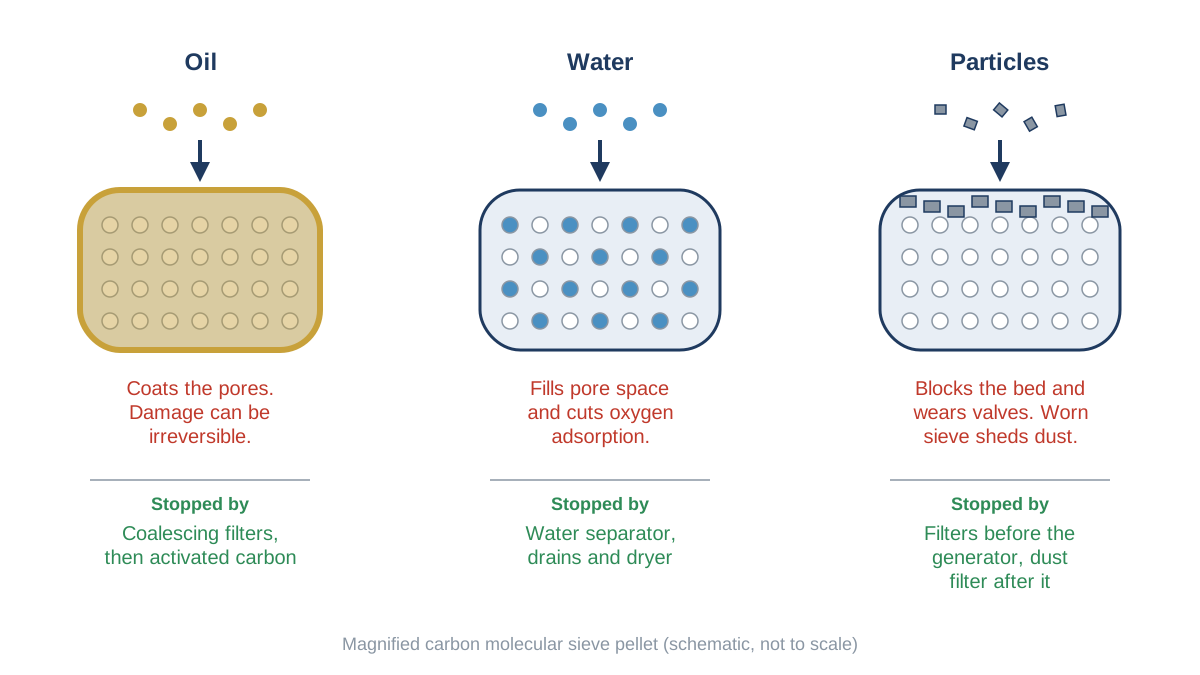
Oil is the most serious threat. Parker Hannifin (2018) warns that high oil levels can contaminate the sieve irreversibly, and a major loss of performance may mean replacing part or all of the bed. Oil reaches the generator as aerosol droplets and as vapour. Coalescing filters capture the droplets, but vapour passes through them. That is why an activated carbon stage follows when the air comes from an oil-lubricated compressor (Atlas Copco n.d.-a; Ingersoll Rand n.d.).
Water
Water vapour competes with oxygen for space in the pores, and liquid water can flood them. Parker Hannifin (2018) rates moisture as less serious than oil but still a cause of lost performance. For that reason, a dryer sits after the compressor and before the generator (Ingersoll Rand n.d.).
Particles
Rust, scale and pipe debris can block the bed and wear the switching valves. The sieve can also shed its own dust as it ages. Carbon dust at the exhaust silencer or on the final filter is a sign the sieve is breaking down (Parker Hannifin 2018). Many generators therefore have an outlet dust filter.
A typical pre-treatment train
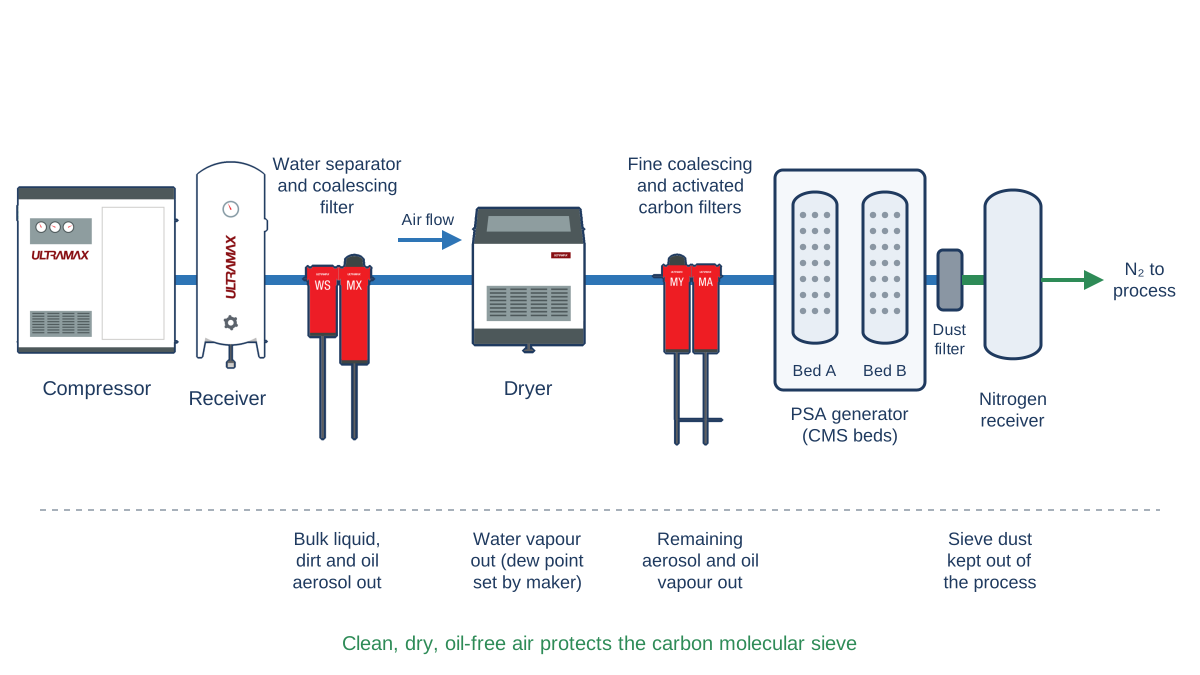
The order of the stages matters. A typical train runs from the compressor and receiver to a water separator and a general-purpose coalescing filter, then the dryer, then a finer coalescing filter and an activated carbon filter before the generator. The water separator removes bulk liquid so the dryer only handles vapour. The first coalescing filter protects the dryer from oil and dirt. The finer stage catches the remaining aerosol, and the carbon stage adsorbs oil vapour before the air reaches the sieve. Parker's twin-bed range, for example, uses two coalescing filters with automatic drains to protect the beds and valves (Parker Hannifin 2018).
Generator makers set their own inlet limits, and they differ. One maker lists ISO 8573-1 Class 4 for water and Class 1 for oil (Atlas Copco n.d.-a). Parker Hannifin (2020) quotes ISO 8573-1:2010 Class 2.2.2 for a compact PSA unit, or 2.2.1 where oil vapour content is high. Its twin-bed manual recommends a pressure dew point of 4 °C or lower (Parker Hannifin 2018). Water Class 4 allows a pressure dew point of about +3 °C, which a refrigerated dryer can deliver, while Class 2 sits around -40 °C and calls for a desiccant dryer. Oil Class 1 allows no more than 0.01 mg/m³ (Atlas Copco 2026). Check your generator manual before you choose the dryer, and see Refrigerated vs Desiccant Dryers: Which do you need?
Feed air temperature counts too. Atlas Copco (n.d.-a) and Ingersoll Rand (n.d.) both give an inlet window of about 10 to 25 °C and 400 to 1,300 kPa (4 to 13 bar). Ventilate the plant room, because hot air loads the dryer harder.
Differential pressure monitoring
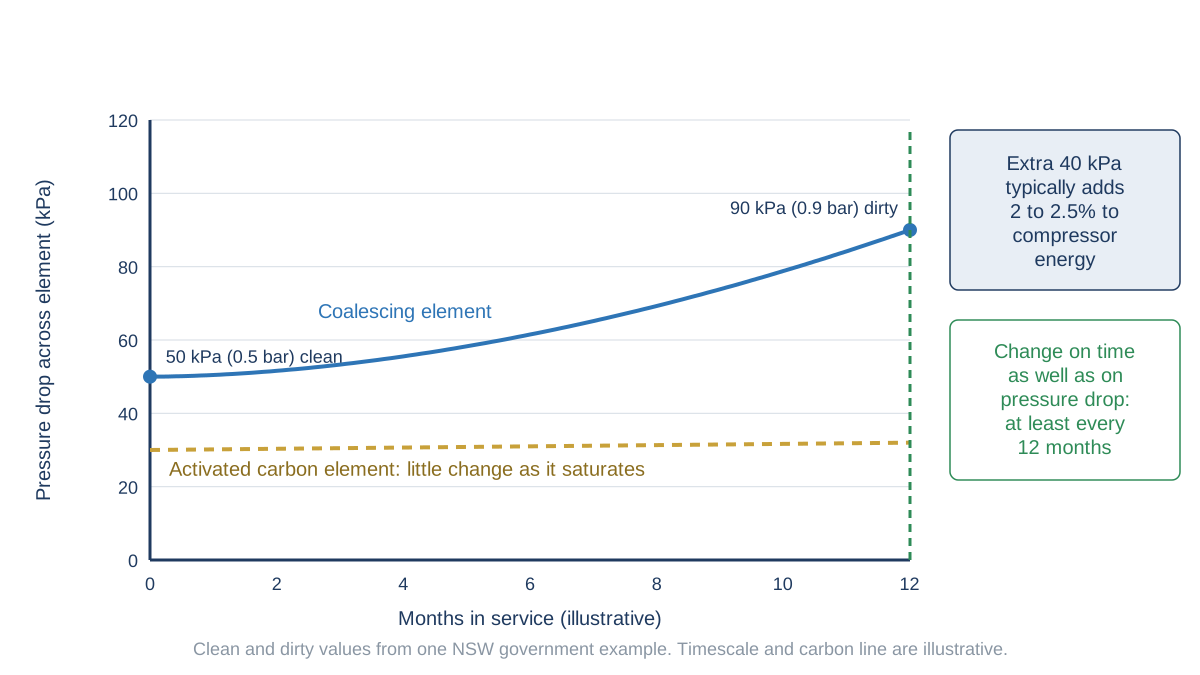
A filter element's pressure drop rises as it loads with dirt. The NSW Office of Environment and Heritage (2017) gives an example of a filter rising from 50 kPa (0.5 bar) when clean to 90 kPa (0.9 bar) when dirty. It estimates the extra 40 kPa typically adds 2 to 2.5% to compressor energy use. Ahead of a generator, a high pressure drop also lowers the pressure that reaches the sieve beds, which can cut nitrogen output. Differential pressure gauges across each housing make the trend easy to read, so log the readings at each inspection.
A gauge has limits, though. Differential pressure gauges show premature blockage, but they are neither filter service indicators nor air quality indicators (Atlas Copco n.d.-b). An activated carbon element can become saturated with little change in pressure drop, because it adsorbs vapour rather than collecting dirt. Change elements on time as well as on pressure drop. Some generators also monitor pressure drop across the adsorption vessels themselves. In Parker's twin-bed range, a high reading there can be a sign that the carbon in the vessels is deteriorating (Parker Hannifin 2018).
Element change intervals
Follow the generator manual first. For one twin-bed range, Parker Hannifin (2018) calls for filter inspection every three months, element changes every six months or sooner, and a new final filter cartridge each year. A compact PSA unit lists its dust filter element and silencer at 12 months and fuller service kits at 24 months (Parker Hannifin 2020). For general compressed air filters, Atlas Copco (n.d.-b) recommends changing elements every 12 months at the very least, and more often in dirty conditions. Keep the dryer and drains in good order too, because a failed drain can send a slug of liquid straight into the filters. A level-sensing drain removes liquid without wasting air, as How does a Zero Air Loss Drain work? explains.
Ultramax supplies replacement filter elements for Oxair and On Site Gases generators, and is the original equipment manufacturer of Oxair filter elements. Ultramax Gas Generation Systems also services generators and supplies spare parts, including filters. Match each element to the part number on the old element or housing. For help, see How to find a Replacement Compressed Air Filter Element. If you are still weighing up a generator, On-site Nitrogen vs Bottled Nitrogen: Which suits your Site? compares the options.
Key takeaways
- Carbon molecular sieve is sensitive to oil and moisture, and oil damage can be irreversible.
- A typical train is water separator, coalescing filter, dryer, fine coalescing filter and activated carbon.
- Generator makers set different inlet classes and dew points, so check the manual before choosing a dryer.
- Log pressure drop across each filter, but change elements on time as well.
- Carbon dust at the silencer or final filter, or falling output, can point to a damaged sieve.
Frequently asked questions
Do I need a carbon filter with an oil-free compressor?
Makers call for coalescing and carbon filtration mainly when the compressor is oil-lubricated. Intake air can still carry hydrocarbons, so follow the generator manual for your installation.
How can I tell if the sieve is damaged?
Watch for lower output or purity at the same settings, carbon dust at the exhaust silencer or final filter, and a rising pressure drop across the vessels.
Is a refrigerated dryer enough?
It depends on the generator. Some makers accept a pressure dew point of about +3 °C, while others specify an ISO 8573-1 water class that needs a desiccant dryer.
Related reading
- How does a PSA Nitrogen Generator work?
- On-site Nitrogen vs Bottled Nitrogen: Which suits your Site?
- What is Pressure Dew Point?
- ISO 8573-1:2010 Purity Classes explained
References
- Atlas Copco. n.d.-a. "PSA Nitrogen Generator: How Pressure Swing Adsorption Works." Atlas Copco UK. Accessed 26 October 2026. https://www.atlascopco.com/en-uk/compressors/wiki/compressed-air-articles/pressure-swing-adsorption-generator.
- Atlas Copco. n.d.-b. "Why Change Your Compressed Air Inline Filter Regularly?" Atlas Copco UAE. Accessed 26 October 2026. https://atlascopco.com/en-ae/compressors/air-compressor-blog/why-change-your-compressed-air-inline-filter-regularly.
- Atlas Copco. 2026. "Understanding ISO Classes for Compressed Air Quality." Atlas Copco UK, 5 January 2026. Accessed 26 October 2026. https://www.atlascopco.com/en-uk/compressors/air-compressor-blog/understanding-iso-classes-for-compressed-air-quality.
- Ingersoll Rand. n.d. "Introduction to PSA Nitrogen Generator Technology." Accessed 26 October 2026. https://www.ingersollrand.com/en-in/resources/custom-air-and-gas-solutions/psa-nitrogen-generator-technology/.
- NSW Office of Environment and Heritage. 2017. Low Capital Cost, Simple Solutions to Improve the Efficiency of Your Compressed Air System. OEH2017/0257. Hosted by Energy NSW. https://www.energy.nsw.gov.au/sites/default/files/2022-08/2017_NSW_CompressedAirGuidepdf.pdf.
- Parker Hannifin. 2018. Dual-Bed Nitrogen Generation Systems, Models DB-1200 to DB-4000: Installation, Operation and Maintenance Manual. Bulletin TI-DB1200-4000, rev. 4. https://www.parker.com/content/dam/Parker-com/Literature/IGFG/PDF-Files/PKR_IOM_DB1200_4000rev4DualBedN2GenSys.pdf.
- Parker Hannifin. 2020. NITROSource Compact PSA Nitrogen Gas Generator. Product information sheet PISNITROSOURCEC-01-EN. https://pharmaceutical.yodify.com/Documentation/Document/ow1Od/PISNITROSOURCEC-01-EN.pdf.
This article is general information only. Check manufacturer documentation and applicable Australian Standards for your installation.