
What is Pressure Dew Point?
Ultramax Systems on 15th Oct 2026
Short answer: Pressure dew point (PDP) is the temperature at which water vapour starts to condense out of compressed air at line pressure. If the air in your pipes cools below its pressure dew point, liquid water forms. Dryers are rated by the PDP they deliver.
What pressure dew point means
All atmospheric air carries some water vapour, and the amount it can hold depends on temperature. The dew point is the temperature at which that vapour starts to condense, and a higher dew point means more moisture in the air (Bureau of Meteorology 2017). As Atlas Copco (n.d.-c) explains, pressure dew point applies the same idea to compressed air at line pressure, while atmospheric dew point describes air at normal atmospheric pressure.
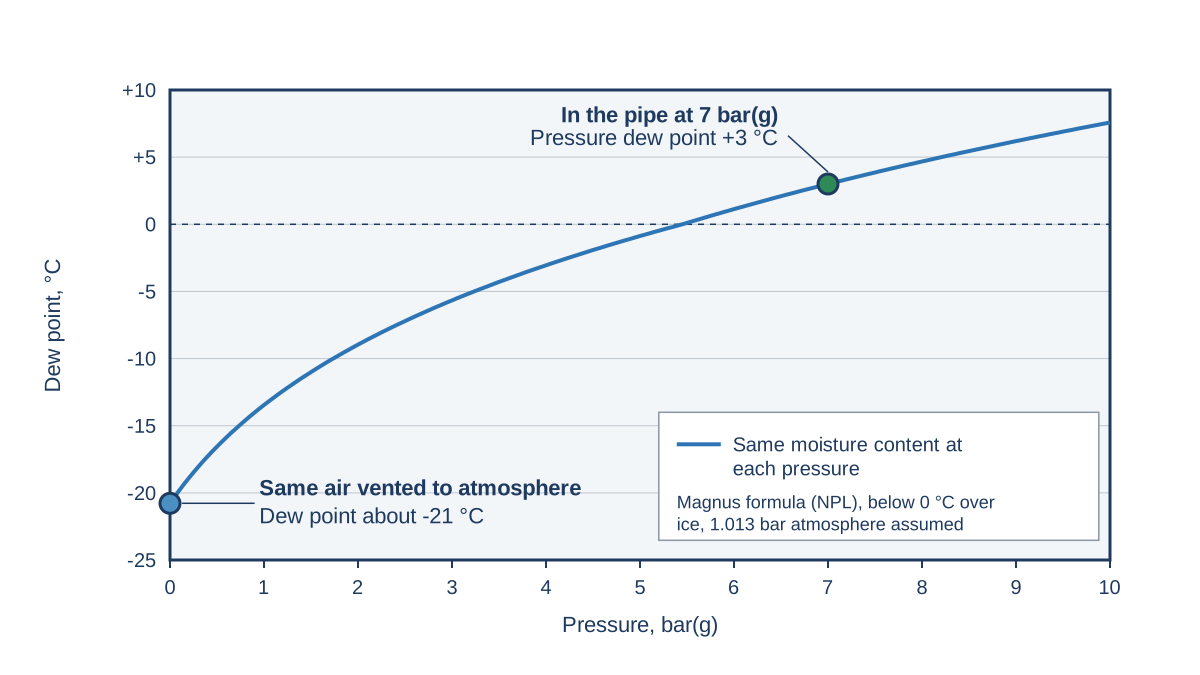
Compression squeezes the water vapour into a smaller volume and raises its partial pressure. As a result, the vapour saturates at a higher temperature, so the same air has a much higher dew point inside the pipe than after it is vented. A PDP of +2 °C at 7 bar, for example, corresponds to roughly -23 °C at atmospheric pressure (Atlas Copco n.d.-d). So check which figure a dryer or sensor quotes before comparing specifications.
Why it matters in a compressed air system
Air leaves the compressor warm and saturated with moisture. It cools as it travels through the aftercooler, receiver and pipework, and if it drops below its pressure dew point anywhere downstream, liquid water forms. It collects in low points and travels on to tools and processes. Over time, moisture corrodes pipelines and production equipment, and in cold weather it can freeze and damage control lines (Atlas Copco n.d.-c).
Local climate sets how much water arrives in the first place. In the tropics, dew points are commonly above 24 °C in spring and summer, according to the Bureau of Meteorology (2017). A compressor in Darwin in the wet season therefore takes in far more water vapour than one in a drier southern city, so size drying equipment for your most humid conditions.
In practice, the aim is to choose a PDP comfortably below the lowest temperature your pipework will see, including any outdoor runs. A dryer does that job, and good condensate removal upstream helps, because liquid water reaching the dryer adds to its load. For more on draining condensate without wasting air, see How does a zero air loss drain work?
How it is measured
Because the dryer sets the PDP, a dew point sensor is usually installed straight after it. A rising reading can point to a dryer fault, so continuous monitoring gives an early warning (Atlas Copco n.d.-a). Common types include chilled mirror, aluminium oxide and capacitive polymer. Polymer sensors respond quickly, while aluminium oxide sensors are robust but slower (Atlas Copco n.d.-a).
A sensor is only as good as its calibration. In Australia, the National Measurement Institute (n.d.) calibrates dew point and frost point hygrometers with internationally traceable results, so check when yours was last calibrated.
Typical values
The type of dryer largely sets the PDP you can achieve. Refrigerated dryers typically reach about +3 °C, while desiccant (adsorption) dryers go much lower (Parker Hannifin 2017; Atlas Copco n.d.-d). ISO 8573-1:2010 uses pressure dew point to define its water purity classes, which gives buyers and suppliers a common way to specify dryness (ISO 8573-1:2010). For more on the classes, see ISO 8573-1 purity classes explained.
| Dryer or class | Pressure dew point | Source |
|---|---|---|
| Refrigerated dryer | Down to about +3 °C (some quote +2 to +10 °C) | Parker Hannifin 2017; Atlas Copco n.d.-d |
| Desiccant (adsorption) dryer | Typically -40 °C; down to -70 °C | Atlas Copco n.d.-d; Parker Hannifin 2017 |
| ISO 8573-1 water class 4 | +3 °C or lower | Atlas Copco n.d.-b |
| ISO 8573-1 water class 2 | -40 °C or lower | Atlas Copco n.d.-b |
| ISO 8573-1 water class 1 | -70 °C or lower | Atlas Copco n.d.-b |
Worked example: +3 °C PDP at 7 bar(g)
This example converts a refrigerated dryer's PDP to an atmospheric dew point, using Magnus-type formulas from the UK National Physical Laboratory (n.d.).
Assumptions: line pressure 7 bar(g); atmospheric pressure 1.013 bar(a); ideal gas; enhancement factor ignored.
- Vapour pressure at the PDP. Over water, e = 611.2 × exp(17.62 × t / (243.12 + t)) Pa. At t = +3 °C, e = 611.2 × exp(0.2148) ≈ 758 Pa.
- Expand to atmospheric pressure. Absolute line pressure is 7 + 1.013 = 8.013 bar(a). The vapour pressure falls in proportion: 758 × 1.013 / 8.013 ≈ 95.8 Pa.
- Solve for the new dew point. Below 0 °C, use NPL's formula over ice: t = 272.62 × x / (22.46 - x), where x = ln(95.8 / 611.2) = -1.853. This gives t ≈ -20.8 °C.
So air at +3 °C PDP and 7 bar(g) has an atmospheric dew point of about -21 °C. The over-water formula gives about -23 °C, which sits close to the +2 °C PDP at 7 bar example that Atlas Copco (n.d.-d) publishes. Published conversions vary with the formula and rounding, so treat any figure as an estimate.
Related terms
- ISO 8573-1 water class: a purity class set by pressure dew point. See ISO 8573-1 purity classes explained.
- Condensate: liquid water and oil removed by drains. See How does a zero air loss drain work?
Related Ultramax products
- Compressed air dryers: refrigerated and desiccant dryers.
- Dryer filter kits: replacement filters for Ultramax dryers.
- Water separators: remove bulk liquid before the dryer.
References
- Atlas Copco. n.d.-a. "The Dew Point Sensor in Compressed Air Technology." Accessed 13 October 2026. https://www.atlascopco.com/en-uk/compressors/wiki/compressed-air-articles/dew-point-sensor.
- Atlas Copco. n.d.-b. "Understanding ISO 8573-1:2010 Compressed Air Quality Classes." Accessed 13 October 2026. https://www.atlascopco.com/en-uk/compressors/air-compressor-blog/understanding-iso-classes-for-compressed-air-quality.
- Atlas Copco. n.d.-c. "What Is a Pressure Dew Point?" Accessed 13 October 2026. https://www.atlascopco.com/en-ca/compressors/air-compressor-blog/what-is-a-pressure-dew-point.
- Atlas Copco. n.d.-d. "Why Dry Compressed Air Is Essential." Accessed 13 October 2026. https://www.atlascopco.com/en-uk/compressors/wiki/compressed-air-articles/drying-compressed-air.
- Bureau of Meteorology. 2017. "Feeling Hot and Bothered? It's Not the Humidity, It's the Dew Point." Bureau of Meteorology Social Media Blog, 19 April 2017. Accessed 14 October 2026. https://media.bom.gov.au/social/blog/1324/feeling-hot-and-bothered-its-not-the-humidity-its-the-dew-point.
- ISO (International Organization for Standardization). 2010. ISO 8573-1:2010 Compressed Air, Part 1: Contaminants and Purity Classes. Geneva: ISO. https://www.iso.org/standard/46418.html.
- National Measurement Institute. n.d. "Temperature and Humidity Measurement Client Services." Accessed 14 October 2026. https://www.industry.gov.au/national-measurement-institute/nmi-services/physical-measurement-services/temperature-and-humidity-measurement-client-services.
- National Physical Laboratory. n.d. "Dew Point and Relative Humidity." Accessed 13 October 2026. https://npl.co.uk/resources/q-a/dew-point-and-relative-humidity.
- Parker Hannifin. 2017. Focused on Compressed Air and Gas Treatment. Parker domnick hunter. https://pharmaceutical.yodify.com/Documentation/Document/emYX1/322838-FOCUSED-ON-Compressed-Air-and-Gas-Treatment-English-PDF-3.pdf.
This article is general information only. Check manufacturer documentation and applicable Australian Standards for your installation.