
Coalescing Filters explained: How they work and when you need one
Ultramax Systems on 15th Oct 2026
Short answer: A coalescing filter removes fine oil and water aerosols, plus small particles, from compressed air. Tiny droplets catch on fibres in the filter media, merge into larger drops and drain to the bowl, where a drain discharges them. It does not remove oil vapour or water vapour, so it works alongside dryers and adsorption filters.
Why compressed air needs a coalescing filter
Air leaving a compressor carries a fine mist of water and, in lubricated machines, oil. Many of these droplets are far too small to settle out on their own, so a water separator or general strainer lets them pass. Left in the air, they foul dryers, contaminate products and shorten the life of pneumatic tools. Coalescing filters are the type used to strip this lubricant and moisture from the air stream (US Department of Energy 2016).
How a coalescing filter works
In most compressed air coalescing filters, air enters the head, travels down the centre of the element and passes through the media from inside to outside (Korane 2016). Some element designs flow the other way, so check the maker's arrow before installing (Pentair 2017).
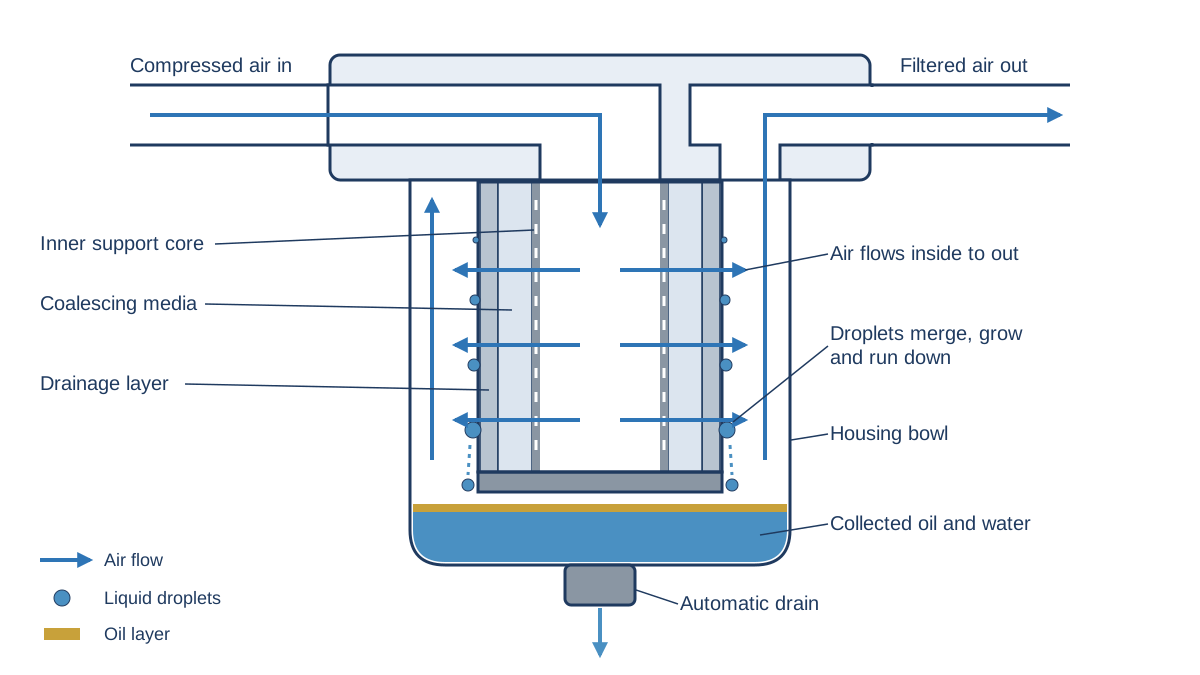
As droplets touch the fibres, they stick and join other droplets. This merging is what "coalescing" means. The drops grow until gravity pulls them down the outside of the element. Liquid then collects in the bowl, and a float or electronic drain removes it (Korane 2016).
The three capture mechanisms
Coalescing media is a dense mat of very fine fibres. Droplets of different sizes reach those fibres in different ways, which is why one element can cover such a wide size range.
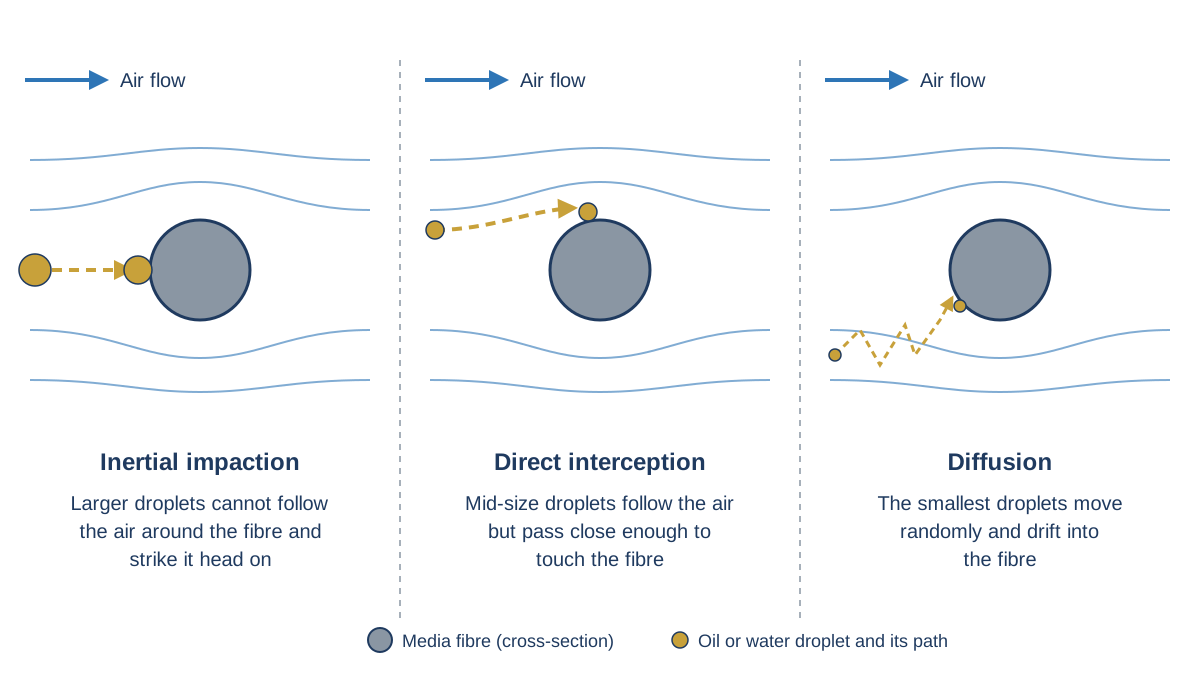
Larger droplets carry too much momentum to follow the air as it bends around a fibre, so they hit it head on. This is inertial impaction. Mid-size droplets do follow the air, but they pass close enough to brush the fibre and stick, which is called direct interception. The smallest droplets move randomly through Brownian motion and drift into fibres by diffusion. Because diffusion needs time, lower air velocity through the media helps it work. Pentair (2017) links impaction mainly with droplets above about 1 micron, interception with roughly 0.3 to 1 micron and diffusion with sizes below about 0.3 micron. Other makers quote slightly different boundaries, so treat these as a guide.
Key parts of the filter
A perforated support core holds the media's shape under pressure. Around it sit the fine fibre layers where droplets are captured and merge. An outer drainage layer, standard in high efficiency coalescing elements, then helps the collected liquid run away (Pentair 2017). The housing and bowl hold the element under pressure and collect the liquid. Finally, a manual, float or electronic drain empties the bowl.
Filter grades and ISO 12500-1 testing
ISO 12500-1 sets the test method for coalescing filters and rates oil aerosol removal as an outlet concentration in mg/m³, together with pressure drop, under standard conditions (ISO 12500-1:2007). Makers commonly pair a general purpose grade with a high efficiency grade, as the example below shows.
| Parker OIL-X grade | Particle reduction | Remaining oil aerosol at 21 °C | Inlet challenge in test |
|---|---|---|---|
| AO (general purpose) | Down to 1 micron | 0.5 mg/m³ | 40 mg/m³ |
| AA (high efficiency) | Down to 0.01 micron | 0.01 mg/m³ | 10 mg/m³ |
Compare grades from different makers only when the inlet challenge and test conditions match. To relate outlet results to purity classes (ISO 8573-1:2010), see our guide to ISO 8573-1 air quality classes.
Where it goes in the system
Placement matters as much as grade. The US Department of Energy (2016) places a coalescing filter ahead of a desiccant dryer to stop oil fouling the desiccant bed, with a particulate filter after the dryer to catch desiccant dust. Within the filter train, Parker Hannifin (2019) puts a general purpose AO filter ahead of a high efficiency AA filter, with a water separator ahead of the AO where bulk liquid is present. For refrigerated dryers, follow the dryer maker's filter arrangement.
Coalescing filters do not remove oil vapour. Where odour or vapour matters, an activated carbon stage typically follows (Korane 2016).
Australian requirements by application
The end use decides how far treatment needs to go. For breathing air, AS/NZS 1715 sets air quality requirements for compressors that supply air-line respirators (AS/NZS 1715:2009). As WorkSafe Queensland (n.d.) points out, oil lubricants in air compressors can break down at high temperatures and produce carbon monoxide. A coalescing filter does not remove it, so breathing air systems add stages such as a hopcalite catalyst. The same regulator recommends testing the air quality periodically.
In food plants, Food Standards Australia New Zealand regulates the food rather than the compressed air, so the air purity target comes from the site's own HACCP-based food safety plan (Raal 2026). Medicine makers have a formal GMP code instead. The Therapeutic Goods Administration (n.d.) states that version 17 of the PIC/S Guide to GMP applies to the manufacture of medicines, APIs and sunscreens from 1 September 2025. In each case, size the filter train to the purity the site specifies.
Differential pressure and element change
A new element adds a small pressure drop: below 70 mbar dry and below 125 mbar when saturated with oil for the grades above (Parker Hannifin 2019). Trapped solids slowly block the media, so the drop rises over time, and that rise has a running cost. The NSW Office of Environment and Heritage (2017) describes a filter whose pressure drop climbs from 0.5 bar (50 kPa) clean to 0.9 bar (90 kPa) dirty, and notes that the extra 0.4 bar typically adds 2 to 2.5 per cent to energy use at full compressor capacity. For that reason, replace elements as the pressure differential indicates, as the US Department of Energy (2016) advises. Parker also sets a 12 month change interval for these elements (Parker Hannifin 2019), and pressure drop alone may not show how well an element still removes oil.
Common mistakes
A high efficiency element fitted without a general purpose prefilter takes contamination the prefilter is meant to stop. A coalescing filter cannot remove oil vapour, odour, carbon monoxide or water vapour, which need carbon stages, catalysts and dryers. A blocked drain floods the bowl, and changing elements only when the gauge reads high ignores the maker's interval.
Key takeaways
- A coalescing filter captures oil and water aerosols and drains them as liquid.
- Impaction, interception and diffusion each capture a different droplet size range.
- ISO 12500-1 rates oil aerosol removal. Compare grades at matching inlet challenges.
- Fit coalescing filters ahead of desiccant dryers, and change elements by pressure drop or interval.
- In Australia, AS/NZS 1715 covers breathing air, while food and pharmaceutical sites set air purity through their own food safety plan or GMP system.
Frequently asked questions
Does a coalescing filter remove water?
It removes liquid water droplets and aerosols. It does not remove water vapour. A dryer handles vapour.
How often should I change a coalescing element?
Change it when differential pressure reaches the maker's limit or at the stated interval, whichever comes first. Parker Hannifin (2019) specifies 12 months for its OIL-X AO and AA elements.
What is the difference between a general purpose and a high efficiency grade?
A high efficiency grade uses finer media and leaves less oil aerosol in the air. It usually sits after a general purpose grade, which protects it from heavier contamination.
Is a coalescing filter enough for breathing air?
No. It removes oil and water aerosols but not carbon monoxide or vapours. Breathing air needs further treatment and monitoring to meet AS/NZS 1715 (AS/NZS 1715:2009).
Related Ultramax products
- G Series compressed air filter housings: Ultramax coalescing, particulate and carbon filter housings.
- Original and alternative filter elements: replacement elements to suit major compressor and filter brands.
- Differential pressure gauges: see when an element needs changing.
- Filter Finder: cross-reference an element by OEM or housing number.
References
- ISO (International Organization for Standardization). 2007. ISO 12500-1:2007 Filters for Compressed Air: Test Methods, Part 1: Oil Aerosols. Geneva: ISO. https://www.iso.org/standard/41150.html.
- ISO (International Organization for Standardization). 2010. ISO 8573-1:2010 Compressed Air, Part 1: Contaminants and Purity Classes. Geneva: ISO. https://www.iso.org/standard/46418.html.
- Korane, Ken. 2016. "How Does a Coalescing Filter Work?" Fluid Power World, 1 September 2016. Accessed 13 October 2026. https://www.fluidpowerworld.com/?p=28783.
- NSW Office of Environment and Heritage. 2017. Low Capital Cost, Simple Solutions to Improve the Efficiency of Your Compressed Air System. Compressed air guide. State of NSW and Office of Environment and Heritage. https://www.energy.nsw.gov.au/sites/default/files/2022-08/2017_NSW_CompressedAirGuidepdf.pdf.
- Parker Hannifin. 2019. OIL-X Die-Cast Aluminium Compressed Air Filters, Grade AO and Grade AA. Product information PISOILXDCAOAA-00-EN. https://pharmaceutical.yodify.com/Documentation/Document/JlJYA/PISOILXDCAOAA-00-EN.pdf.
- Pentair. 2017. Ultrafit Coalescing Filters. https://www.pentair.com/assets/ef-br-ultrafit-11091-en.
- Raal, Byron. 2026. "What Food-Grade Compressed Air Actually Means." Food Processing, 21 August 2026. Accessed 14 October 2026. https://www.foodprocessing.com.au/content/processing/article/what-food-grade-compressed-air-actually-means-1676384682.
- Standards Australia. 2009. AS/NZS 1715:2009 Selection, Use and Maintenance of Respiratory Protective Equipment. Standards Australia and Standards New Zealand. https://store.standards.org.au/product/as-nzs-1715-2009.
- Therapeutic Goods Administration. n.d. "Good Manufacturing Practice (GMP) Requirements for Medicinal Products: PIC/S Guide to GMP PE009-17." Accessed 14 October 2026. https://www.tga.gov.au/resources/guidance/good-manufacturing-practice-gmp-requirements-medicinal-products-pics-guide-gmp-pe009-17.
- US Department of Energy. 2016. Improving Compressed Air System Performance: A Sourcebook for Industry. 3rd ed. Washington, DC: US Department of Energy and Compressed Air Challenge. https://www.energy.gov/sites/prod/files/2016/03/f30/Improving%20Compressed%20Air%20Sourcebook%20version%203.pdf.
- WorkSafe Queensland. n.d. "Carbon Monoxide in Breathing Air During Air Compressor Use." Accessed 14 October 2026. https://www.worksafe.qld.gov.au/safety-and-prevention/hazards/hazardous-exposures/carbon-monoxide-in-breathing-air-during-air-compressor-use.
This article is general information only. Check manufacturer documentation and applicable Australian Standards for your installation.