
ISO 8573-1:2010 Purity Classes explained
Ultramax Systems on 15th Oct 2026
Short answer: ISO 8573-1 purity classes rate compressed air for three contaminants: solid particles, water and oil. A class is written as three numbers in that order, such as ISO 8573-1:2010 [1:4:1]. Lower numbers mean cleaner air, and Class 0 is a custom limit that must be stricter than Class 1.
What ISO 8573-1 covers
Compressed air picks up contaminants from the intake to the point of use. Buyers, engineers and suppliers need a shared scale for how clean it must be, and ISO 8573-1 provides one. The standard sets purity classes for particles, water and oil, and those classes can be applied at any point in the system where you specify the air (ISO 8573-1:2010). Other parts of the ISO 8573 series describe how to measure each contaminant. ISO confirmed the 2010 edition in 2017, and a new edition registered in December 2025 will replace it (ISO/AWI 8573-1), so check for a newer edition before you write a specification.
How to read a purity class
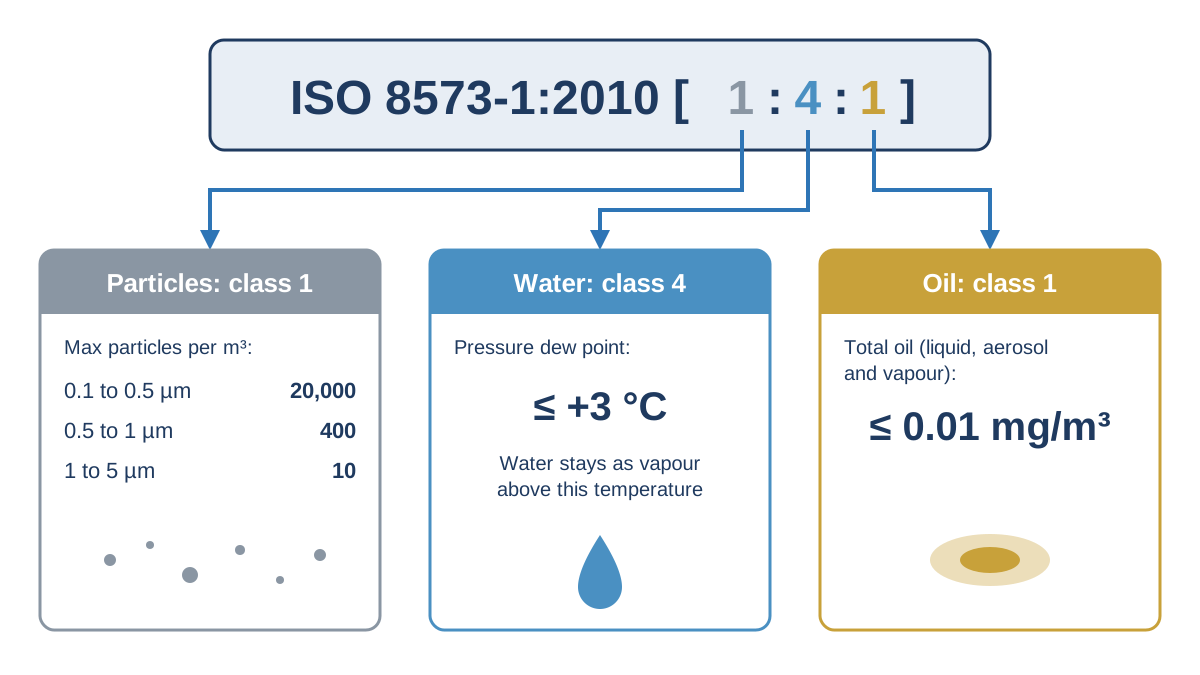
A purity class is written as three digits in a fixed order: particles first, then water, then oil. Lower numbers mean cleaner air, so Class 1 is stricter than Class 4. As EXAIR (2024) notes, the digits can be separated by colons or full stops, so [1:4:1] and 1.4.1 describe the same air. It also pays to quote the edition year, because limits can change between editions. Written as ISO 8573-1:2010 [1:4:1], the code leaves no room for doubt.
The three contaminant groups
Particles
For particles, Classes 1 to 5 limit how many particles each cubic metre of air may contain within set size bands. Each step down the scale permits fewer particles in every band, as the selected values below show (Kaeser Kompressoren 2021; Atlas Copco n.d.). Classes 6 and 7 work differently. Instead of counting particles, they set a mass concentration limit in mg/m³ (Kaeser Kompressoren 2021).
| Class | 0.1 to 0.5 µm | 0.5 to 1 µm | 1 to 5 µm |
|---|---|---|---|
| 1 | 20,000 | 400 | 10 |
| 2 | 400,000 | 6,000 | 100 |
| 3 | Not specified | 90,000 | 1,000 |
Water
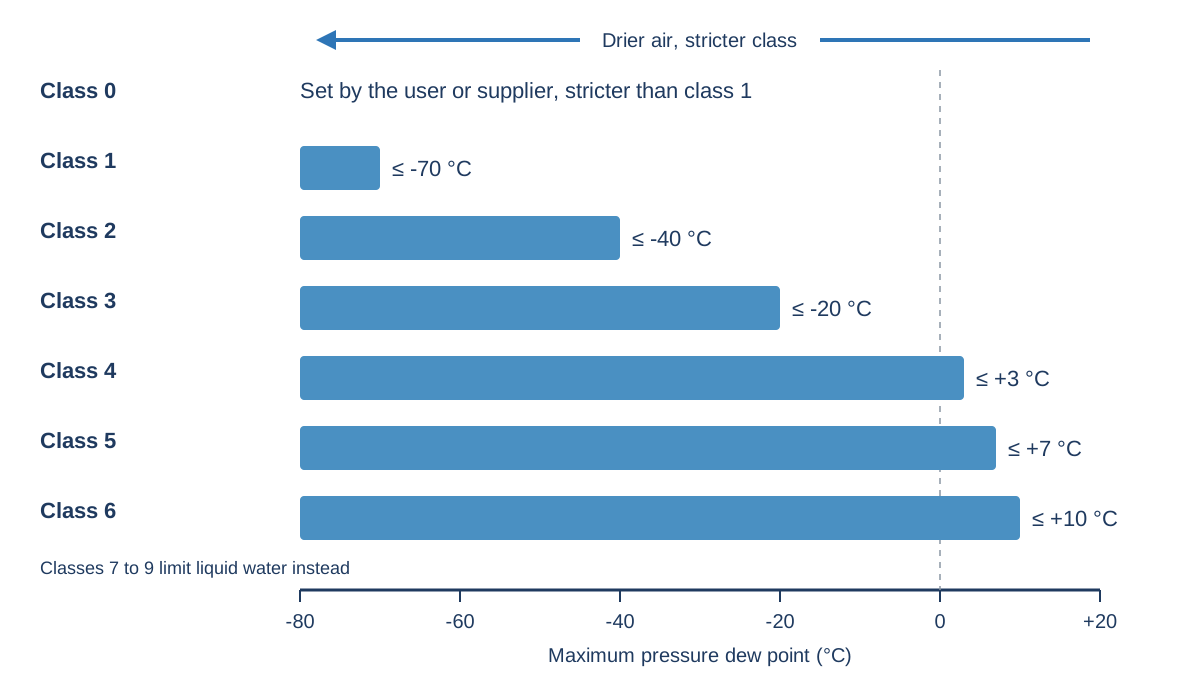
Water classes also fall into two groups. Classes 1 to 6 set a maximum pressure dew point, which is the temperature at which water vapour starts to condense at line pressure. The limits run from -70 °C at Class 1 to +10 °C at Class 6 (Kaeser Kompressoren 2021; Atlas Copco n.d.). Classes 7 to 9 limit liquid water content instead, up to 10 g/m³ at Class 9 (Atlas Copco 2025). For more on how dew point works, read What is pressure dew point?
Oil
The oil classes limit total oil, which counts liquid, aerosol and vapour together. Class 1 allows 0.01 mg/m³ or less, Class 2 allows 0.1, Class 3 allows 1 and Class 4 allows 5 mg/m³. Class X covers anything above 5 mg/m³ (Atlas Copco n.d.; Kaeser Kompressoren 2021). Because vapour counts toward the total, filter choice matters. In the purifier design from Parker Hannifin (2015), coalescing filters target oil aerosols and an activated carbon stage handles oil vapour.
What Class 0 means
Class 0 is the most misunderstood part of the standard. It does not mean zero contamination. Instead, the user or equipment supplier sets a limit, and that limit must be stricter than Class 1 (Atlas Copco n.d.). For Class 0 work, such as clean room applications, Kaeser Kompressoren (2021) advises buyers to consult the supplier. A Class 0 claim therefore means little on its own. Ask to see the agreed limit and the test method behind it.
Where purity classes are used
The standard does not say which class a process needs, so industry bodies publish guidelines that map common uses to typical classes. Atlas Copco (n.d.) summarises two of them for food and beverage. The BCAS food and beverage guideline suggests [2:2:1] for air in direct contact with product and [2:4:2] for indirect contact. VDMA 15390, which covers food and pharmaceutical production, suggests [2:4:1] for product contact air where ambient temperature is above 10 °C, and [2:2:1] at 10 °C or below.
General industry sits further down the scale. Typical examples include [3:4:4] for industrial pneumatic tools and [4:4:3] for textile work (Atlas Copco 2025). Treat these figures as a starting point, not a specification. Your process owner or a qualified person should set the final class.
Australian standards for breathing and medical air
ISO 8573-1 is a general scale for industrial air, and it does not cover gases such as carbon monoxide. That is why some uses in Australia have their own standards. Supplied air respirators fall under AS/NZS 1715 (AS/NZS 1715:2009). WorkSafe Queensland (n.d.) explains that it defines acceptable levels of oxygen, carbon monoxide, carbon dioxide, moisture and temperature for supplied air. That standard is also in transition. Standards Australia (2025) is replacing AS/NZS 1715 and AS/NZS 1716 with a suite of ISO-based respiratory standards, with old and new running in parallel until 2030.
Medical air is separate again. AS 2568 sets minimum purity requirements for medical air from on-site compressor systems, delivered to the terminal units of a medical gas pipeline (AS 2568:2019). The pipeline systems themselves are installed and tested to AS 2896 (AS 2896:2021). An ISO 8573-1 class alone does not show that air is fit to breathe or suitable for patient use, so work from the relevant Australian Standard with a qualified person.
Common mistakes
Most specification errors are simple ones, such as reading the numbers backwards (Class 1 is cleaner than Class 4) or leaving out the edition year, which lets different parties work from different tables. Location is another trap. Air quality can change as air travels through the pipework, so a class measured at the compressor may not describe the air at the point of use. State where the class applies, and do not treat Class 0 as a universal grade.
Key takeaways
- ISO 8573-1 rates compressed air for particles, water and oil, in that order.
- Lower class numbers mean cleaner air.
- Water classes 1 to 6 are set by pressure dew point, from -70 °C to +10 °C.
- Class 0 is a custom limit stricter than Class 1, not a zero reading.
- Use industry guidelines as a starting point and confirm with a qualified person.
- Breathing air (AS/NZS 1715) and medical air (AS 2568) have their own Australian Standards.
Frequently asked questions
What does ISO 8573-1:2010 [1:2:1] mean?
Particles Class 1, water Class 2 (pressure dew point -40 °C or lower) and oil Class 1 (0.01 mg/m³ or lower total oil).
Is ISO 8573-1 the same as breathing air quality?
No. The purity classes cover particles, water and oil, not gases such as carbon monoxide. In Australia, breathing air falls under AS/NZS 1715 and its ISO-based successors. See What is a hopcalite filter?
Which filters set the class?
The whole treatment train does: separators, coalescing filters, dryers and carbon stages. Filter makers commonly state the class each element is designed to reach.
Related Ultramax products
- G Series compressed air filter housings: coalescing, particulate and activated carbon stages.
- G Series medical sterile filters: sterile filtration for critical applications.
- Breathing air systems: purifiers for supplied-air respirators.
- Compressed air dryers: achieve the pressure dew point class you need.
Related reading: What is a coalescing filter?.
References
- Atlas Copco. n.d. Best Practices Guide to Air Quality. https://www.atlascopco.com/content/dam/atlas-copco/compressor-technique/oil-free-air/documents/ISO%20best%20practices%20guide.pdf.pdf.
- Atlas Copco. 2025. "Understanding ISO 8573-1:2010 Compressed Air Quality Classes." Accessed 13 October 2026. https://www.atlascopco.com/en-au/compressors/air-compressor-blog/understanding-iso-classes-for-compressed-air-quality.
- EXAIR. 2024. "Air Quality Classes: ISO 8573-1." EXAIR Blog, 6 December 2024. Accessed 13 October 2026. https://blog.exair.com/2024/12/06/air-quality-classes-iso-8573-1/.
- ISO (International Organization for Standardization). 2010. ISO 8573-1:2010 Compressed Air, Part 1: Contaminants and Purity Classes. Geneva: ISO. https://www.iso.org/standard/46418.html.
- ISO (International Organization for Standardization). 2025. "ISO/AWI 8573-1 Compressed Air, Part 1: Contaminants and Purity Classes." Under development, registered 4 December 2025. Accessed 14 October 2026. https://www.iso.org/standard/93584.html.
- Kaeser Kompressoren. 2021. Compressed Air Treatment Diagrams for Rotary Screw Compressors. P-711ED. Hosted by Jefferson Lab. https://hallaweb.jlab.org/tech/Detectors/public_html/manuals/data_sheets-manuals/J-L/K/kaeser/P-711-ED-4-21_17-21631.pdf.
- Parker Hannifin. 2015. Breathable Compressed Air. Brochure 174004470_02_EN. Parker domnick hunter. https://iacserv.com/content/IAC_PDF_Files/Brochure/PARKER_BREATHABLE_COMPRESSED_AIR_BROCHURE.pdf.
- Standards Australia. 2009. AS/NZS 1715:2009 Selection, Use and Maintenance of Respiratory Protective Equipment. Standards Australia and Standards New Zealand. https://store.standards.org.au/product/as-nzs-1715-2009.
- Standards Australia. 2019. AS 2568:2019 Purity of Medical Air Produced from On-Site Compressor Systems. Reissued incorporating Amendment No. 1 (2022). Sydney: Standards Australia. https://store.standards.org.au/product/as-2568-2019.
- Standards Australia. 2021. AS 2896:2021 Medical Gas Systems: Installation and Testing of Non-Flammable Medical Gas Pipeline Systems. Sydney: Standards Australia. https://store.standards.org.au/product/as-2896-2021.
- Standards Australia. 2025. "What You Need to Know: Australia's New Respiratory Protection Standards." 28 April 2025. Accessed 14 October 2026. https://www.standards.org.au/blog/what-you-need-to-know-australias-new-respiratory-protection-standards.
- WorkSafe Queensland. n.d. "Carbon Monoxide in Breathing Air During Air Compressor Use." Accessed 14 October 2026. https://www.worksafe.qld.gov.au/safety-and-prevention/hazards/hazardous-exposures/carbon-monoxide-in-breathing-air-during-air-compressor-use.
This article is general information only. Check manufacturer documentation and applicable Australian Standards for your installation.