
How does a PSA Nitrogen Generator work?
Ultramax Systems on 26th Oct 2026
Short answer: A PSA (pressure swing adsorption) nitrogen generator passes clean, dry compressed air through a bed of carbon molecular sieve, which holds back oxygen and lets nitrogen through. Two beds take turns: one makes nitrogen under pressure while the other is depressurised to release the oxygen it has collected. Purity, flow and compressed air use are linked, so higher purity costs more air.
What a PSA nitrogen generator does
A nitrogen generator makes nitrogen on site from compressed air, so the site no longer depends on cylinder or bulk liquid deliveries. PSA units typically cover purities from about 95% to 99.999% (Atlas Copco n.d.), and some sources put the upper end at 99.9995% (Conley 2024). Lower purities suit jobs such as tyre inflation and fire prevention, while food, beverage and plastics moulding often call for higher grades. To weigh on-site supply against deliveries, see On-site Nitrogen vs Bottled Nitrogen: Which suits your Site?
How carbon molecular sieve separates oxygen
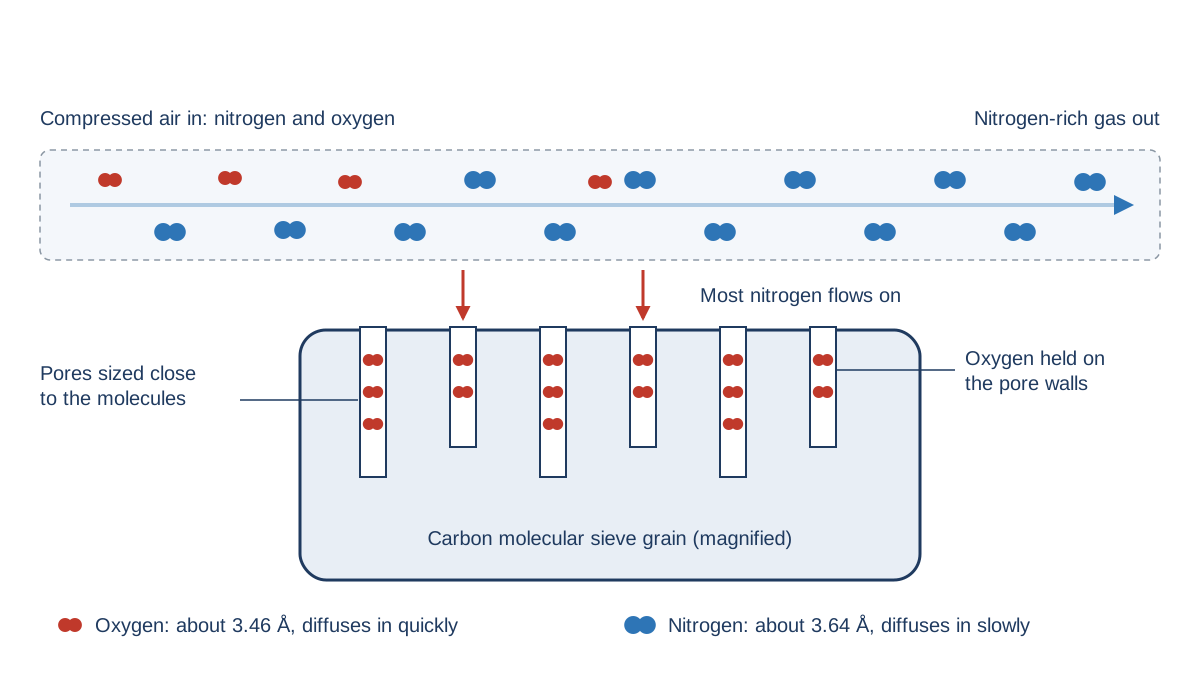
The working material is carbon molecular sieve (CMS), a carbon adsorbent with very fine pores. Oxygen and nitrogen molecules are close in size, but oxygen is slightly smaller, at about 3.46 Å against 3.64 Å for nitrogen (Atlas Copco n.d.). That small difference lets oxygen diffuse into the pores much faster than nitrogen. Under pressure, oxygen collects on the pore walls while most of the nitrogen flows straight on as product gas.
The separation depends on speed rather than capacity. Văduva and Stanciu (2006) describe it as a difference in adsorption rates on CMS. The generator therefore switches beds before the slower nitrogen catches up. This is adsorption, not absorption: the oxygen sticks to the sieve's surface rather than dissolving into it, so a drop in pressure releases it again. Adsorption vs Absorption: What is the Difference? explains the distinction.
The two-bed cycle
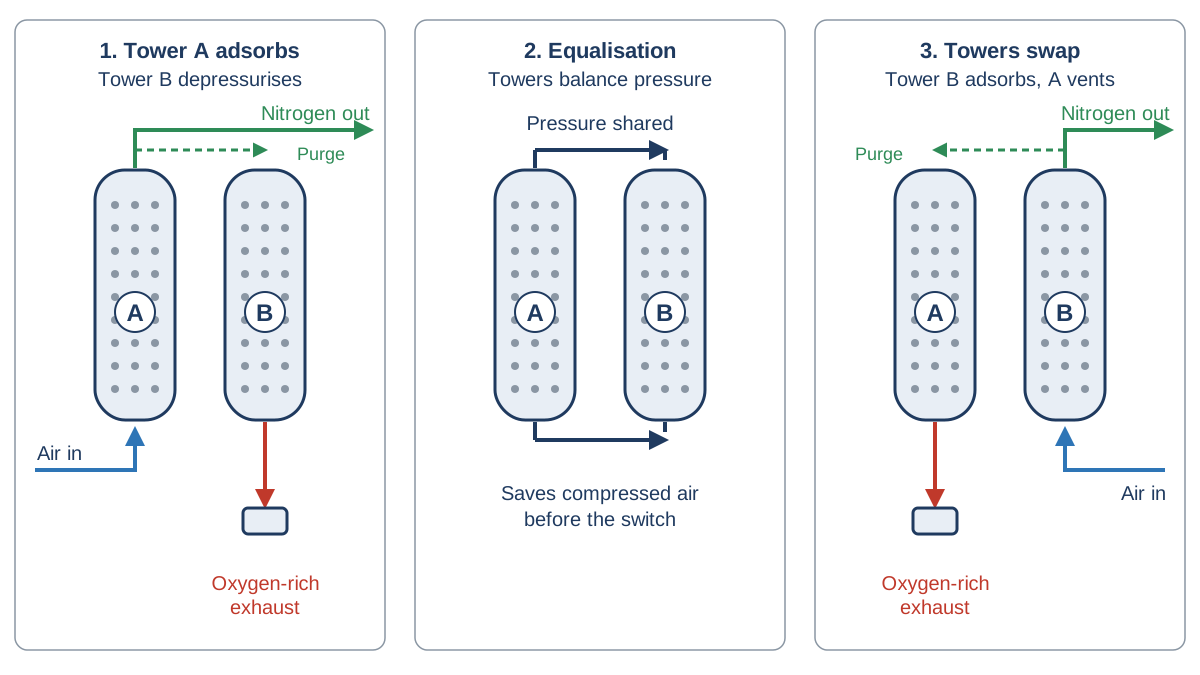
A PSA generator typically has two towers filled with CMS that take turns. Atlas Copco (n.d.) describes four phases. First, clean, dry air enters tower A, oxygen is trapped and nitrogen leaves as product, with a little of it sent across to tower B. Second, the towers equalise pressure, which recovers some compressed air before the switch. Third, tower B is depressurised and its oxygen-rich gas is blown out through the exhaust, helped by the nitrogen purge. Finally, the towers swap roles and the cycle repeats.
The exhaust is noisy and rich in oxygen, so it normally passes through a silencer to a ventilated point. The product side is the opposite: nitrogen leaking into a small, closed room can lower the oxygen level, a risk covered in the on-site versus bottled nitrogen article.
The complete system
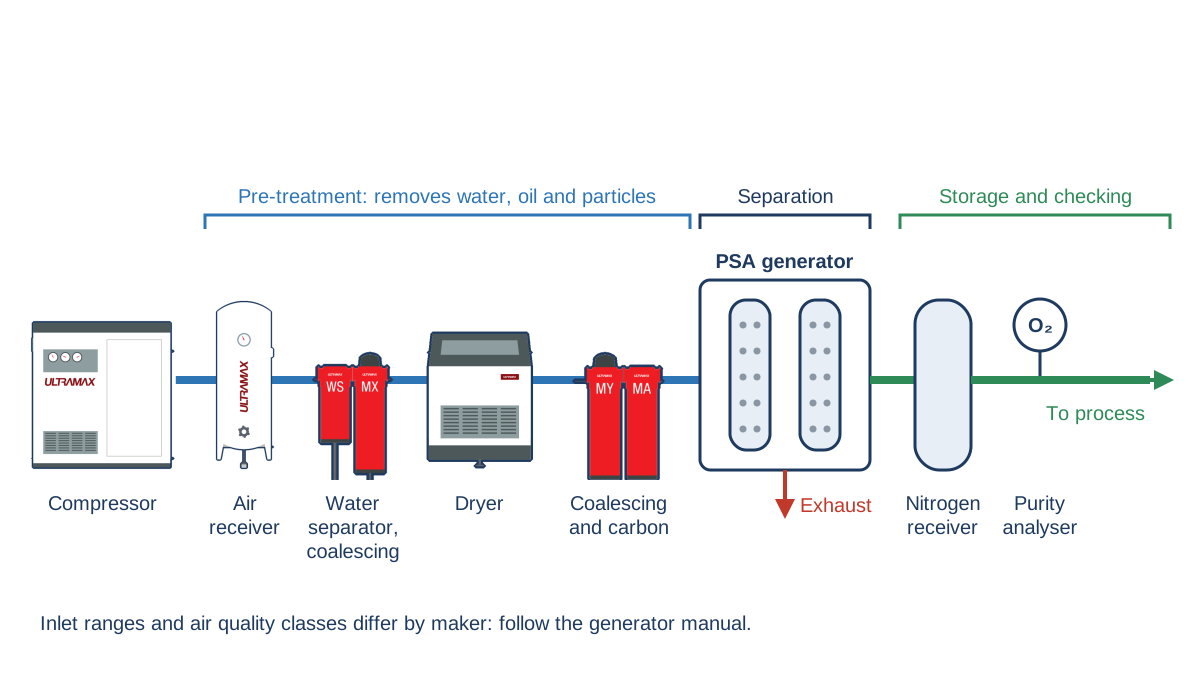
The generator is only one part of a treatment train. A typical layout runs from the compressor and receiver through a water separator, coalescing filters, a dryer and, for oil-lubricated compressors, an activated carbon filter. A nitrogen receiver and an oxygen analyser follow the generator. Atlas Copco (n.d.) treats a dryer between the compressor and the generator as essential, and notes that coalescing and carbon filters need servicing where an oil-lubricated compressor is used. Compressed air dryers and filters protect the sieve as much as the process.
Inlet requirements differ between makers, so work from the generator manual. One maker quotes an inlet range of 400 to 1300 kPa (4 to 13 bar) at 10 to 25 °C (Atlas Copco n.d.). Another asks for 500 to 1300 kPa (5 to 13 bar) and air to ISO 8573-1 Class 2.2.2 (Parker Hannifin n.d.). Filtration for Nitrogen Generators: Protecting the Sieve Beds covers the pre-treatment train in detail. Ultramax supplies replacement filter elements for Oxair and On Site Gases generators.
Purity versus flow
For a given generator, purity and flow pull against each other. Longer adsorption phases deliver more nitrogen at lower purity, while shorter cycles favour purity over volume (Atlas Copco n.d.). Van Ormer (2024) shows the recovered nitrogen falling steeply as purity rises towards 99.999%, so a generator supplies far less gas at its top grade.
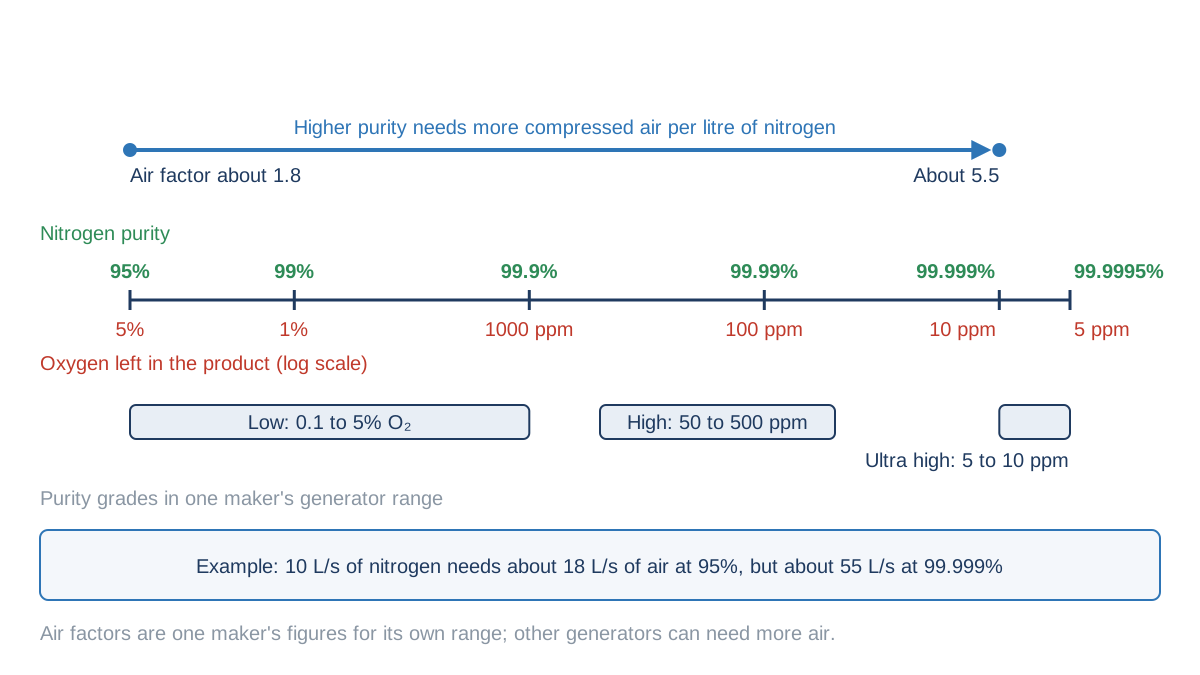
Purity is often stated as the oxygen left in the product. Nitrogen at 99.9% leaves up to 0.1% oxygen, or 1000 ppm. One maker groups its PSA range into grades of 0.1 to 5% oxygen, 50 to 500 ppm and 5 to 10 ppm (Parker Hannifin n.d.). Ask your process owner for a maximum oxygen level rather than a percentage.
Air-to-nitrogen ratio and running cost
The air factor, or air-to-nitrogen ratio, is the volume of compressed air a generator uses for each volume of nitrogen it delivers (Atlas Copco n.d.). Atlas Copco (2018) quotes air factors from about 1.8 at 95% to 5.5 at 99.999% for its own range and describes them as industry-low, so other generators may need more. Temperature matters too. In one example, the ratio rises from 3.6:1 at 30 °C to 4.2:1 at 60 °C (Conley 2024). PSA ratings commonly assume dry inlet air of about 13 to 21 °C, and recovery drops above about 21 to 24 °C (Van Ormer 2024), which matters in hot Australian plant rooms.
As an illustration, 10 L/s of nitrogen at an air factor of 1.8 needs about 18 L/s of compressed air. At 5.5 it needs about 55 L/s, three times the compressor capacity. Pressurising a tower can also briefly draw three to four times the average air flow (Conley 2024), so receiver capacity matters. Compressed air systems can use up to 30% of a site's electricity, and the Australian Government (n.d.) advises assessing the air quality each task really needs. The same logic applies here: specify the lowest purity the process needs. For sizing, see How to Size an Air Compressor.
Looking after the sieve
A well-maintained CMS bed typically lasts 10 years or more, but moisture and oil reduce its capacity and shorten its life (Atlas Copco n.d.). Conley (2024) reports that with oil-flooded compressors, an activated carbon bed can stretch sieve replacement from every two to four years to every 10 to 20 years. Replacing the adsorbent typically costs 30 to 45% of a new generator, and fluctuating air pressure can also degrade it over time. Watch purity, dew point and pressure trends, and change coalescing filters and carbon elements on schedule.
The towers and nitrogen receiver are pressure vessels. In Western Australia, pressure vessels in hazard level A, B or C under AS 4343 need item registration, although serially produced vessels are excluded (WorkSafe WA 2022). Rules vary between states, so check with your state regulator and see Pressure Vessel Registration and Inspection in Australia.
Ultramax's gas generation division, Ultramax Gas Generation Systems, designs, supplies, installs and services PSA and membrane nitrogen generators. It can help when you are planning a new system or reviewing an existing one.
Key takeaways
- A PSA generator uses carbon molecular sieve to adsorb oxygen faster than nitrogen, leaving nitrogen-rich product gas.
- Two towers alternate between adsorbing under pressure and venting oxygen at low pressure, with an equalisation step that saves air.
- Higher purity means less nitrogen per unit of compressed air; one maker quotes air factors of about 1.8 at 95% and 5.5 at 99.999%.
- Specify purity as a maximum oxygen level, and choose the lowest purity the process needs.
- Dry, oil-free, filtered inlet air protects the sieve, which can last 10 years or more when well maintained.
Frequently asked questions
Can a PSA generator run on air from an oil-lubricated compressor?
Yes, with suitable pre-treatment. Coalescing and activated carbon filters, plus a dryer, keep oil and water away from the sieve. Follow the generator maker's inlet air quality class.
How does PSA compare with a membrane nitrogen generator?
Atlas Copco gives membrane units a purity range of about 95 to 99.5%, against 95 to 99.999% for PSA. Membranes are simpler and quieter, while PSA suits higher purities.
How long does carbon molecular sieve last?
Well-maintained sieve typically lasts 10 years or more. Oil, liquid water, high inlet temperatures and unstable pressure shorten that life.
Related reading
- Filtration for Nitrogen Generators: Protecting the Sieve Beds
- On-site Nitrogen vs Bottled Nitrogen: Which suits your Site?
- Adsorption vs Absorption: What is the Difference?
- Refrigerated vs Desiccant Dryers: Which do you need?
References
- Atlas Copco. n.d. "PSA Nitrogen Generator: How Pressure Swing Adsorption Works." Atlas Copco Australia. Accessed 26 October 2026. https://www.atlascopco.com/en-au/compressors/air-compressor-blog/psa-nitrogen-generator.
- Atlas Copco. 2018. "New High-Capacity Additions to Atlas Copco NGP+ Nitrogen Generators Range." Accessed 26 October 2026. https://www.atlascopco.com/en-uk/compressors/news-and-stories/extended-ngp-plus-nitrogen-generator-range.
- Australian Government. n.d. "Compressed Air." Business equipment guides, energy.gov.au. Accessed 26 October 2026. https://www.energy.gov.au/business/equipment-guides/compressed-air.
- Conley, Kevin. 2024. "Selecting a Reliable and Efficient Nitrogen Generation System." Compressed Air Best Practices, 29 July 2024. Accessed 26 October 2026. https://www.airbestpractices.com/technology/air-treatment-n2/selecting-reliable-and-efficient-nitrogen-generation-system.
- Parker Hannifin. n.d. "NITROSource PSA Nitrogen Gas Generator (5% to 5 ppm Maximum Remaining Oxygen Content)." Product series page. Accessed 26 October 2026. https://ph.parker.com/de/en/nitrosource-psa-nitrogen-gas-generator.
- Văduva, M., and V. Stanciu. 2006. "Separation of Nitrogen from Air by Selective Adsorption of Carbon Molecular Sieves." U.P.B. Scientific Bulletin, Series A 68 (2): 71-86. https://scientificbulletin.upb.ro/static/pdfs/rez27274.pdf.
- Van Ormer, Hank. 2024. "Managing the Energy Cost of On-Site Nitrogen Generators." Compressed Air Best Practices, March 2024. Accessed 26 October 2026. https://www.airbestpractices.com/technology/air-treatment-n2/managing-the-energy-cost-of-onsite-nitrogen-generators.
- WorkSafe WA. 2022. "What Kinds of Plant Require Registration." Last updated 30 March 2022. Accessed 26 October 2026. https://www.worksafe.wa.gov.au/what-kinds-plant-require-registration.
This article is general information only. Check manufacturer documentation, applicable Australian Standards and your state regulator's requirements for your installation.