
How does a Zero Air Loss Drain work?
Ultramax Systems on 15th Oct 2026
Short answer: A zero air loss drain collects condensate in a small chamber and uses a level sensor to decide when to empty it. When the liquid reaches a high level, a pilot solenoid opens a diaphragm valve. The valve closes again while a layer of liquid still covers the outlet, so only condensate leaves and the compressed air stays in the system.
Why condensate drains matter
Every compressor turns the humidity in its intake air into liquid water. As hot compressed air cools in the aftercooler, receiver, filters and dryer, that moisture condenses and settles at the low points of the system. Left in place, it floods filter housings, carries over into the air lines and corrodes pipework and vessels. Safe Work Australia (2015) warns that internal corrosion can thin the walls of an air receiver, which is why its drain valve belongs at the lowest point, where it can remove all the condensate.
The traditional answer was a manual valve, opened by an operator at the end of each shift. Where no automatic drain is fitted, receiver condensate should be drained daily, typically when the compressor is switched off (Safe Work Australia 2015). In practice these valves are often left cracked open so nobody has to remember them, which lets compressed air bleed away around the clock. The US Department of Energy (2016) regards this kind of continuous loss as something that should not be tolerated in a well-run plant. Automatic drains were developed to remove condensate reliably without that waste, and the zero air loss design takes the idea furthest.
How a zero air loss drain works
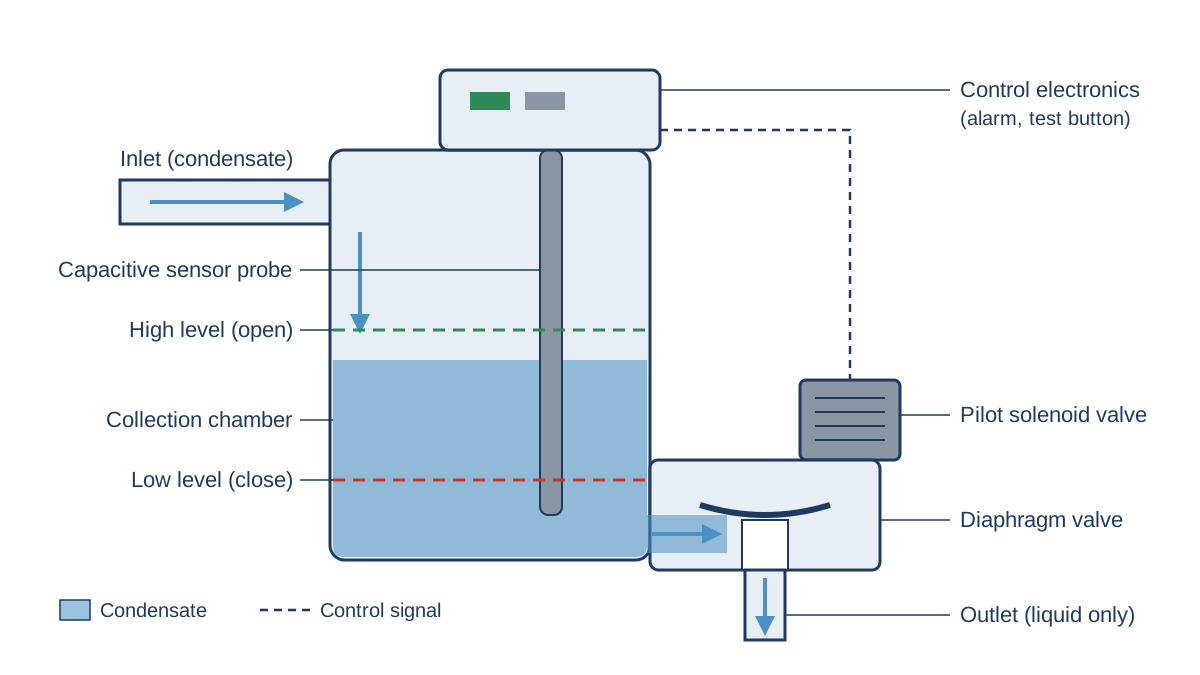
Most electronic zero air loss drains share a similar layout. Condensate runs by gravity into a small collection chamber fitted with a sensor probe. A control board reads the probe and switches a small pilot solenoid, and the pilot in turn operates a larger diaphragm valve on the outlet. The arrangement means the drain responds to the amount of liquid actually present, not to a clock.
Sensing the condensate level
The sensor is the heart of the drain. Many designs use a capacitive probe, which detects the change in electrical capacitance as liquid rises around it and works with two set points: a high level that starts a discharge and a low level that ends it (BEKO Technologies n.d.-a). Because the probe has no moving parts, it is less prone to sticking in dirty, oily condensate than a mechanical float. Other manufacturers reach the same result by different means, and Parker Hannifin (n.d.) describes a non-wearing level control on its electronic drains.
Pilot solenoid and diaphragm valve
The electronics do not open the main outlet directly. Instead they energise a small pilot solenoid, which uses system pressure to lift a diaphragm off its seat and open the discharge line (BEKO Technologies 2016). This two-stage approach lets a small, low-power solenoid control a valve with a generous flow path, which suits condensate that may carry rust, scale and oil sludge.
The cycle: fill, discharge, close
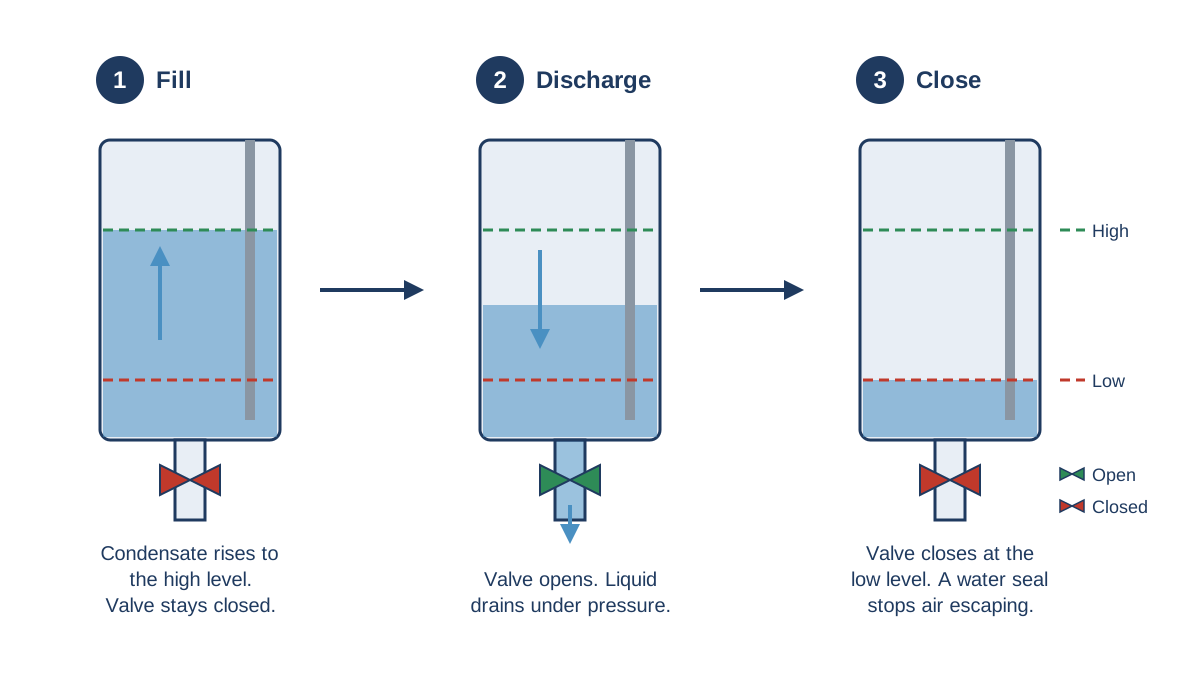
A working drain repeats a simple three-step cycle. Condensate first collects in the chamber while the valve stays closed. When the liquid reaches the high level, the electronics open the valve and system pressure pushes the condensate out. As the level falls to the low set point, the valve shuts again. Some liquid remains over the outlet, and that small water seal is what stops compressed air from following the condensate out of the drain.
How it compares with timer and float drains
Timer drains are cheap and simple, but they open on a fixed schedule whether or not there is any condensate to remove. They will operate even when the chamber is empty, venting compressed air each time (US Department of Energy 2016). The loss adds up quickly. Parker Hannifin (2018) estimates that a timed drain opening for 5 seconds every 10 minutes can lose around 1 m³ of air per hour, and its settings need seasonal adjustment as condensate loads change between summer and winter.
Float drains also respond to liquid level and waste no air when they work properly. Their weakness is the moving float and linkage, which can clog with sediment and stick either open or closed (US Department of Energy 2004). Electronic level-sensing drains avoid that failure mode, at the cost of needing power and periodic servicing. For new installations, the NSW Office of Environment and Heritage (2017) recommends sensing drains where the budget allows, because electronic versions have the fastest valve action and waste the least air. For a sense of what escaping air costs over a year, see How much do compressed air leaks cost?
| Drain type | How it opens | Typical drawback |
|---|---|---|
| Manual valve | An operator opens it | Often left open, wasting air |
| Timer solenoid | Fixed interval and open time | Opens even when little or no condensate is present |
| Float drain | A float lifts at a set level | Can stick open or closed if fouled by sediment |
| Electronic level-sensing | Sensor detects the high level | Needs power and periodic servicing |
Alarm and test functions
Most electronic drains also help maintenance staff spot problems before they become floods. A test button lets you check that the valve opens, although it is intended for checks and not for continuous draining (BEKO Technologies 2016). Many models add an alarm output that signals when the drain cannot clear its chamber, and some pair this with an integrated strainer to protect the valve (Parker Hannifin n.d.).
Where zero air loss drains are used
A drain belongs at each point where condensate collects. In a typical system that means the aftercooler or moisture separator outlet, the air receiver, each filter housing (coalescing filters in particular) and the separator in a refrigerated dryer. Manufacturers offer versions for different conditions. Atlas Copco (n.d.), for example, lists drains for oil-contaminated condensate alongside coated models for oil-free or aggressive condensate. Matching capacity, pressure rating and condensate type to each location is what keeps the system reliable.
Receiver drains and Australian inspection requirements
An automatic drain helps control corrosion in an air receiver, but it does not replace inspection of the vessel. Safe Work Australia (2015) calls for periodic internal and external inspection by a competent person, points to AS/NZS 3788 for in-service inspection, and notes that a receiver may need registration under the Work Health and Safety Regulations depending on its hazard level under AS 4343. In Western Australia, a safety alert on a ruptured air receiver listed inadequate inspection and maintenance among the contributing factors and recommended regular inspection in line with AS/NZS 3788 (WorkSafe WA 2020). Check your registration and inspection obligations with the regulator in your state.
Common installation and maintenance mistakes
Most drain problems trace back to installation. One drain should serve one collection point, and the inlet line needs a continuous fall with no water pockets, or a vent line where that is not possible (BEKO Technologies n.d.-b). Sharing a drain between several points, or running the inlet pipe uphill, leaves condensate trapped where it can do damage.
Maintenance matters too. Scale and sludge can block the valve, which is why a strainer before the drain is recommended to stop the valve seat being held open or closed (NSW Office of Environment and Heritage 2017). The strainer needs regular cleaning, and diaphragms and seals wear over time. Replacing the service unit or kit on the manufacturer's schedule keeps the drain closing cleanly. Finally, oily condensate typically needs treatment before it reaches the sewer, which is the job of an oil-water separator.
Key takeaways
- A zero air loss drain opens only when its sensor detects liquid at a high level.
- A pilot solenoid operates a diaphragm valve, which closes while liquid still covers the outlet.
- Timer and manual drains commonly waste compressed air, and float drains can stick if fouled.
- Fit one drain per collection point, with a continuous fall on the inlet line.
- An automatic receiver drain does not replace in-service inspection of the vessel under AS/NZS 3788.
Frequently asked questions
Does a zero air loss drain need electricity?
Electronic level-sensing drains need power for the sensor and solenoid. Some float drains also operate without air loss and need no power, although they carry the sticking risk described above.
Can I discharge drain condensate into the sewer?
Not without checking first. Condensate from lubricated compressors contains oil, and the sewage authority should be consulted before any discharge (US Department of Energy 2016). In Australia that means your water utility. In Western Australia, for example, Water Corporation (n.d.) requires a trade waste permit before a business discharges wastewater other than from office facilities or staff amenities.
How often should a zero air loss drain be serviced?
It depends on the model and the quality of the condensate. Follow the manufacturer's service interval and act on any alarm or service indicator.
Related Ultramax products
- Electronic level-sensing drains with alarm: zero air loss drains for receivers, filters and dryers.
- Air saving products: drains that discharge only liquid.
- Condensate drains: float and other drain types.
- Timed solenoid drains: including combination strainer valves.
References
- Atlas Copco. n.d. "Condensate Drains: WSD, EWD, WD and TWD." Accessed 13 October 2026. https://atlascopco.com/en-us/compressors/products/condensate-treatment/wsd-ewd-wd-twd1.
- BEKO Technologies. n.d.-a. "Condensate Drains (BEKOMAT)." Accessed 13 October 2026. https://beko-technologies.com/en-gb/products/condensate-technology/condensate-drains.
- BEKO Technologies. n.d.-b. BEKOMAT 31U: Instructions for Installation and Operation. Hosted by ManualsLib. Accessed 13 October 2026. https://www.manualslib.com/manual/2398296/Beko-Bekomat-31u.html.
- BEKO Technologies. 2016. Instructions for Installation and Operation: Service-Unit BEKOMAT 31U / 31U F. Neuss: BEKO Technologies. https://www.beko-technologies.com/fileadmin/beko-technologies.com/EN/manuals_en/bekomat_su/bekomat_31u_f_s-unit_manual_en_01-1610_v01.pdf.
- NSW Office of Environment and Heritage. 2017. Low Capital Cost, Simple Solutions to Improve the Efficiency of Your Compressed Air System. OEH2017/0257. Hosted by Energy NSW. https://www.energy.nsw.gov.au/sites/default/files/2022-08/2017_NSW_CompressedAirGuidepdf.pdf.
- Parker Hannifin. n.d. "ED3000 Series Electronic Level Sensing Condensate Drain." Accessed 13 October 2026. https://ph.parker.com/us/en/ed3030-g230.
- Parker Hannifin. 2018. Zero Loss Condensate Drains and Oil/Water Separators. Brochure BROCONDENSATE-00-EN. https://pharmaceutical.yodify.com/Documentation/Document/XVwyR/BROCONDENSATE-00-EN.pdf.
- Safe Work Australia. 2015. Compressed Air and Air Receiver Information Sheet. https://www.safeworkaustralia.gov.au/system/files/documents/1703/compressed-air-information-sheet.pdf.
- US Department of Energy. 2004. Energy Tips: Compressed Air, Tip Sheet #13. Washington, DC: Industrial Technologies Program. https://www.energy.gov/sites/prod/files/2014/05/f16/compressed_air13.pdf.
- US Department of Energy. 2016. Improving Compressed Air System Performance: A Sourcebook for Industry. 3rd ed. Washington, DC: US Department of Energy and Compressed Air Challenge. https://www.energy.gov/sites/prod/files/2016/03/f30/Improving%20Compressed%20Air%20Sourcebook%20version%203.pdf.
- Water Corporation. n.d. "Trade Waste." Accessed 14 October 2026. https://www.watercorporation.com.au/Help-and-advice/Trade-waste.
- WorkSafe WA. 2020. "Safety Alert 02/2020: Pressure Vessel Failure Injures Worker." Updated 25 November 2024. Accessed 14 October 2026. https://worksafe.wa.gov.au/publications/safety-alert-022020-pressure-vessel-failure-injures-worker.
This article is general information only. Check manufacturer documentation and applicable Australian Standards for your installation.