
Refrigerated vs Desiccant Dryers: Which do you need?
Ultramax Systems on 16th Oct 2026
Short answer: A refrigerated dryer suits most workshops and factories where pipes stay above freezing and a pressure dew point of about +3 °C is dry enough. A desiccant dryer suits air that must stay dry below that, such as outdoor lines in cold areas, instrument air and sensitive processes. Desiccant drying costs much more to run, so choose it only where you need it.
How each dryer works
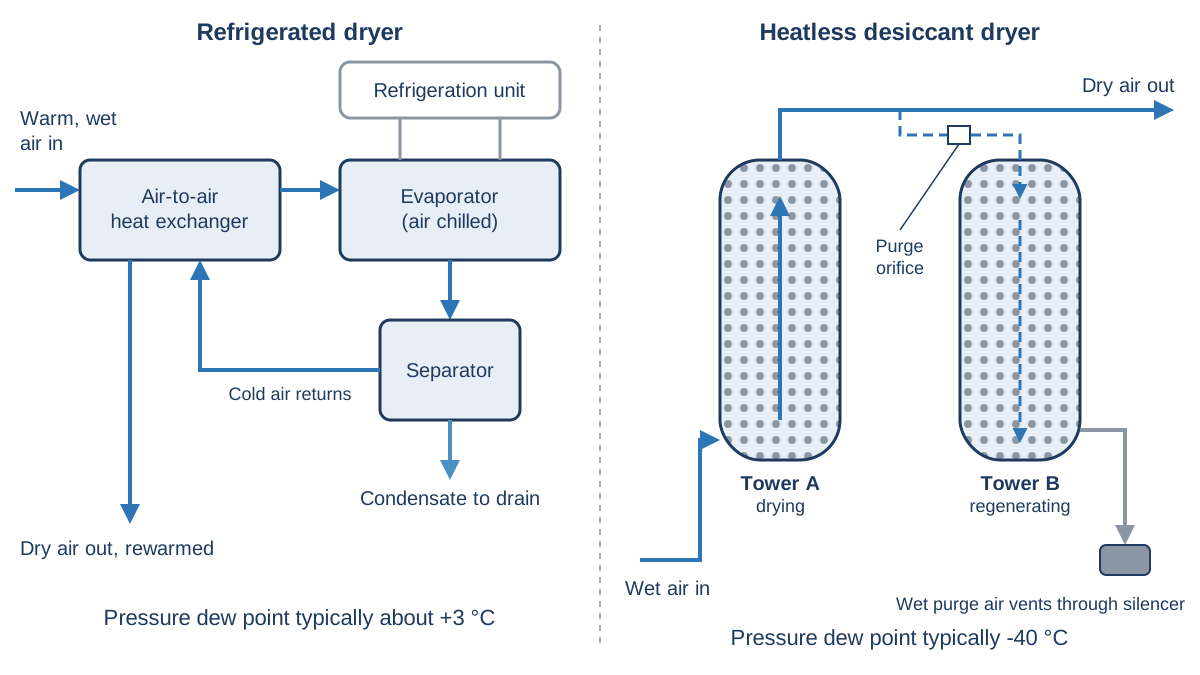
A refrigerated dryer cools the compressed air until much of its water vapour condenses. The air first passes through an air-to-air heat exchanger, then through an evaporator chilled by a refrigeration circuit. A separator and drain remove the liquid. The cold, dry air then rewarms in the heat exchanger as it pre-cools the incoming air. Because water would freeze on the evaporator, it should not run below 0 °C (Natural Resources Canada 2014). That sets the dryer's practical floor at a pressure dew point of a few degrees above zero.
A desiccant dryer works by adsorption. Wet air passes up through a tower packed with desiccant beads, which hold water vapour on their surface. A second tower regenerates at the same time, then the two swap roles. In a heatless design, some of the dried air is expanded through an orifice and blown back through the regenerating tower, carrying the moisture out to atmosphere. Heated and blower purge designs use heat instead.
Refrigerated vs desiccant dryers at a glance
| Factor | Refrigerated dryer | Desiccant dryer |
|---|---|---|
| Typical pressure dew point | About +2 to +3 °C | About -40 °C, with -70 °C possible |
| Typical ISO 8573-1 water class | Class 4 (+3 °C) | Class 2 (-40 °C) or Class 1 (-70 °C) |
| Compressed air used for drying | None | Heatless: about 15 to 20% of rated flow; heated and blower types use less or none |
| Running cost | Low | Several times higher |
| Main consumables | Filters, drain service | Desiccant, pre-filter and after-filter elements, valves |
| Sensitivity to heat | Capacity falls in hot rooms and with hot inlet air | Also needs cool inlet air; hot air overloads the bed |
| Below-freezing pipework | Not suitable | Suitable |
Pressure dew point capability
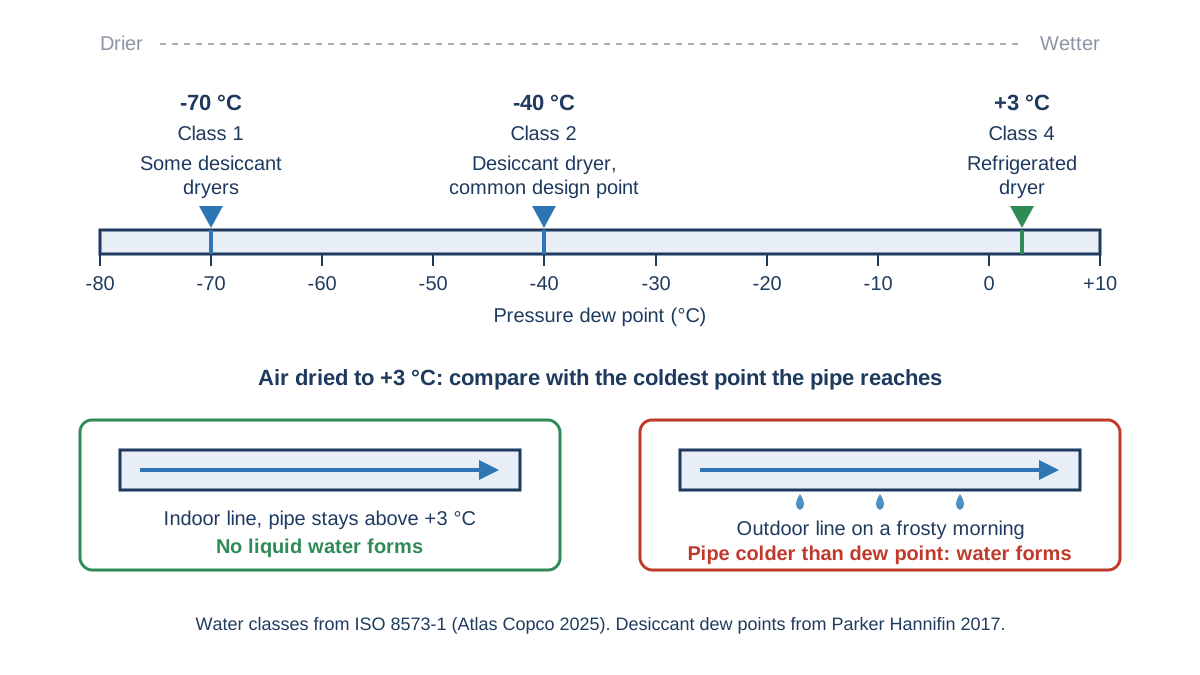
Natural Resources Canada (2014) puts the usual outlet dew point of a refrigerated dryer at about 2 °C or higher. Desiccant dryers reach well below freezing. A pressure dew point of -40 °C is a common design point, and some dryers reach -70 °C (Parker Hannifin 2017). ISO 8573-1 expresses this as water classes. Class 4 allows a pressure dew point of +3 °C, Class 2 allows -40 °C and Class 1 allows -70 °C (Atlas Copco 2025). For background, see What is Pressure Dew Point? and ISO 8573-1 purity classes explained.
The key test is the coldest temperature your air will meet, because liquid water forms wherever a pipe drops below the pressure dew point. A +3 °C dew point is fine indoors in most Australian workshops, but not in a line that runs outside on a frosty morning.
Energy use and purge loss
An uncontrolled heatless desiccant dryer uses about 15 to 20% of its nameplate rating as purge air, which costs about 6.4 to 8.5 kW per 100 L/s of rating (3 to 4 kW per 100 cfm; Natural Resources Canada 2014). A refrigerated dryer uses about 1.7 kW per 100 L/s (0.8 kW per 100 cfm), including the compressor power needed to overcome its pressure drop (Marshall 2014). Per m³/min of rating, that is roughly 1.1 to 1.4 kW for heatless drying against 0.3 kW for refrigerated drying.
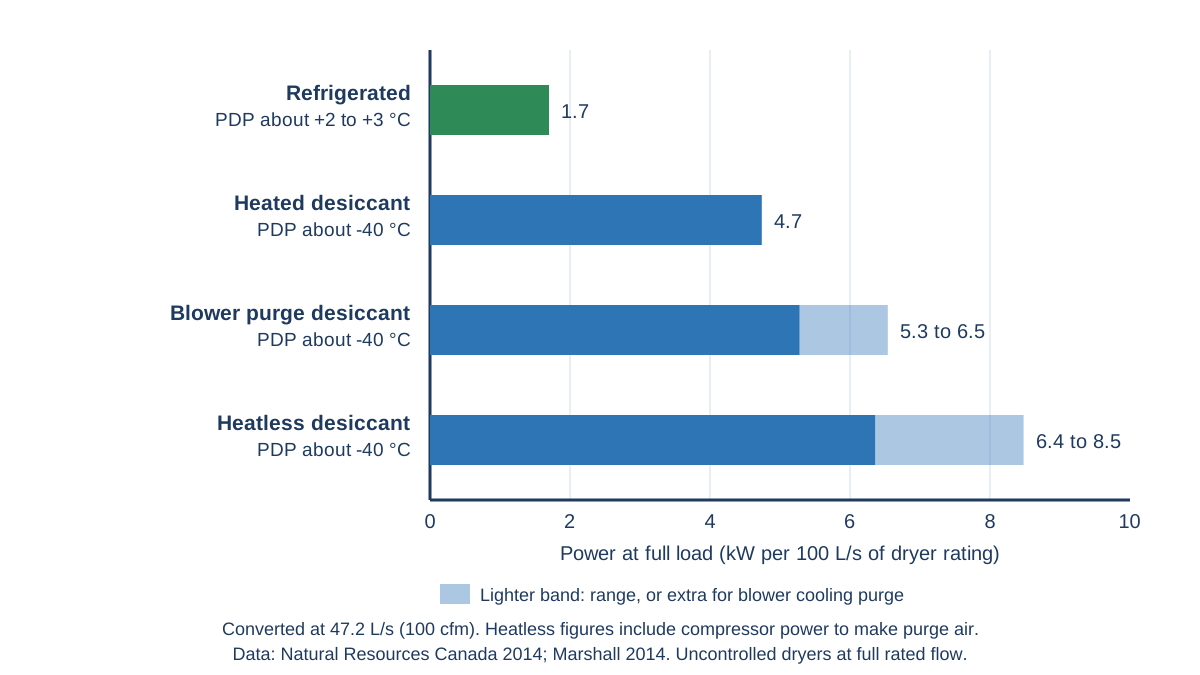
Part load makes the gap wider. Marshall (2014) shows that a heatless dryer running at half its rated flow still purges the same air, so purge rises to 30 to 40% of the actual flow. Overall, drying to -40 °C can cost 5 to 10 times as much as drying to +2 °C (Natural Resources Canada 2014). Over-specifying dew point is an expensive habit.
Sensitivity to inlet temperature and Australian heat
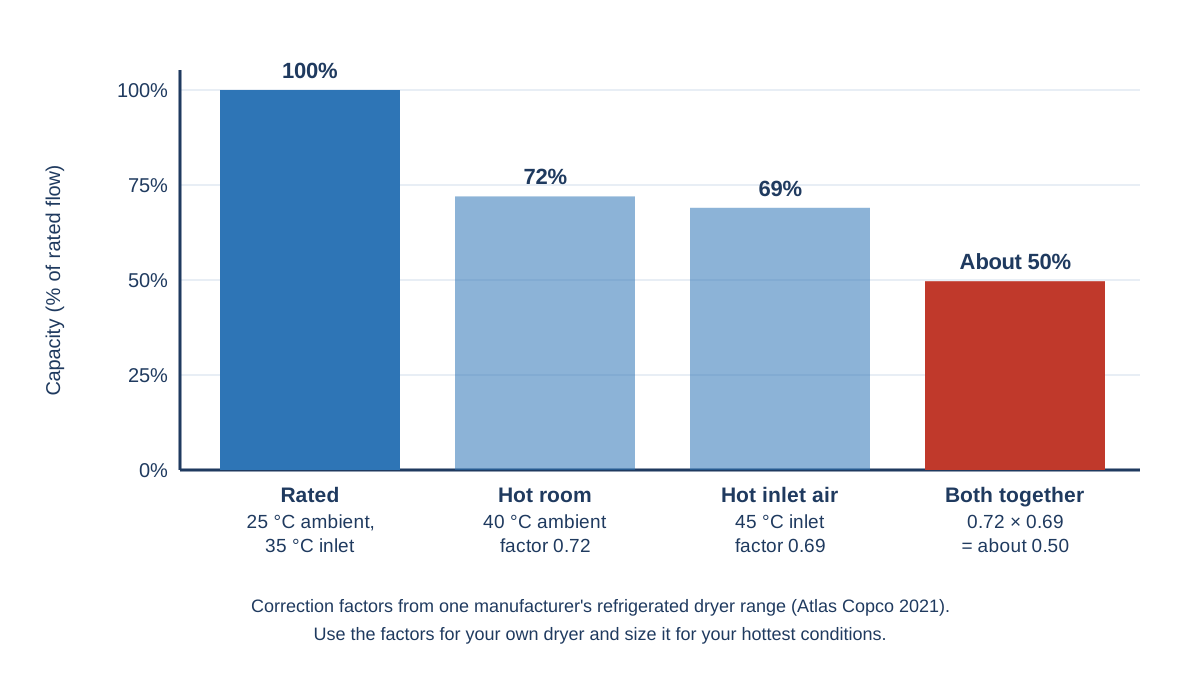
Dryer ratings assume mild conditions. One manufacturer rates its refrigerated range at 25 °C ambient and 35 °C inlet air. At 40 °C ambient its capacity factor drops to 0.72, and at 45 °C inlet air the factor is 0.69 (Atlas Copco 2021). Applied together, those two factors would leave about half the rated capacity. A hot Australian summer can turn a correctly sized dryer into an undersized one.
Desiccant dryers are not immune. Inlet air above about 38 °C will generally overload air dryers and cause moisture problems (Natural Resources Canada 2014). Ventilate the compressor room and size either dryer for your hottest conditions. A water separator ahead of the dryer removes bulk liquid so the dryer only handles vapour.
Maintenance
A refrigerated dryer mainly needs clean condenser fins, a working drain and filter changes. A desiccant dryer needs more care. The US Department of Energy (2016) recommends a coalescing filter before a desiccant dryer to stop oil fouling the bed, and a particulate filter after it to catch desiccant fines. Desiccant also wears out: Atlas Copco (n.d.) gives a typical service interval of 3 to 5 years in normal conditions, while heat-regenerated dryers can need fresh desiccant sooner, often after 2 to 3 years (Ceccato Australia n.d.). Desiccant dryer kits cover these service items.
When to choose a refrigerated dryer
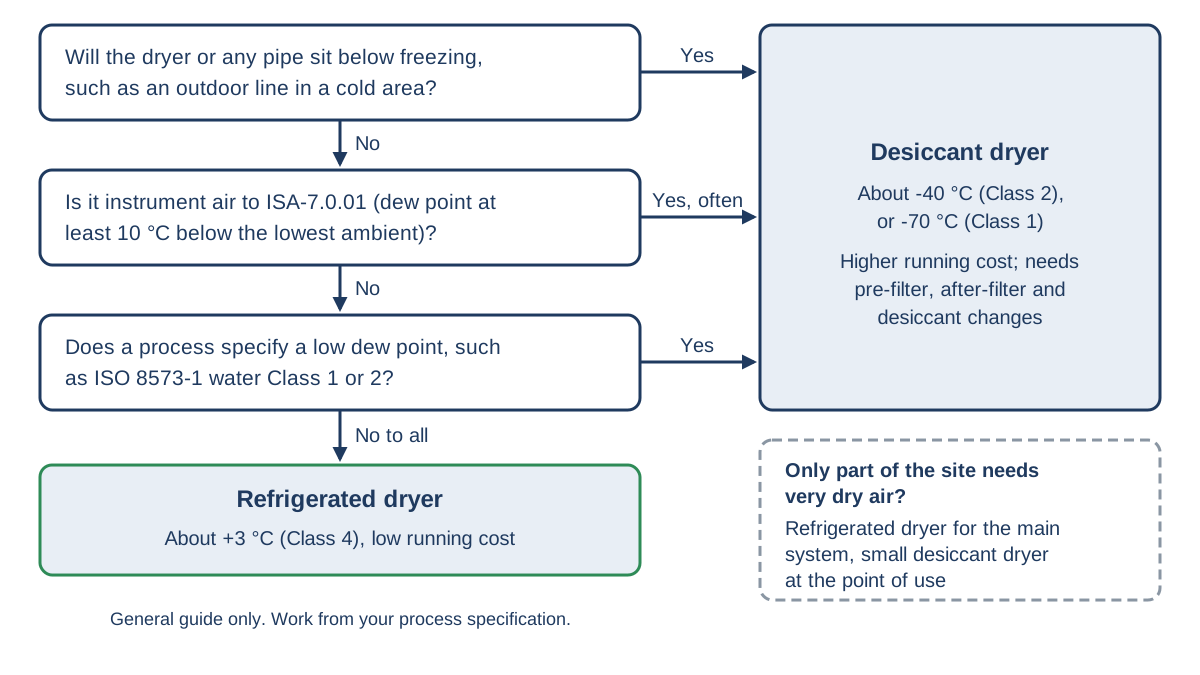
Choose a refrigerated dryer for general workshop and factory air where all pipework stays indoors and above freezing. That covers most air tools and general production air. Seeing water at the tool anyway? See water in air tools.
When to choose a desiccant dryer
Outdoor lines in cold areas
Parts of Australia get cold enough to freeze a line dried to +3 °C. At Canberra Airport, for example, the minimum falls to 2 °C or lower (the threshold for possible frost) on an average of 57 winter nights, according to the Bureau of Meteorology (2017). Refrigerated dryers are not recommended where the dryer itself sits in sub-freezing ambient conditions (US Department of Energy 2016).
Instrument air
The ISA-7.0.01 instrument air standard calls for a pressure dew point at least 10 °C below the lowest ambient temperature any part of the system sees, and not above 4 °C at line pressure (D'Orazio 2026). That often points to desiccant drying.
Breathing air, food and pharmaceutical air
In Australia, Appendix A of AS/NZS 1715 sets air quality requirements for compressors and cylinders supplying supplied-air respirators (AS/NZS 1715:2009). WorkSafe Queensland (n.d.) notes that those requirements cover moisture as well as oxygen, carbon monoxide and carbon dioxide. Food and pharmaceutical processes usually specify an ISO 8573-1 water class, so work from that specification with your process owner.
Cost of ownership
A desiccant dryer adds purge or heater energy, desiccant changes and extra filter elements to the bill. Where only part of a site needs very dry air, a common approach is a refrigerated dryer for the main system and a small desiccant dryer at the point of use.
Key takeaways
- Refrigerated dryers typically reach about +3 °C pressure dew point; desiccant dryers reach about -40 °C or lower.
- An uncontrolled heatless dryer uses about 15 to 20% of its rated flow as purge air.
- Hot rooms and hot inlet air cut refrigerated dryer capacity, so apply the maker's correction factors.
- Use desiccant drying for frost-exposed lines, instrument air and processes that specify a low dew point.
- Desiccant dryers need pre-filters, after-filters and periodic desiccant replacement.
Frequently asked questions
Can a refrigerated dryer reach -40 °C?
No. The evaporator must stay above freezing, so a refrigerated dryer cannot reach desiccant dew points.
Can I reduce a heatless dryer's purge loss?
Yes. Dew point demand controls cut purge at part load.
Related reading
- What is Pressure Dew Point?
- ISO 8573-1 purity classes explained
- Coalescing filters explained
- Screw vs Piston Compressor: Which suits your Workshop?
References
- Atlas Copco. n.d. "Winter Discount on Desiccant Changes and Desiccant Dryer Spare Parts." Accessed 15 October 2026. https://atlascopco.com/en-uk/compressors/News-and-stories/desiccant-dryers.
- Atlas Copco. 2021. Compressed Air Dryers: F-Series Refrigerant Dryers. Leaflet. Atlas Copco Australia. https://atlascopco.com/content/dam/atlas-copco/local-countries/australia/documents/ct-brochures/Atlas-Copco-Dryers-F6-400-Leaflet.pdf.
- Atlas Copco. 2025. "Understanding ISO 8573-1:2010 Compressed Air Quality Classes." Atlas Copco Australia. Accessed 15 October 2026. https://www.atlascopco.com/en-au/compressors/air-compressor-blog/understanding-iso-classes-for-compressed-air-quality.
- Bureau of Meteorology. 2017. "Australian Capital Territory in Winter 2017: Dry Season with Warm Days and Cool Nights." Seasonal Climate Summary, 1 September 2017. Accessed 15 October 2026. https://www.bom.gov.au/climate/current/season/act/archive/201708.summary.shtml.
- Ceccato Australia. n.d. "What to Know about Desiccant Dryers." Accessed 15 October 2026. https://ceccato.com/en-au/blog/guide-on-compressed-air-treatment/what-to-know-about-desiccant-dryers.
- D'Orazio, Joe. 2026. "Understanding ISA-7.0.01-1996 Instrument Air Standard." Compressed Air Best Practices, 25 August 2026. Accessed 15 October 2026. https://www.airbestpractices.com/standards/iso-and-cagi/understanding-isa70011996-instrument-air-standard.
- Marshall, Ron. 2014. "Desiccant Dryers: Ten Lessons Learned." Compressed Air Best Practices, 24 March 2014. Compressed Air Challenge. Accessed 15 October 2026. https://www.airbestpractices.com/system-assessments/air-treatmentn2/desiccant-dryers-ten-lessons-learned.
- Natural Resources Canada. 2014. "Energy Efficiency Reference Guide: Compressed Air." Last modified 14 January 2025. Accessed 15 October 2026. https://natural-resources.canada.ca/energy-efficiency/energy-star/energy-efficiency-reference-guide-compressed-air.
- Parker Hannifin. 2017. Focused on Compressed Air and Gas Treatment. Brochure BROFOCAGT-01-EN. Parker domnick hunter. https://pharmaceutical.yodify.com/Documentation/Document/emYX1/322838-FOCUSED-ON-Compressed-Air-and-Gas-Treatment-English-PDF-3.pdf.
- Standards Australia. 2009. AS/NZS 1715:2009 Selection, Use and Maintenance of Respiratory Protective Equipment. Standards Australia and Standards New Zealand. https://store.standards.org.au/product/as-nzs-1715-2009.
- US Department of Energy. 2016. Improving Compressed Air System Performance: A Sourcebook for Industry. 3rd ed. Washington, DC: US Department of Energy and Compressed Air Challenge. https://www.energy.gov/sites/prod/files/2016/03/f30/Improving%20Compressed%20Air%20Sourcebook%20version%203.pdf.
- WorkSafe Queensland. n.d. "Carbon Monoxide in Breathing Air During Air Compressor Use." Accessed 15 October 2026. https://www.worksafe.qld.gov.au/safety-and-prevention/hazards/hazardous-exposures/carbon-monoxide-in-breathing-air-during-air-compressor-use.
This article is general information only. Check manufacturer documentation and applicable Australian Standards for your installation.