
On-site Nitrogen vs Bottled Nitrogen: Which suits your Site?
Ultramax Systems on 26th Oct 2026
Short answer: Bottled nitrogen in high-pressure cylinders or manifold packs suits low, irregular or mobile demand, where a generator would take too long to pay back. Bulk liquid suits high, continuous demand and very high purity. On-site generation suits steady demand at the purity you actually need, because you make the gas from compressed air instead of paying for deliveries, rental and purity you may not use.
Three ways to supply nitrogen
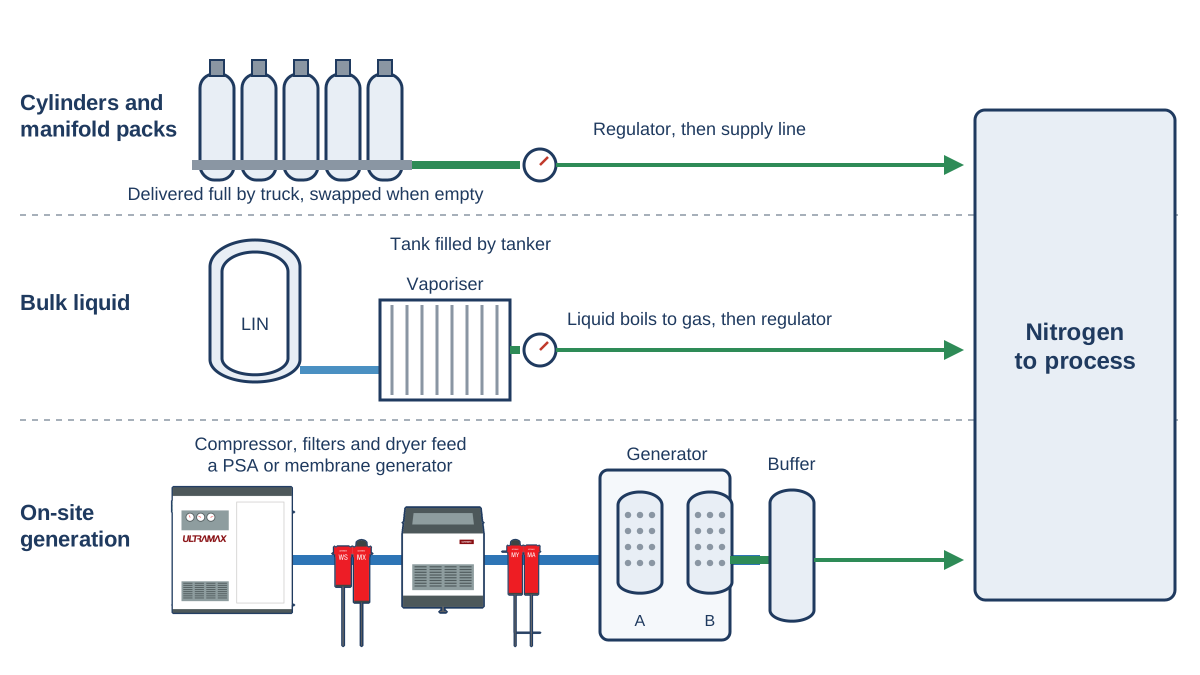
Most sites get nitrogen in one of three ways. High-pressure cylinders arrive full and are swapped when empty, either singly or as manifolded packs of 12 cylinders for steadier use (Coregas n.d.-a). Bulk liquid nitrogen arrives by tanker and goes into an insulated tank on site, and a vaporiser turns it back into gas. On-site generation starts with compressed air. A pressure swing adsorption (PSA) or membrane generator separates nitrogen from the oxygen in the air, and a buffer receiver stores the product.
With cylinders and liquid, you buy a finished product. With a generator, you own the plant, pay for the electricity and maintain the compressor, filters and dryer that feed it. For how a generator separates the gas, see How does a PSA Nitrogen Generator work?
On-site vs bottled nitrogen at a glance
| Factor | Cylinders and packs | Bulk liquid | On-site generator |
|---|---|---|---|
| Typical demand | Low, intermittent or mobile | High and continuous | Steady, from low to high |
| Purity | Set by the grade you buy | Very high | Adjustable, typically 95% to 99.999% for PSA |
| Main cost drivers | Gas price, cylinder rental, delivery, handling | Gas price, tank rental, delivery, evaporation | Capital, electricity for compressed air, maintenance |
| Supply risk | Running out between deliveries | Running out between deliveries | Compressor, power or air treatment failure |
| Main hazards | High stored pressure, heavy cylinders, oxygen depletion | Cold burns, rapid expansion, oxygen depletion | Pressure equipment, oxygen depletion |
Cost drivers
Purchased gas bills also cover cylinder or tank rental, delivery and handling, and Atlas Copco (n.d.-a) lists evaporation from liquid storage as another hidden cost. A generator swaps those for capital, electricity and maintenance. Electricity usually dominates: energy makes up to 85% of the total cost of compressed air (NSW Office of Environment and Heritage 2017).
Purity drives the energy bill. A generator needs more compressed air for each cubic metre of nitrogen as purity rises, a ratio known as the air factor. Air consumption data for one maker's twin-bed PSA range works out at roughly 2 m³ of air per m³ of nitrogen at 95% purity, about 3.7 at 99.9% and about 16 at 99.999% (Parker Hannifin 2018). Atlas Copco (n.d.-a) gives up to 12 for PSA at 99.999%. Specify the lowest purity your process genuinely needs.
Scale usually decides the answer. Atlas Copco (n.d.-a) suggests that generation becomes especially cost-effective above about 20,000 to 30,000 m³ of nitrogen a year, often with a return on investment within two years. Treat that vendor estimate as a starting point.
An illustrative example
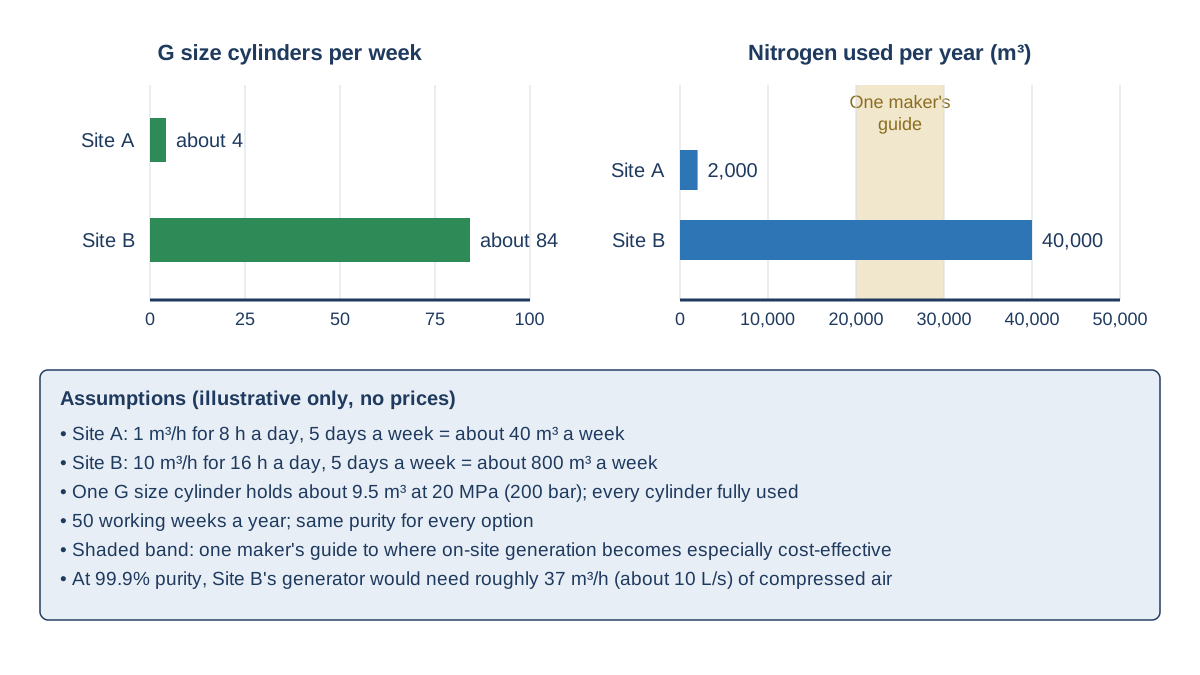
The example below compares two sites on cylinder supply. It assumes G size cylinders holding about 9.5 m³ of gas each (Coregas n.d.-b), fully used, over 50 working weeks a year. Site A uses 1 m³/h for 8 hours a day, 5 days a week: about 4 cylinders a week and 2,000 m³ a year. Site B uses 10 m³/h for 16 hours a day: roughly 84 cylinders a week and 40,000 m³ a year, where liquid supply or a generator deserves a costed quote. At 99.9% purity and an air factor of about 3.7, Site B's generator would need roughly 37 m³/h, or about 10 L/s, of compressed air.
Purity
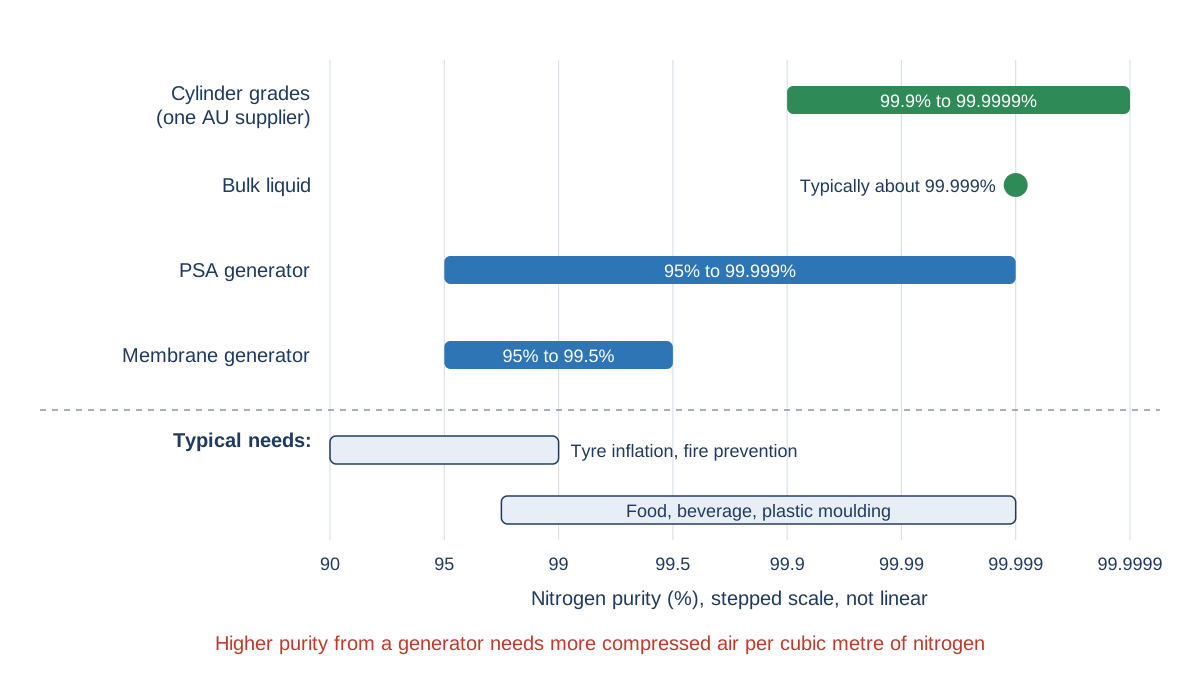
Bottled nitrogen comes in fixed grades. Coregas (n.d.-a) lists industrial grades of 99.9% and 99.99% and a laboratory grade of 99.999%, and its flyer adds a 99.9999% grade (Coregas n.d.-b). Purchased gas is almost always ultra-high purity, so many users pay for purity they do not need (Atlas Copco n.d.-a).
A generator lets you choose. PSA units typically produce 95% to 99.999% nitrogen, while membrane units cover about 95% to 99.5%. Tyre inflation and fire prevention typically need 90% to 99%, while food, beverage and plastic moulding uses range from 97% to 99.999% (Atlas Copco n.d.-b).
Flow and demand pattern
Single cylinders suit low, intermittent or mobile use, and a 12-cylinder pack suits steady, moderate demand. A liquid tank is often the most cost-effective option for high demand, such as continuous laser cutting (Coregas n.d.-a). A generator is sized for a steady output at a set purity. A buffer receiver after the generator carries short peaks, and the generator refills it between them.
Reliability
Purchased gas fails when a delivery is late or stock runs out. A generator fails when its compressor, power supply or air treatment fails. Many sites with critical processes keep a small cylinder bank as backup.
Generator reliability rests on clean, dry feed air. The carbon molecular sieve in a PSA generator is particularly sensitive to moisture and oil (Atlas Copco n.d.-b), so the filters and dryer ahead of it need scheduled service. Ultramax supplies replacement filter elements for Oxair and On Site Gases generators. Filtration for Nitrogen Generators: Protecting the Sieve Beds explains the pre-treatment train in detail.
Safety
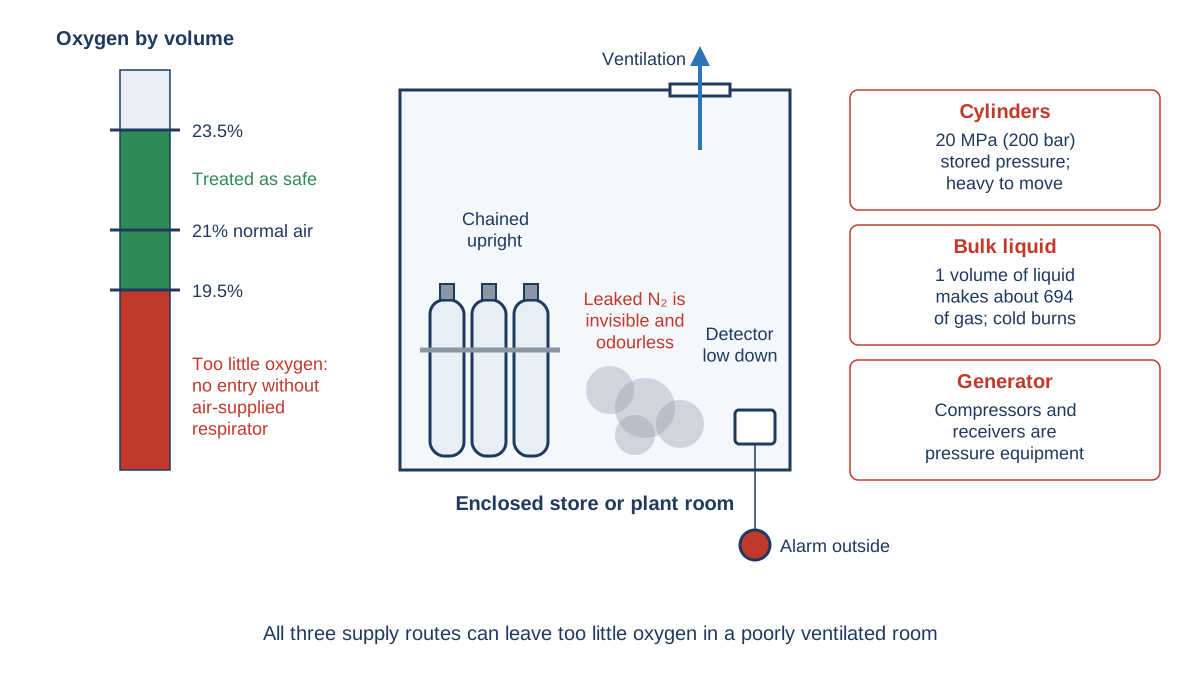
Nitrogen is colourless and odourless, and it harms people by displacing oxygen. SafeWork NSW (2019) warns that leaks from nitrogen and carbon dioxide cylinders in enclosed cellars and cool rooms can overcome workers before they notice. Its controls include ventilated storage, secured upright cylinders, leak tests and a low-mounted gas detector with an alarm outside the room. The WorkSafe WA (2022) confined spaces code treats 19.5% to 23.5% oxygen by volume as safe, and it notes that purging with an inert gas such as nitrogen can displace oxygen.
Each route also brings its own hazards. A G size cylinder is filled to about 20 MPa (200 bar) (Coregas n.d.-b), so a damaged valve can release a lot of energy, and full cylinders are heavy to move. AS 4332 sets out requirements and recommendations for storing and handling gases in cylinders (Australian Business Licence and Information Service n.d.). Liquid nitrogen adds cold burns and rapid expansion, since one volume of liquid becomes about 694 volumes of gas at 20 °C (US Department of Agriculture 2016). A generator's compressors and receivers are pressure equipment needing the usual plant checks. Ask a competent person to assess ventilation and oxygen monitoring for your site.
Space and installation
Cylinders need a secure, ventilated store and delivery access. A liquid tank needs a pad, the supplier's separation distances and tanker access. A generator needs plant room space for the compressor, treatment, generator and receivers. Atlas Copco (n.d.-b) gives a typical PSA operating window of 400 to 1,300 kPa (4 to 13 bar) inlet pressure and 10 to 25 °C, so a hot, unventilated shed is a poor location.
Which suits your site?
Choose cylinders for low, irregular or mobile use, laboratory grades and backup. Choose bulk liquid for high, continuous demand or very high purity. Consider a generator when demand is steady, the purity you need sits within its range and you have spare compressed air capacity or room for a dedicated compressor. If generation looks right, Ultramax's gas generation division, Ultramax Gas Generation Systems, designs, supplies, installs and services on-site nitrogen generators. Equipment hire is also available, which can be a practical way to trial generation first. Measure actual use before getting quotes. For compressor sizing, see How to size an Air Compressor for your Application.
Key takeaways
- Cylinders suit low, irregular or mobile demand; bulk liquid suits high, continuous demand.
- A generator suits steady demand at the purity you actually need.
- Generator running cost rises steeply with purity.
- One maker puts the sweet spot for generation above about 20,000 to 30,000 m³ a year.
- Every route can deplete oxygen in a poorly ventilated room.
Frequently asked questions
Can a nitrogen generator reach 99.999% purity?
Some PSA generators can, but they need far more compressed air per cubic metre of nitrogen at that level. Check whether your process really needs it.
Can I run a generator from my existing compressor?
Possibly, if the compressor has spare capacity and the air meets the generator maker's inlet quality, pressure and temperature limits. Check both before you buy.
Related reading
- How does a PSA Nitrogen Generator work?
- Filtration for Nitrogen Generators: Protecting the Sieve Beds
- Adsorption vs Absorption: What is the Difference?
References
- Atlas Copco. n.d.-a. "How Nitrogen and Oxygen Purity Affect Costs." Atlas Copco Australia. Accessed 26 October 2026. https://atlascopco.com/en-au/compressors/wiki/compressed-air-articles/nitrogen-oxygen-purity-cost.
- Atlas Copco. n.d.-b. "PSA Nitrogen Generator: How Pressure Swing Adsorption Works." Atlas Copco UK. Accessed 26 October 2026. https://www.atlascopco.com/en-uk/compressors/wiki/compressed-air-articles/pressure-swing-adsorption-generator.
- Australian Business Licence and Information Service. n.d. "AS 4332 The Storage and Handling of Gases in Cylinders: Western Australia." Accessed 26 October 2026. https://ablis.business.gov.au/service/wa/as-4332-the-storage-and-handling-of-gases-in-cylinders/30764.
- Coregas. n.d.-a. "Nitrogen Gas." Accessed 26 October 2026. https://www.coregas.com.au/gases/nitrogen-gas.
- Coregas. n.d.-b. Nitrogen 4.0, 5.0, 6.0. Product flyer. Hosted by Caddy Storage. https://caddystorage.com.au/wp-content/uploads/2019/06/Nitrogen-4.0-5.0-6.0-Flyer.pdf.
- NSW Office of Environment and Heritage. 2017. Low Capital Cost, Simple Solutions to Improve the Efficiency of Your Compressed Air System. OEH2017/0257. Hosted by Energy NSW. https://www.energy.nsw.gov.au/sites/default/files/2022-08/2017_NSW_CompressedAirGuidepdf.pdf.
- Parker Hannifin. 2018. Dual-Bed Nitrogen Generation Systems, Models DB-1200 to DB-4000: Installation, Operation and Maintenance Manual. Bulletin TI-DB1200-4000, rev. 4. https://www.parker.com/content/dam/Parker-com/Literature/IGFG/PDF-Files/PKR_IOM_DB1200_4000rev4DualBedN2GenSys.pdf.
- SafeWork NSW. 2019. "Cellar Safety: Exposure to Gases." Safety alert, 20 May 2019. Accessed 26 October 2026. https://www.safework.nsw.gov.au/safety-alerts/safety-alerts/gases-in-cellars-and-cool-rooms.
- US Department of Agriculture. 2016. "Liquid Nitrogen Safety." Agricultural Research Service. Last modified 12 August 2016. Accessed 26 October 2026. https://www.ars.usda.gov/northeast-area/docs/safety-health-and-environmental-training/liquid-nitrogen-safety/.
- WorkSafe WA. 2022. Confined Spaces: Code of Practice. Department of Mines, Industry Regulation and Safety, Government of Western Australia. https://www.worksafe.wa.gov.au/system/files/migrated/sites/default/files/atoms/files/221172_cp_confinedspaces.pdf.
This article is general information only. Check manufacturer documentation and applicable Australian Standards for your installation.