
Adsorption vs Absorption: What is the Difference?
Ultramax Systems on 26th Oct 2026
Short answer: Adsorption is when molecules of a gas or liquid collect on the surface of a solid, including the walls of its pores. Absorption is when a substance is taken into the whole volume of another material, much as a gas dissolves into a liquid. In compressed air, desiccant dryers, activated carbon filters and PSA nitrogen generators all work by adsorption.
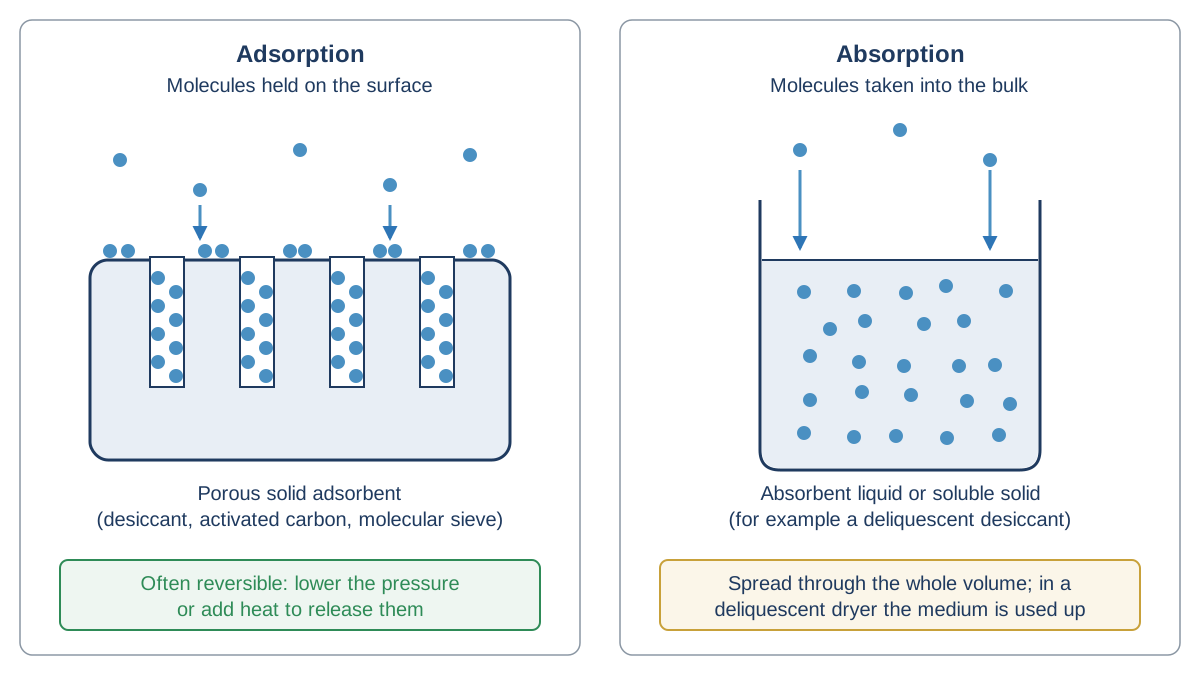
Adsorption: held on the surface
IUPAC, the international chemistry body, describes adsorption as an increase in the concentration of a substance at the interface between two phases, such as a solid and a gas (IUPAC 2025a). The solid is the adsorbent. Australia's drinking water guidelines call activated carbon an excellent adsorbent and note its use for organic contaminants and for compounds that cause taste and odour (NHMRC and NRMMC 2011). Good adsorbents are highly porous, so a small grain hides a very large internal surface.
In compressed air treatment, adsorption is mainly a physical process. Water molecules stick to the desiccant's surface without changing its structure, so the desiccant can be regenerated and reused for many years (Atlas Copco n.d.). Because the molecules are held only loosely, lowering the pressure or adding heat releases them again.
Absorption: taken into the bulk
Absorption is the retention of one material by another, for example a gas dissolving into a liquid (IUPAC 2025b). The absorbed substance spreads through the whole volume rather than sitting on the surface. It can be purely physical, like carbon dioxide dissolving in water, or involve a chemical reaction. In compressed air drying, the absorbent is gradually used up and has to be replaced, which is why absorption dryers are uncommon in modern systems (Atlas Copco n.d.). IUPAC (2025c) uses "sorption" as the umbrella term for both processes.
Where you meet each in compressed air
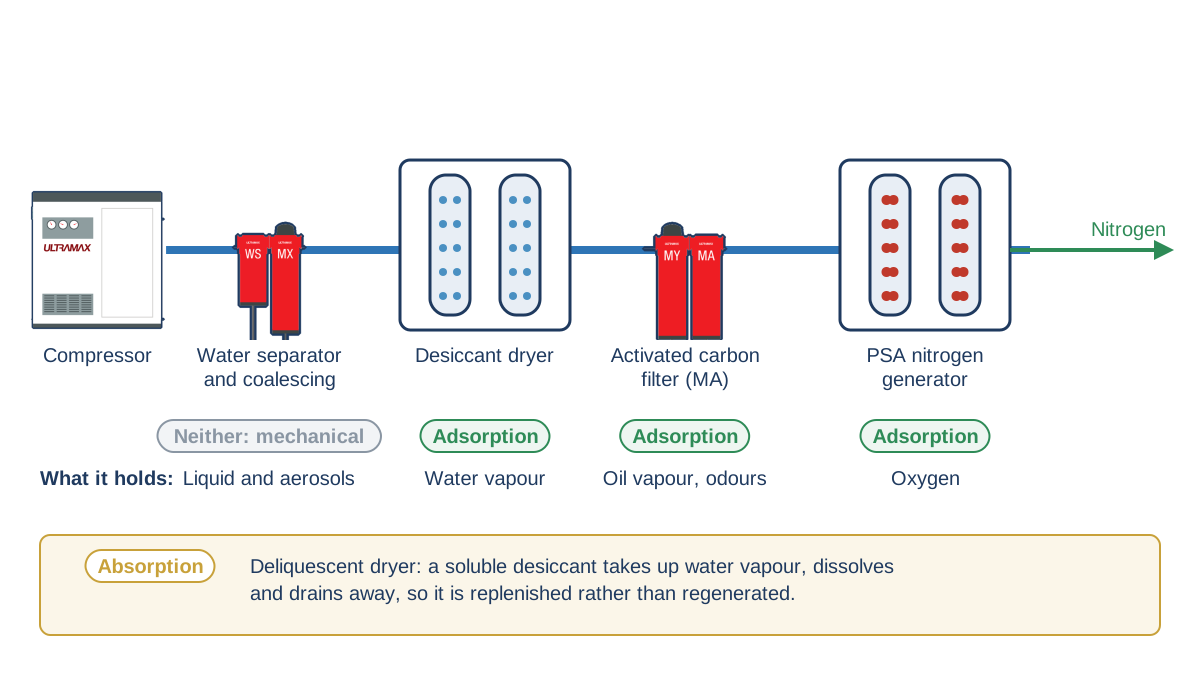
Desiccant dryers. A regenerative desiccant dryer adsorbs water vapour by collecting it in the desiccant's many pores, then regenerates the bed by reducing the pressure in the tower (US Department of Energy 2016). Atlas Copco (n.d.) lists activated alumina for general drying to about -40 °C, silica gel for bulk water removal and molecular sieve for -70 °C and below. For a comparison with refrigeration drying, see Refrigerated vs Desiccant Dryers: Which do you need?
Deliquescent dryers. These absorb rather than adsorb. The desiccant dissolves as it takes up water, so it is used up and cannot be regenerated (US Department of Energy 2016).
Activated carbon filters. Coalescing filters catch liquid and aerosols, but oil vapour and odours pass through them. Activated carbon adsorbs these. One maker's oil vapour filter is designed for a residual oil content of 0.003 mg/m³ or less, with a 12-month element change when it is correctly sized (Parker Hannifin n.d.). Ultramax G Series filter housings take activated carbon elements, and odour adsorption filters do the same job on vacuum pump exhausts.
PSA nitrogen generators. Carbon molecular sieve adsorbs oxygen faster than nitrogen, as explained in How does a PSA Nitrogen Generator work? Hopcalite works differently again: it is a catalyst that converts carbon monoxide, as covered in What is a Hopcalite Filter?
Why the difference matters
An adsorbent has a finite surface, and once it is full the contaminant starts to pass straight through. Respirator gas filters behave the same way: WorkSafe Queensland (n.d.) warns that once their capacity is reached, gas or vapour passes through and gives no protection. Regenerable beds, such as dryer desiccant and carbon molecular sieve, are cleared every cycle. Carbon in a line filter is not, so it is replaced on a schedule. Oil and liquid water coat adsorbent surfaces, which is why a coalescing filter normally sits ahead of a desiccant dryer (US Department of Energy 2016). Absorbents, by contrast, are consumed by design and need topping up.
Related terms
- Sorption: the general term covering both adsorption and absorption.
- Desorption: the release of adsorbed molecules, for example during dryer regeneration.
- Adsorbent and adsorbate: the solid that holds the molecules, and the molecules it holds.
- Pressure dew point: the measure of how dry an adsorption dryer gets the air. See What is Pressure Dew Point?
Related reading
- How does a PSA Nitrogen Generator work?
- Refrigerated vs Desiccant Dryers: Which do you need?
- Coalescing filters explained
- What is a Hopcalite Filter?
References
- Atlas Copco. n.d. "How an Adsorption Dryer Works: Desiccant Drying Explained." Atlas Copco USA. Accessed 26 October 2026. https://www.atlascopco.com/en-us/compressors/wiki/compressed-air-articles/absorption-adsorption.
- IUPAC (International Union of Pure and Applied Chemistry). 2025a. "Adsorption." In Compendium of Chemical Terminology (the Gold Book), 5th ed., online version 5.0.0. https://doi.org/10.1351/goldbook.A00155.
- IUPAC (International Union of Pure and Applied Chemistry). 2025b. "Absorption." In Compendium of Chemical Terminology (the Gold Book), 5th ed., online version 5.0.0. https://doi.org/10.1351/goldbook.A00036.
- IUPAC (International Union of Pure and Applied Chemistry). 2025c. "Sorption." In Compendium of Chemical Terminology (the Gold Book), 5th ed., online version 5.0.0. https://doi.org/10.1351/goldbook.S05769.
- NHMRC and NRMMC (National Health and Medical Research Council and Natural Resource Management Ministerial Council). 2011. "8.3.3 Adsorption." In Australian Drinking Water Guidelines. Version 4.0, updated June 2025. Canberra: NHMRC. Accessed 26 October 2026. https://guidelines.nhmrc.gov.au/australian-drinking-water-guidelines/part-2/chapter-8/8.3-overview-of-chemical-treatment-processes/8.3.3-adsorption.
- Parker Hannifin. n.d. "OIL-X OVR Oil Vapour Reduction Filter." Product series page. Accessed 26 October 2026. https://ph.parker.com/us/en/ovr-oil-vapour-removal-filter.
- US Department of Energy. 2016. Improving Compressed Air System Performance: A Sourcebook for Industry. 3rd ed. Washington, DC: US Department of Energy and Compressed Air Challenge. https://www.energy.gov/sites/prod/files/2016/03/f30/Improving%20Compressed%20Air%20Sourcebook%20version%203.pdf.
- WorkSafe Queensland. n.d. "Respiratory Protective Equipment (RPE)." Accessed 26 October 2026. https://worksafe.qld.gov.au/injury-prevention-safety/managing-risks/personal-protective-equipment-ppe/respiratory-protective-equipment-rpe.
This article is general information only. Check manufacturer documentation and applicable Australian Standards for your installation.