
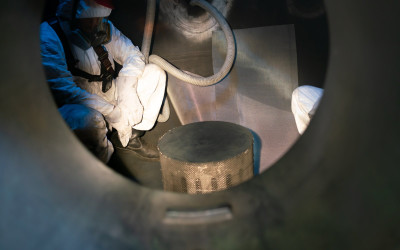
Pressure Vessel Registration and Inspection in Australia
Ultramax Systems on 26th Oct 2026
Short answer: In most of Australia, a pressure vessel such as an air receiver can need two kinds of registration: design registration for hazard levels A to D and item registration for hazard levels A to C, with the hazard level worked out under AS 4343. Once in service, a competent person inspects it at intervals guided by AS/NZS 3788. Rules and exclusions differ between states, so confirm the detail with your state regulator.
Why air receivers are regulated
An air receiver stores a lot of energy. If the shell is corroded, over-pressurised or badly repaired, it can rupture without warning. Safe Work Australia (2015) warns that receivers can explode and cause serious injury or death when they are not properly inspected and maintained. In 2020, a transportable receiver in Western Australia ruptured while a worker was filling it from another receiver, and fragments injured him. The contributing factors included an unknown design pressure, no data plate, inadequate relief devices, poor inspection and substandard repairs (WorkSafe WA 2020). Registration and inspection exist to catch each of those failures before someone gets hurt.
Which law applies in your state
Every Australian jurisdiction except Victoria has implemented the model Work Health and Safety (WHS) laws, and Western Australia was the last to start, on 31 March 2022 (Safe Work Australia n.d.). In those jurisdictions, Schedule 5 of the WHS Regulations lists the plant designs and items of plant that must be registered. Victoria runs its own scheme under the Occupational Health and Safety Regulations 2017, where Schedule 2 lists plant that needs design registration, including pressure equipment (WorkSafe Victoria 2026b).
| Jurisdiction | Main law for plant registration | Regulator |
|---|---|---|
| Western Australia | WHS laws (in force from 31 March 2022) | WorkSafe WA |
| Queensland, South Australia, NSW, Tasmania, NT, ACT | WHS laws based on the model laws | Workplace Health and Safety Queensland, SafeWork SA, SafeWork NSW, WorkSafe Tasmania, NT WorkSafe, WorkSafe ACT |
| Victoria | Occupational Health and Safety Regulations 2017 | WorkSafe Victoria |
Hazard levels under AS 4343
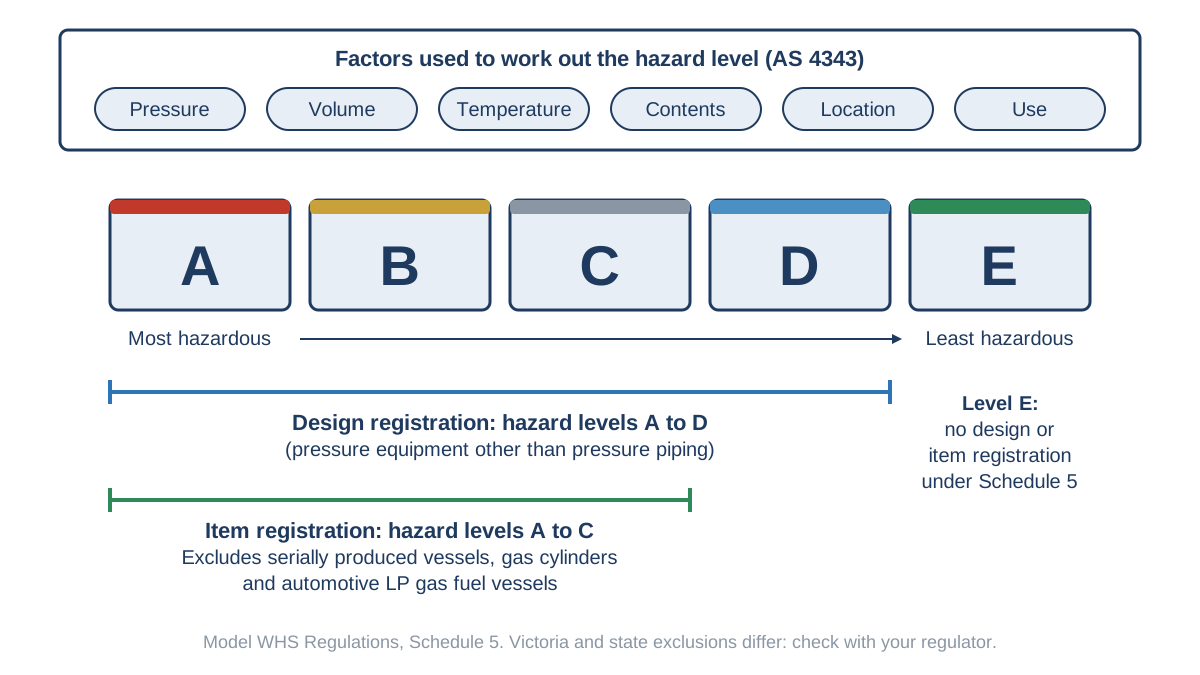
Registration depends on the vessel's hazard level. AS 4343:2014 sets the criteria for working out the hazard level of pressure equipment and also classifies the fluids it contains (AS 4343:2014). Levels run from A, the most hazardous, to E, the least. SafeWork SA (2021) lists volume, pressure, temperature, location, use and contents among the factors, and notes that the designer, manufacturer or importer usually does the assessment. Owners should find the hazard level in the vessel's documentation; if it is missing, ask the supplier.
Design registration
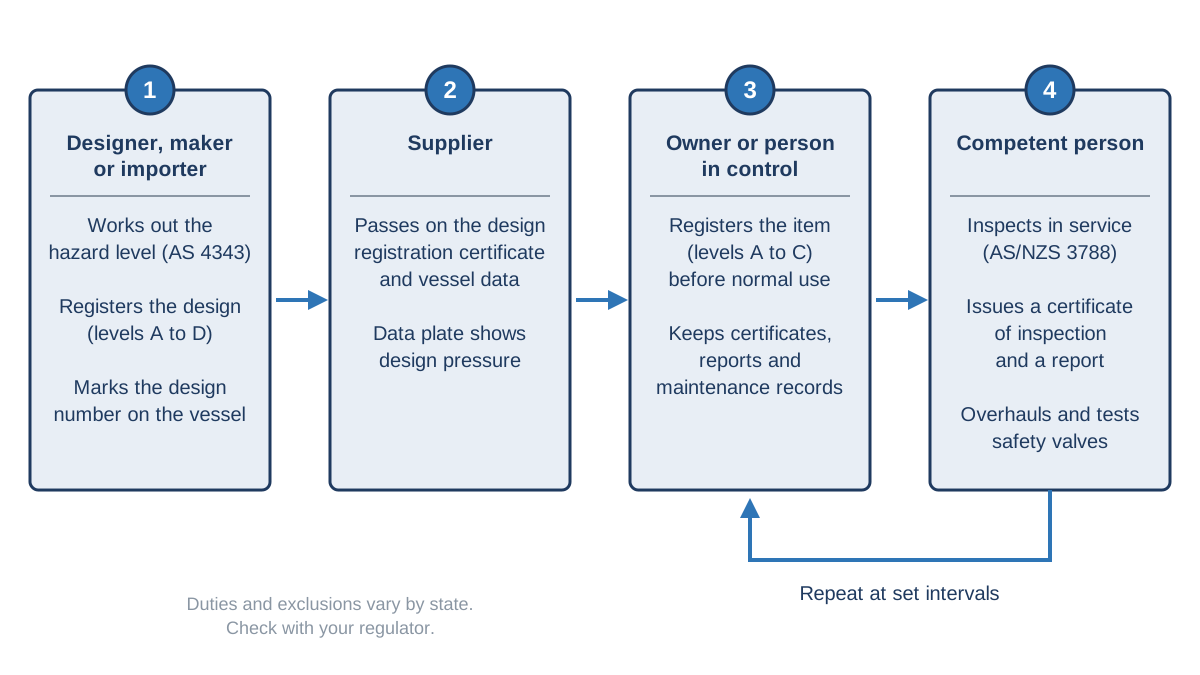
Design registration covers pressure equipment, other than pressure piping, in hazard levels A, B, C or D (WorkSafe WA 2024). WorkSafe WA (2026) treats compliance with AS/NZS 1200 as reasonably practicable and expects a chosen standard to be applied in full. In South Australia, the design registration number must be permanently marked on each vessel built to that design, and owners should hold a copy of the design registration certificate (SafeWork SA 2021). Imported vessels are not exempt: if an overseas design is unregistered, the importer or the person controlling the plant must register it.
Item registration
Item registration covers individual pressure vessels in hazard levels A, B or C. Gas cylinders, automotive LP gas fuel vessels and serially produced vessels are excluded (WorkSafe WA 2022; Workplace Health and Safety Queensland n.d.). A registrable vessel must be registered before it goes into normal operation (SafeWork SA 2021). WorkSafe WA (2026) notes that average to large air receivers, such as those on workshop compressors, typically need registration. Whether a particular receiver counts as serially produced depends on its design documentation, so confirm it with the supplier or your regulator rather than assuming.
In-service inspection under AS/NZS 3788
Registration is a snapshot, and inspection keeps the vessel safe over its life. AS/NZS 3788 sets minimum requirements for in-service inspection and fitness for service, including repairs, alterations and re-rating of equipment made to any recognised standard (AS/NZS 3788:2024). The current edition is AS/NZS 3788:2024 with Amendment 1 of 2025, although some regulator pages still refer to the 2006 edition. Safe Work Australia (2015) calls for external and internal inspections at suitable intervals by a competent person.
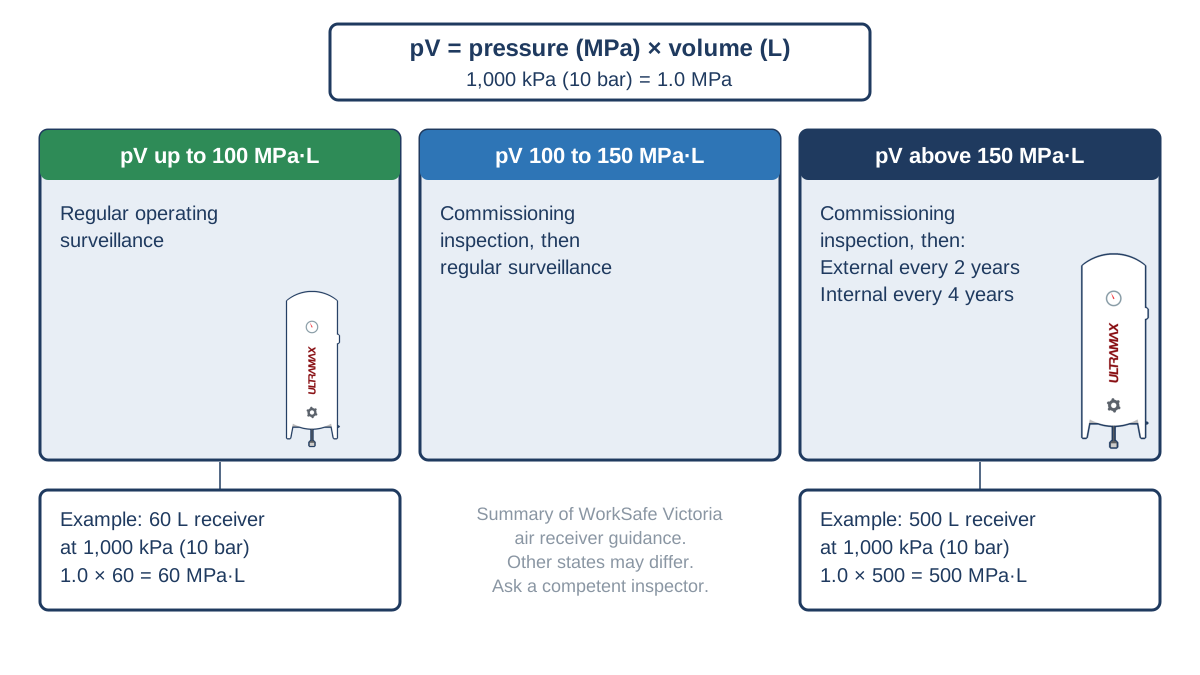
Intervals depend on the vessel. WorkSafe Victoria (2026a) sorts air receivers by pV, the pressure in MPa multiplied by the volume in litres. At 100 MPa·L or less, regular operating surveillance applies. Above 150 MPa·L, a commissioning inspection is followed by an external inspection every 2 years and an internal inspection every 4 years. A 500 L receiver rated at 1,000 kPa (10 bar) gives 1.0 MPa × 500 L = 500 MPa·L, which sits in the top band. Other states may differ, so ask your inspector.
Who counts as competent? SafeWork SA (2021) describes a person with education and training in pressure equipment inspection, and suggests asking for evidence of qualifications and training records before engaging one. It names Engineers Australia, the Australasian Institute of Engineer Surveyors and the Australian Institute for the Certification of Inspection Personnel as recognised bodies. After each inspection, expect a certificate of inspection and a report.
What an air receiver owner typically needs
Safe Work Australia (2015) expects a receiver to have a design pressure at least equal to the highest working pressure on site, a pressure gauge, a drain at the lowest point and an inspection opening. It also needs a safety relief valve set no higher than the design pressure, with a test lever or ring, and the release mechanism should be checked periodically, for example monthly. Relief valves should also be overhauled and bench tested by competent persons at set intervals (WorkSafe Victoria 2026a). A NATA test certificate on a replacement valve gives you a documented test result to file. When an inspection or valve service falls due, Ultramax's gas generation division, Ultramax Gas Generation Systems in Cannington WA, carries out pressure vessel inspections and safety relief valve servicing. Whoever you engage, confirm they meet your regulator's expectations for a competent person. For background, see What is Set Pressure on a Safety Relief Valve? and What does AS-coded mean on a Safety Relief Valve?
Drain the receiver daily unless an automatic drain is fitted, and inspect automatic drains as the maker recommends (Safe Work Australia 2015). An electronic drain clears condensate without relying on someone to open a valve.
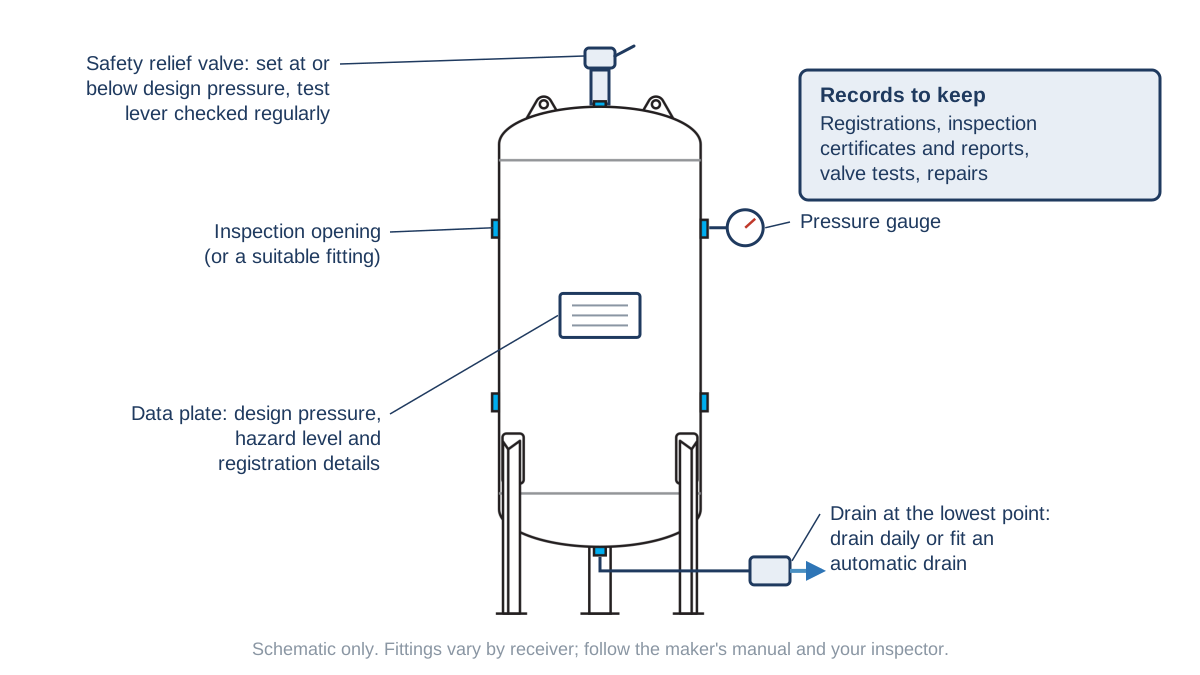
Records matter as much as hardware. WorkSafe Victoria (2026a) requires records of inspection and maintenance for vessels in hazard levels A to D, and notes that a reminder sticker is no substitute. Keep registration certificates, data plate details, inspection certificates and reports, safety valve test results and repair records in one place. If you are choosing a new receiver, start with the design pressure and size, as covered in Air Receiver Sizing: Formula and Worked Example.
Key takeaways
- Registration depends on the AS 4343 hazard level: design registration for levels A to D and item registration for levels A to C.
- Victoria uses its own OHS Regulations 2017, and every state publishes its own guidance, so check with your regulator.
- A competent person inspects receivers in service under AS/NZS 3788, now in its 2024 edition.
- Owners need a correctly set safety valve, a gauge, a working drain, an inspection opening and complete records.
Frequently asked questions
Does my workshop compressor receiver need registering?
It may. WorkSafe WA notes that average to large receivers on workshop compressors typically need item registration, but small serially produced vessels can be excluded. Confirm with your state regulator.
How often should an air receiver be inspected?
It depends on the vessel and the state. WorkSafe Victoria's summary sets external inspections every 2 years and internal inspections every 4 years for receivers above 150 MPa·L. Ask a competent inspector to confirm the intervals for your vessel.
References
- Safe Work Australia. 2015. Compressed Air and Air Receiver Information Sheet. https://www.safeworkaustralia.gov.au/system/files/documents/1703/compressed-air-information-sheet.pdf.
- Safe Work Australia. n.d. "The Model WHS Laws." Accessed 26 October 2026. https://www.safeworkaustralia.gov.au/law-and-regulation/legislation.
- SafeWork SA. 2021. "Pressure Plant and Equipment." Published 9 November 2021, last modified 3 March 2026. Accessed 26 October 2026. https://www.safework.sa.gov.au/workplaces/plant-tools-and-vehicles/pressure-vessels.
- Standards Australia. 2014. AS 4343:2014 Pressure Equipment: Hazard Levels. Listing accessed via ANSI Webstore, 26 October 2026. https://webstore.ansi.org/standards/sai/43432014.
- Standards Australia and Standards New Zealand. 2024. AS/NZS 3788:2024 Pressure Equipment: In-Service Inspection. Amended by Amdt 1:2025. Listing accessed via ANSI Webstore, 26 October 2026. https://webstore.ansi.org/standards/sai/nzs37882024.
- Workplace Health and Safety Queensland. n.d. "What Type of Plant Requires Registration?" Accessed 26 October 2026. https://worksafe.qld.gov.au/licensing-and-registrations/plant-registration/what-type-of-plant-requires-registration.
- WorkSafe Victoria. 2026a. "Air Receiver Pressure Vessels." Reviewed 7 September 2026. Accessed 26 October 2026. https://worksafe.vic.gov.au/air-receiver-pressure-vessels.
- WorkSafe Victoria. 2026b. "Plant and Equipment Requiring Design Registration." Reviewed 29 June 2026. Accessed 26 October 2026. https://www.worksafe.vic.gov.au/plant-and-equipment-requiring-design-registration.
- WorkSafe WA. 2020. "Safety Alert 02/2020: Pressure Vessel Failure Injures Worker." 27 May 2020, last updated 25 November 2024. Accessed 26 October 2026. https://worksafe.wa.gov.au/publications/safety-alert-022020-pressure-vessel-failure-injures-worker.
- WorkSafe WA. 2022. "What Kinds of Plant Require Registration." Last updated 30 March 2022. Accessed 26 October 2026. https://www.worksafe.wa.gov.au/what-kinds-plant-require-registration.
- WorkSafe WA. 2024. "What Kinds of Plant Design or Alteration to Plant Design Requires Registration?" Last updated 25 November 2024. Accessed 26 October 2026. https://worksafe.wa.gov.au/what-kinds-plant-design-or-alteration-plant-design-requires-registration.
- WorkSafe WA. 2026. "Frequently Asked Questions: Plant and Machinery." Last updated 24 March 2026. Accessed 26 October 2026. https://www.worksafe.wa.gov.au/frequently-asked-questions-plant-and-machinery.
This article is general information only and is not compliance advice. Registration and inspection rules vary between states and territories. Check with your state regulator, the applicable Australian Standards and a competent pressure equipment inspector for your vessel.