
Compressed Air in Mining and Mineral Processing
Ultramax Systems on 15th Oct 2026
Short answer: Mines use compressed air for drills, rock breakers, shotcrete, plant instruments and refuge chamber breathing air, while flotation usually runs on separate low-pressure blowers. Australian mine safety laws and regulator guidance cover hoses, pressure equipment and refuge chambers. Heat and dust make intake filtration, drying and condensate handling more important than in a typical factory.
How mines use compressed air
Compressed air is a workhorse utility on mine sites because it tolerates water and rough handling and runs easily through long pipe ranges. Underground, it powers handheld drills, rock breakers, pumps and maintenance tools, and in drilling equipment it drives the hammer action at the bit (Atlas Copco 2026). On the surface, it serves workshops, tyre bays and drill rigs.
The processing plant has different needs. Instrument air operates control valves and actuators, so it must be clean and dry rather than plentiful. Atlas Copco (2026) notes that flotation cells need a steady stream of low-pressure air to form the froth, and that heap leaching and pneumatic conveying also run at low pressure. Blowers or low-pressure compressors usually serve those duties more efficiently than the main air range.
In wet-mix shotcrete, the concrete is pumped to the nozzle and compressed air is added there to project the mix onto the rock (American Shotcrete Association n.d.). Breathing air for refuge chambers and air-fed respirators carries the highest air quality stakes on the site.
Australian regulatory requirements
Mine safety in Australia is regulated state by state. In Western Australia, the Work Health and Safety Act 2020 took effect on 31 March 2022 and absorbed the safety elements of the Mines Safety and Inspection Act 1994 (Tancredi 2022). Mine sites now work under the Work Health and Safety (Mines) Regulations 2022, which deal with principal mining hazards, safe escape and refuge, and self-rescuers, among many other matters (Government of Western Australia 2022). The NSW Resources Regulator and Resources Safety & Health Queensland publish their own guidance and alerts.
Hoses, valves and stored energy
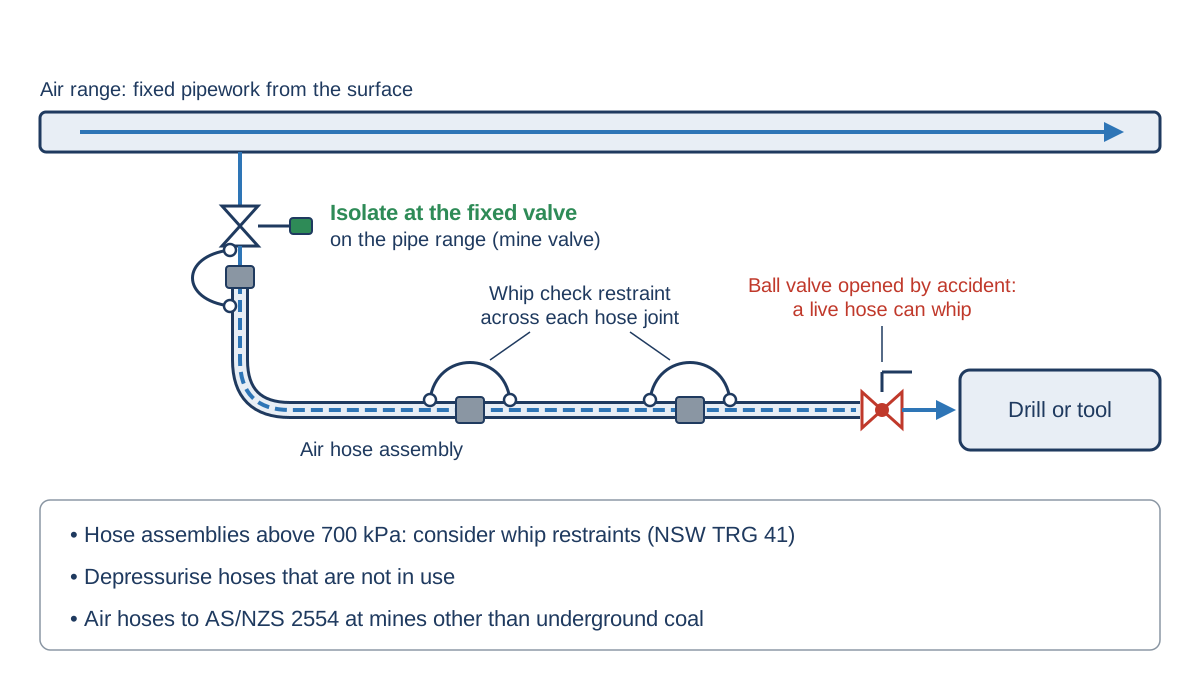
The NSW Resources Regulator (2025) has replaced MDG 41 with Technical Reference Guide 41, which covers compressed air systems at mines. It recommends considering whip restraints on air or gas hose assemblies above 700 kPa (7 bar) and points to AS/NZS 2554 for air hoses at mines other than underground coal. A 2023 NSW bulletin on hoses whipping after ball valves opened by accident adds two sound habits: isolate at the fixed valve on the pipe range, and depressurise hoses not in use (NSW Resources Regulator 2023). Robust mine valves at each take-off and whip check restraints across hose joints support both controls.
Pressure equipment
Air receivers are pressure equipment. In Western Australia, pressure vessels in hazard level A, B or C under AS 4343 need item registration, although serially produced vessels and gas cylinders are excluded (WorkSafe WA 2022). Mobile compressors need the same care. Resources Safety & Health Queensland (2021) reported a fire on a reverse circulation drill rig after the compressor air receiver was over-pressurised, a relief valve operated and a hose detached, releasing air and oil onto a hot exhaust. Its recommendations included competent maintenance to the manufacturer's instructions and regular checks of pressure and temperature protection devices.
Dust
A WA checklist for respirable crystalline silica lists water sprays or fogging during loading, working mist sprays, and wet methods or vacuums for cleaning dusty areas (Department of Local Government, Industry Regulation and Safety n.d.). Blowing dust off surfaces or clothing with an air gun works against those measures.
Breathing air and refuge chambers
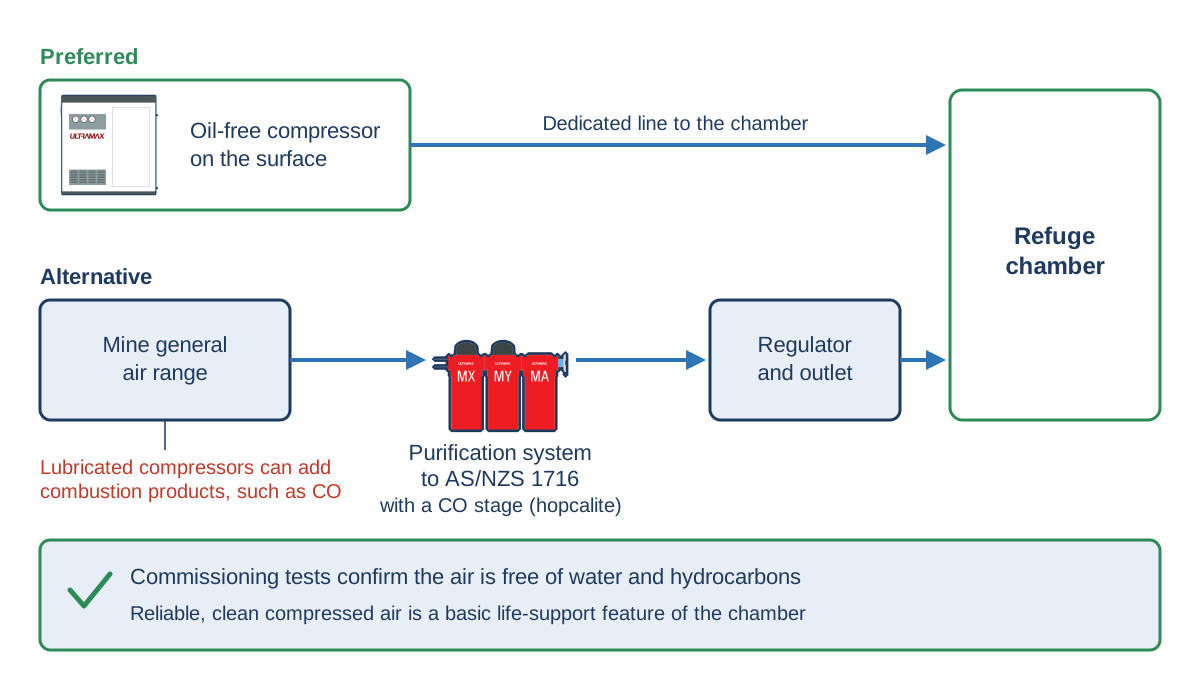
WorkSafe WA (2025) lists reliable and clean compressed air among the basic life-support features of a refuge chamber. The state's refuge chamber guideline prefers a dedicated line from a genuine oil-free compressor on the surface. Where the chamber draws on the mine's general air range instead, the air should pass through a purification system that meets AS/NZS 1716, with a regulator and outlet. The guideline also warns that lubricated compressors can contaminate the air with combustion products, and it asks for commissioning tests that confirm the air is free of water and hydrocarbons (Department of Mines and Petroleum 2013). Carbon monoxide is a particular concern, and a hopcalite stage is the usual way to convert it.
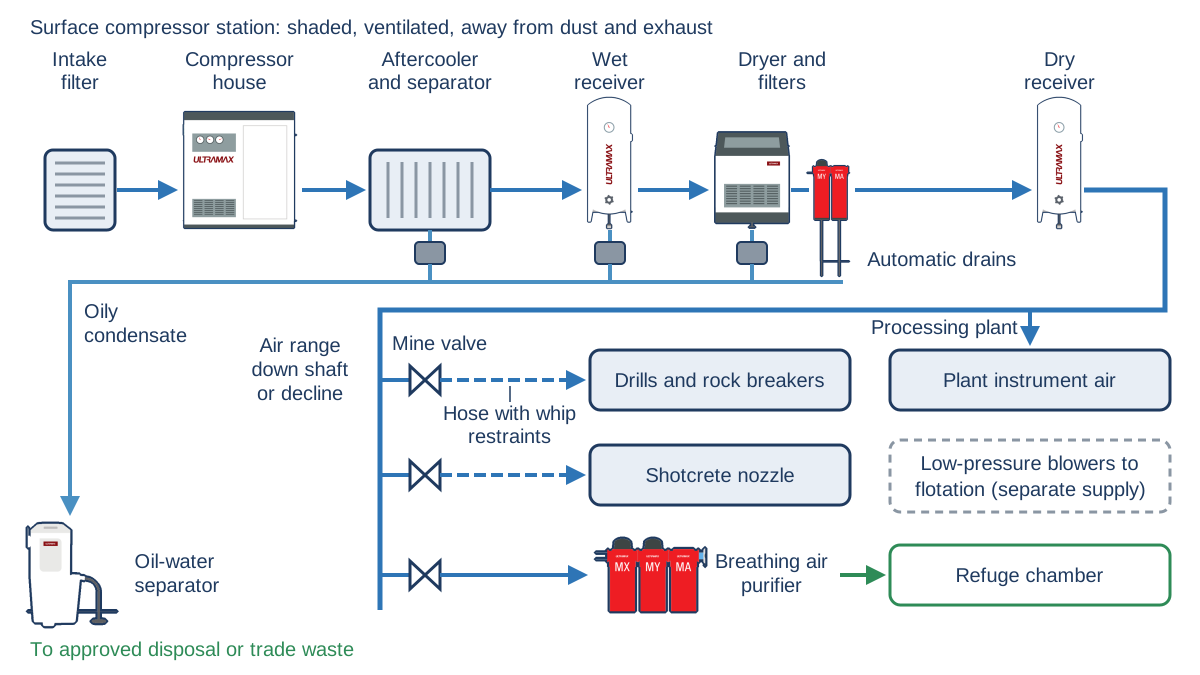
Typical mine site compressed air system
A surface compressor station feeds a treated air main. One branch serves the processing plant and another runs down the shaft or decline as the air range, with mine valves at each take-off and restrained hoses to the tools.
Risks in a harsh environment
Heat comes first. Hot intake air is less dense, so a compressor moves less mass of air for the same rated free air delivery, and hot, humid air carries more water vapour into the aftercooler, drains and dryer. A shaded, ventilated compressor station away from haul road dust and diesel exhaust helps on both counts.
Dust is next. Fine mineral dust blocks intake filters and contaminates compressor oil, so intake filters typically need closer inspection than in a factory. Downstream, particulate and coalescing filters protect drills, valves and instruments from rust, scale and oil carryover.
Finally, long underground ranges take a beating from equipment and rock. Damaged joints leak around the clock (see how much compressed air leaks cost) and add to the hose whip risk.
Recommended treatment train
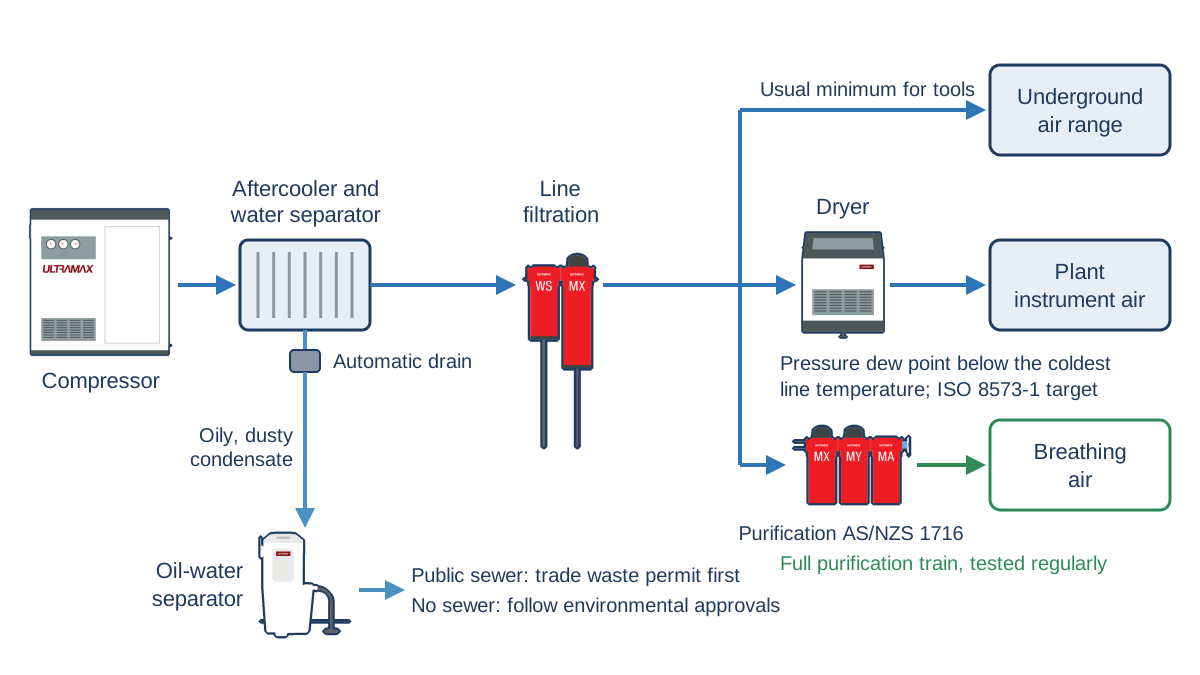
Treat air only as far as each use requires. For general underground air, an aftercooler, water separator, automatic drains and line filtration are the usual minimum, because liquid water and scale damage tools. Plant instrument air typically needs a dryer as well, chosen to give a pressure dew point below the coldest temperature the lines will see, and a purity target that you can specify with ISO 8573-1. Breathing air needs a full purification train with breathing air systems that meet AS/NZS 1716 at the point of supply, plus regular testing.
Condensate is the last part of the train. Compressor condensate on a mine site contains oil and fine dust, so it should pass through an oil-water separator before disposal. Where the site connects to a public sewer, a trade waste permit is normally needed first; in Western Australia, Water Corporation (n.d.) requires one before a business discharges wastewater other than from office facilities or staff amenities. Remote sites without sewer should follow their environmental approvals.
Key takeaways
- Mines use compressed air for drills, rock breakers, shotcrete, instruments and refuge chambers; flotation usually runs on separate blowers.
- WA mines fall under the Work Health and Safety (Mines) Regulations 2022, and NSW TRG 41 covers mine compressed air systems.
- Consider whip restraints on air hoses above 700 kPa (7 bar), isolate at the fixed valve and depressurise hoses not in use.
- Refuge chamber air should be oil-free or purified to AS/NZS 1716 and tested for water and hydrocarbons.
- Heat and dust make intake location, filtration, drying and condensate treatment more important than in a factory.
Frequently asked questions
Can a refuge chamber run off the mine's main air range?
It can, but the WA guideline prefers a dedicated line from an oil-free source. Where the main range is used, the air needs a purification system to AS/NZS 1716 and testing at commissioning.
When do air hoses need whip restraints?
NSW TRG 41 recommends considering whip restraints for air or gas hose assemblies above 700 kPa (7 bar). Base the decision on your site risk assessment.
Related reading
- What is a Hopcalite Filter?
- How does an Oil-Water Separator work?
- How much do Compressed Air Leaks cost?
- Air Receiver Sizing: Formula and Worked Example
References
- American Shotcrete Association. n.d. "What Is the Difference Between Shotcrete and Gunite?" Accessed 15 October 2026. https://shotcrete.org/faq-items/what-is-the-difference-between-shotcrete-and-gunite/.
- Atlas Copco. 2026. "Use of Air Compressors and Low-Pressure Blowers in Mining and Mineral Processes." 13 March 2026. Accessed 15 October 2026. https://www.atlascopco.com/en-au/compressors/air-compressor-blog/use-of-compressors-and-blowers-in-mining.
- Department of Local Government, Industry Regulation and Safety. n.d. Respirable Crystalline Silica and Other Dusts in Mines: Checklist. Perth: WorkSafe WA. Accessed 15 October 2026. https://www.worksafe.wa.gov.au/system/files/documents/2026-07/MS_FM_Respirable-crystalline-silica_0.pdf.
- Department of Mines and Petroleum. 2013. Refuge Chambers in Underground Mines: Guideline. Perth: Resources Safety, Department of Mines and Petroleum. Hosted by WorkSafe WA. https://www.worksafe.wa.gov.au/system/files/documents/2025-02/MSH_G_RefugeChambersUGmines.pdf.
- Government of Western Australia. 2022. Work Health and Safety (Mines) Regulations 2022. https://www.legislation.wa.gov.au/legislation/prod/filestore.nsf/FileURL/mrdoc_46951.htm/$FILE/Work%20Health%20and%20Safety%20(Mines)%20Regulations%202022%20-%20%5B01-a0-00%5D.html.
- NSW Resources Regulator. 2023. Safety Bulletin SB23-04: Hose Ball Valves Injure Mine Workers. Department of Regional NSW. https://www.resources.nsw.gov.au/sites/default/files/2023-05/safety-bulletin-sb23-04-hose-ball-valves-injure-mine-workers.pdf.
- NSW Resources Regulator. 2025. Technical Reference Guide 41: Fluid Power Safety Systems at Mines. Version 2.0. NSW Department of Primary Industries and Regional Development. https://www.resources.nsw.gov.au/sites/default/files/2025-03/trg-41-fluid-power-safety-systems.pdf.
- Resources Safety & Health Queensland. 2021. "Fire on RC Drill Rig from Compressed Air System." Mines Inspectorate Safety Alert No. 388, 9 March 2021. Accessed 15 October 2026. https://www.rshq.qld.gov.au/safety-notices/mines/fire-on-rc-drill-rig-from-compressed-air-system.
- Tancredi, Holly. 2022. "New Work Health and Safety Regulations for WA Mining Industry." Mining Magazine Australia, 1 June 2022. https://miningmagazine.com.au/new-work-health-and-safety-regulations-for-wa-mining-industry/.
- Water Corporation. n.d. "Trade Waste." Accessed 15 October 2026. https://www.watercorporation.com.au/Help-and-advice/Trade-waste.
- WorkSafe WA. 2022. "What Kinds of Plant Require Registration." Last updated 30 March 2022. Accessed 15 October 2026. https://www.worksafe.wa.gov.au/what-kinds-plant-require-registration.
- WorkSafe WA. 2025. "Mines Safety Bulletin No. 141: Maintenance of Refuge Chambers for Underground Mines." 18 March 2025. Accessed 15 October 2026. https://worksafe.wa.gov.au/publications/mines-safety-bulletin-no-141-maintenance-refuge-chambers-underground-mines.
This article is general information only. Check manufacturer documentation, applicable Australian Standards and your state mining regulator's requirements for your site.