
Air Receiver Sizing: Formula and Worked Example
Ultramax Systems on 16th Oct 2026
Short answer: Size an air receiver for a demand event with V = t × (C − S) × Pa ÷ (P1 − P2). That is the event time, multiplied by the flow the compressor cannot supply, multiplied by atmospheric pressure, divided by the pressure drop you can tolerate. For a workshop whose 35 L/s compressor faces a 50 L/s demand for 60 seconds, with 100 kPa (1.0 bar) of allowable drop, the answer is about 912 litres, so a 1,000 litre receiver suits. Then check that the same receiver keeps a load/unload compressor from cycling too often.
Why receiver size matters
An air receiver stores compressed air so the system can meet short peaks without a pressure collapse. It also slows the rate at which pressure changes, which helps the compressor controls work properly. A large receiver can even let a smaller compressor serve intermittent peaks instead of buying capacity that sits idle most of the day (US Department of Energy 2016). The Australian Government's energy advice makes a related point: air compressors are most efficient near full load, and storage receivers can reduce peak loads (Australian Government n.d.).
Too little storage shows up as pressure sags at the tools and rapid load/unload cycling. The NSW Office of Environment and Heritage (2017) notes that the shorter a compressor's load/unload cycles are, the higher its average unloaded power.
Assumptions
The formulas below rest on a few simplifying assumptions that suit normal workshop and plant sizing.
- The air in the receiver stays at a constant temperature during the event (isothermal behaviour).
- Flows are free air delivery (FAD) at the compressor's inlet conditions, so Pa is the local atmospheric pressure, taken here as 101.3 kPa absolute (1.013 bar).
- The compressor delivers its full rated FAD throughout the event.
- The volume of the pipework is ignored, which adds a small safety margin.
- P1 and P2 are measured at the receiver. Any pressure drop between the receiver and the tools must be allowed for when you choose P2.
The receiver formula for a demand event
A receiver of volume V at absolute pressure P holds V × P ÷ Pa litres of free air. When its pressure falls from P1 to P2, it releases V × (P1 − P2) ÷ Pa litres of free air. During an event that lasts t seconds, the receiver has to supply the shortfall between demand and compressor output, which is (C − S) × t. Setting the two equal and solving for V gives the standard formula:
V = t × (C − S) × Pa ÷ (P1 − P2)
No single sizing method is universally agreed, but this balance is the one commonly used (Engineering ToolBox n.d.). Marshall (2015), writing as a Compressed Air Challenge instructor, uses the same structure, defining C as the intermittent demand and S as the compressor capacity left over after normal demand.
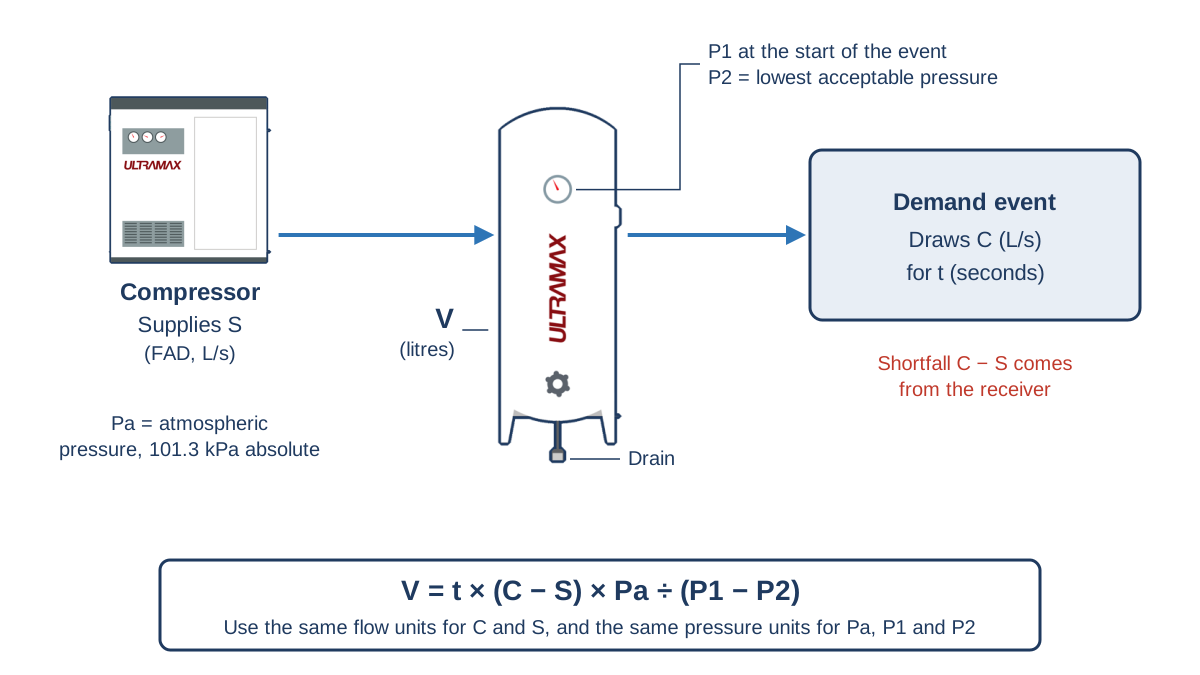
| Symbol | Meaning | SI unit |
|---|---|---|
| V | Receiver volume required | litres (L) |
| t | Duration of the demand event | seconds (s) |
| C | Total air demand during the event, as free air | L/s |
| S | Compressor output available during the event, as FAD | L/s |
| Pa | Atmospheric pressure | kPa absolute |
| P1 | Receiver pressure when the event starts | kPa |
| P2 | Lowest acceptable receiver pressure | kPa |
Because the formula uses the difference P1 − P2, you can enter both pressures in kPa gauge or both in kPa absolute. Pa must be absolute. If C and S are in L/s and t is in seconds, V comes out in litres.
Worked example: an Australian workshop
Consider a Perth fabrication and automotive workshop with one fixed-speed rotary screw compressor on load/unload control. The figures are illustrative, so substitute your own measurements.
- Compressor output. The compressor delivers S = 35 L/s FAD. It loads at 700 kPa (7.0 bar) and unloads at 800 kPa (8.0 bar).
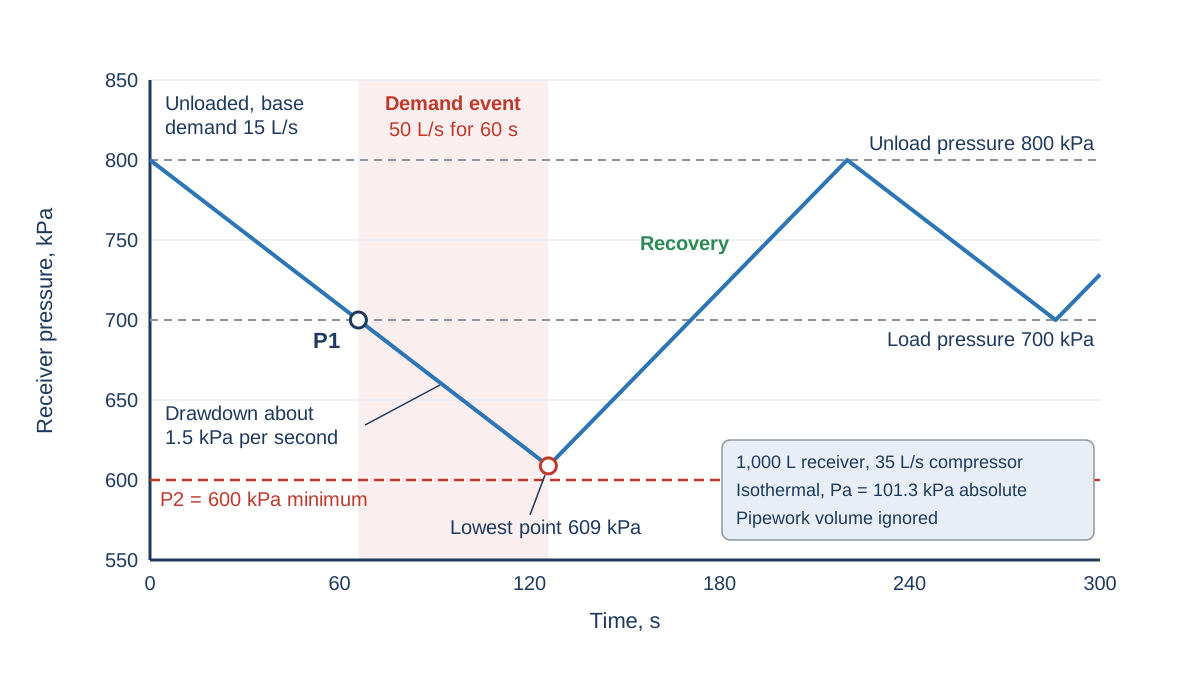
- Demand event. When the blast cabinet runs alongside the tyre bay and assembly tools, total demand reaches C = 50 L/s for t = 60 s. The shortfall is C − S = 15 L/s.
- Pressure limits. The worst case is an event that starts just as the compressor reaches its load pressure, so P1 = 700 kPa (7.0 bar). The tools need about 600 kPa (6.0 bar) at the receiver after allowing for pipe and hose losses, so P2 = 600 kPa. The allowable drop is 100 kPa (1.0 bar).
- Calculate. V = 60 s × 15 L/s × 101.3 kPa ÷ 100 kPa = 911.7 L.
- Select. Round up to the next common size, a 1,000 L receiver. With that receiver, pressure falls at about 1.5 kPa (0.015 bar) per second during the event and bottoms out near 609 kPa (6.09 bar), just above P2.
The load/unload control form
The second job of a receiver is to limit compressor cycling. On load/unload control, a compressor fills the receiver from the load pressure to the unload pressure, then runs unloaded while demand draws the pressure back down. With a pressure band Δp = Pu − Pl, a receiver of volume V stores V × Δp ÷ Pa litres of free air per cycle. If Q is the compressor FAD and D is the demand, the loaded time is V × Δp ÷ (Pa × (Q − D)) and the unloaded time is V × Δp ÷ (Pa × D).
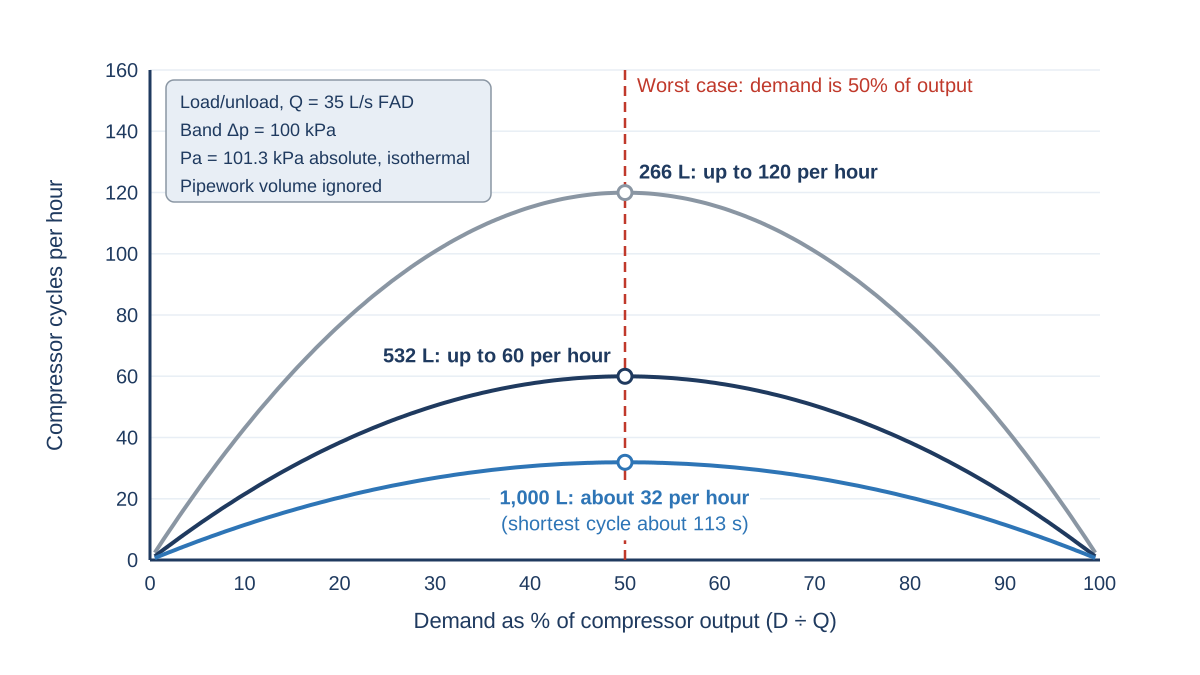
Adding those two times shows that the cycle is shortest when demand is exactly half the compressor's output. At that point, the cycle time is 4 × V × Δp ÷ (Pa × Q). Kaeser (n.d.) treats the same 50% load as the critical case in its receiver calculator. Rearranging for the receiver that keeps cycling at or below Z cycles per hour gives:
V = 900 × Q × Pa ÷ (Z × Δp)
Here V is in litres, Q in L/s, Δp and Pa in kPa, and Z in cycles per hour (the 900 comes from 3,600 seconds per hour divided by 4). Kaeser's calculator gives guideline maximums of 120 cycles per hour for compressors up to 18.5 kW, 60 up to 75 kW and 30 above that (Kaeser n.d.). Your compressor manufacturer's limit takes precedence.
For the workshop example, Q = 35 L/s and Δp = 100 kPa (1.0 bar). Keeping to 120 cycles per hour needs only about 266 L, and 60 cycles per hour needs about 532 L. The 1,000 L receiver chosen for the demand event gives a minimum cycle time of about 113 seconds, or roughly 32 cycles per hour, so the event calculation governs in this case.
Sensitivity: which inputs matter most
The table changes one input at a time from the worked example and recalculates the required volume. All values are calculated with the formula above.
| Input changed | New value | Required volume (L) |
|---|---|---|
| None (base case) | t = 60 s, C = 50 L/s, S = 35 L/s, P2 = 600 kPa | 912 |
| Event duration t | 30 s | 456 |
| Event duration t | 120 s | 1,823 |
| Demand C | 60 L/s | 1,520 |
| Compressor output S | 40 L/s | 608 |
| Minimum pressure P2 | 550 kPa (5.5 bar), 150 kPa drop | 608 |
| Minimum pressure P2 | 650 kPa (6.5 bar), 50 kPa drop | 1,823 |
The required volume scales directly with event duration and with the shortfall, so a small rise in demand above compressor output has a large effect. The allowable pressure drop sits in the denominator, so halving it from 100 to 50 kPa (1.0 to 0.5 bar) doubles the receiver. A narrow band and a high minimum tool pressure are expensive to support with storage alone.
Rules of thumb and their limits
Rules of thumb are usually quoted in imperial units (US gallons per cfm of compressor capacity). The conversions below use about 8.0 litres per L/s (1 US gal/cfm).
| Rule of thumb | Litres per L/s | For a 35 L/s compressor |
|---|---|---|
| Older rule (1 gal/cfm) (Marshall 2015) | 8 | about 280 L |
| Atlas Copco range (3 to 4 gal/cfm) (Atlas Copco 2020) | 24 to 32 | about 840 to 1,120 L |
| Load/unload base compressors (5 gal/cfm) (Mehltretter n.d.) | 40 | about 1,400 L |
Marshall (2015) notes that the 8 L per L/s (1 US gal/cfm) rule dates from modulating compressors, and argues for more storage on load/unload machines where efficiency matters. The workshop's 1,000 L receiver works out at about 28.6 L per L/s (3.6 US gal/cfm), which sits inside the Atlas Copco range. Be careful with metric versions of these rules. The same Atlas Copco (2020) page converts its rule (3 to 4 US gal/cfm) to 10 to 15 litres per L/s, but the arithmetic gives 24 to 32 litres per L/s.
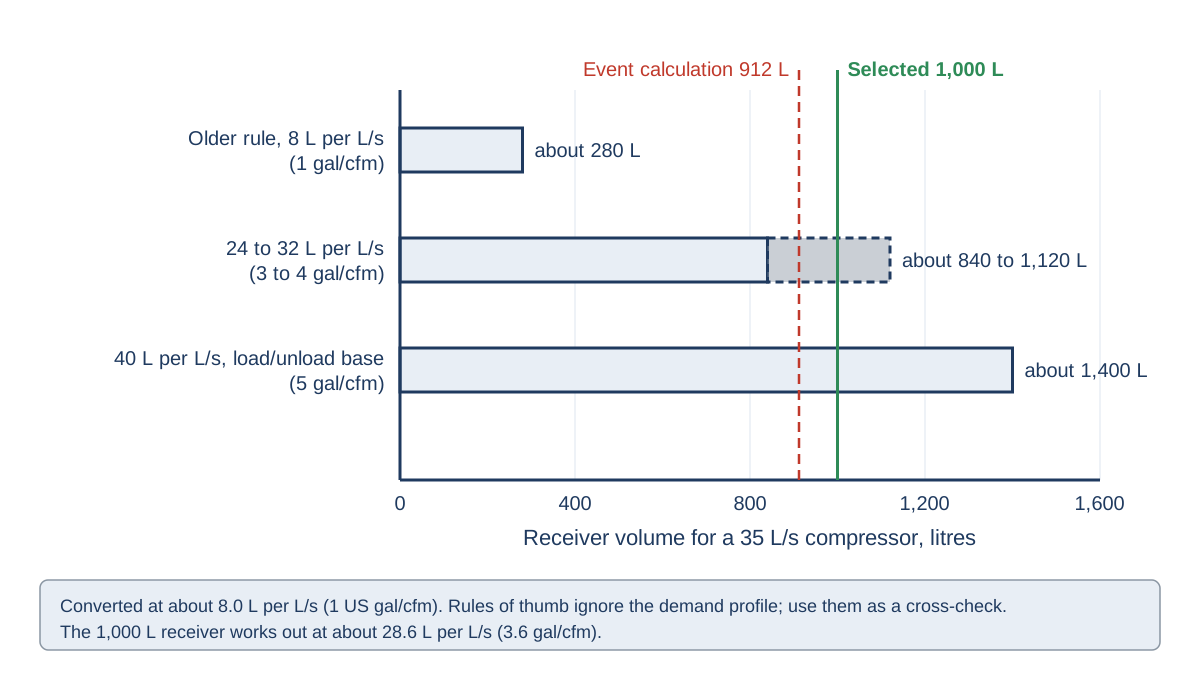
Rules of thumb ignore the demand profile, so use them as a cross-check. The event formula has limits too:
- Fast events. In a sudden drawdown, the air in the receiver cools as it expands. With no heat transfer at all, the usable air between 700 and 600 kPa (7.0 and 6.0 bar) falls to about 73% of the isothermal value, so allow a margin for events lasting only seconds.
- Lost pressure band. Pressure drop between the compressor and the first receiver eats into the usable band, and the NSW Office of Environment and Heritage (2017) reports that losing more than 30% of the band this way is not uncommon.
- Compressor state. If the compressor is unloaded or stopped when the event begins, S is lower for the first part of the event.
- Point of use. For one large intermittent user, a receiver near that user with a check valve and a metering valve can refill slowly between events without disturbing the rest of the system (US Department of Energy 2004).
Australian requirements for air receivers
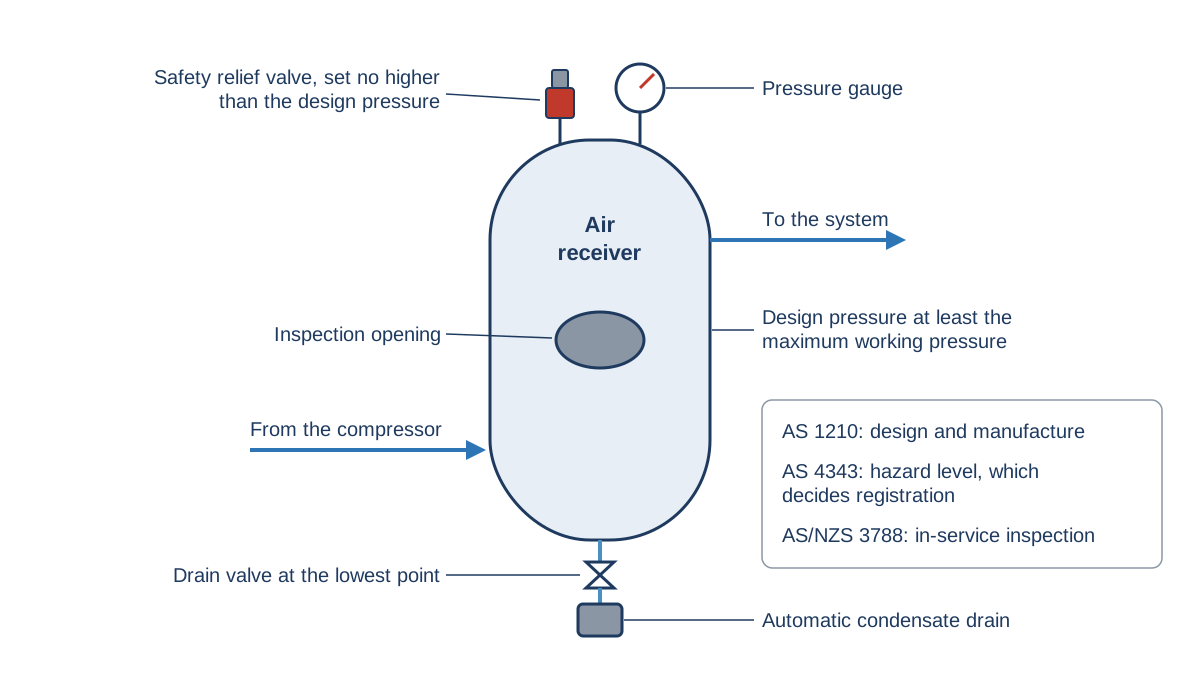
An air receiver is a pressure vessel, so sizing is only part of the decision. AS 1210 sets minimum requirements for the materials, design, manufacture, testing and inspection of pressure vessels (Standards Australia 2010). Safe Work Australia (2015) advises choosing a receiver whose design pressure is at least the maximum working pressure, fitting a safety relief valve set no higher than that design pressure, and fitting a pressure gauge, an inspection opening and a drain valve at the lowest point. Pair that drain with an automatic condensate drain so it is not left to a daily manual task.
Registration depends on the vessel's hazard level, which is determined under AS 4343 (Standards Australia 2014). In Western Australia, pressure vessels in hazard level A, B or C require item registration, although serially produced vessels are excluded (WorkSafe WA 2022). Receivers also need periodic external and internal inspection, and Safe Work Australia (2015) points to AS/NZS 3788 for in-service inspection; the current edition is AS/NZS 3788:2024 (Standards Australia and Standards New Zealand 2024). Check registration and inspection obligations with your state regulator or a competent person.
Key takeaways
- For a demand event, size the receiver with V = t × (C − S) × Pa ÷ (P1 − P2), using L/s, seconds and kPa.
- For load/unload cycling, use V = 900 × Q × Pa ÷ (Z × Δp), which covers the worst case at 50% load.
- Size for the larger of the two results. Halving the allowable pressure drop doubles the receiver.
- Rules of thumb of roughly 24 to 40 litres per L/s are useful cross-checks, not a substitute for the calculation.
- Design to AS 1210, check the AS 4343 hazard level for registration, and inspect in service to AS/NZS 3788.
Frequently asked questions
How do I find the demand C for an event?
Measure it with a flow meter if you can. Otherwise add up the rated air consumption of the tools that run together.
Does a variable speed compressor need as much storage?
Usually less for cycling control, because it matches output to demand instead of loading and unloading. You still need enough storage to ride through demand events and the start-up of a standby compressor, so run the event calculation.
Related reading
- What is Free Air Delivery (FAD)?
- How to size an Air Compressor for your Application
- How does a Zero Air Loss Drain work?
- How much do Compressed Air Leaks cost?
References
- Atlas Copco. 2020. "What Is an Air Receiver?" 10 December 2020. Accessed 15 October 2026. https://www.atlascopco.com/en-uk/compressors/air-compressor-blog/what-is-an-air-receiver.
- Australian Government. n.d. "General Manufacturing." energy.gov.au. Accessed 15 October 2026. https://www.energy.gov.au/business/sector-guides/manufacturing/general-manufacturing.
- Engineering ToolBox. n.d. "Compressed Air Receivers." Accessed 15 October 2026. https://www.engineeringtoolbox.com/compressed-air-receivers-d_846.html.
- Kaeser Kompressoren. n.d. "Calculate Receiver Size." Accessed 15 October 2026. https://www.kaeser.com/int-en/services/know-how/calculator/pressure-vessel-size/.
- Marshall, Ron. 2015. "Optimize Compressed Air Storage to Drive System-Wide Energy Efficiency." Plant Services, 11 March 2015. https://www.plantservices.com/equipment/compressed-air-systems/article/11311881/optimize-compressed-air-storage-to-drive-system-wide-energy-efficiency.
- Mehltretter, Neil. n.d. "When Sizing Met Safety: A Storage Tale." Kaeser Talks Shop. Kaeser Compressors. Accessed 15 October 2026. https://us.kaeser.com/compressed-air-resources/kaeser-talks-shop/when-sizing-met-safety.aspx.
- NSW Office of Environment and Heritage. 2017. Low Capital Cost, Simple Solutions to Improve the Efficiency of Your Compressed Air System. OEH2017/0257. Hosted by Energy NSW. https://www.energy.nsw.gov.au/sites/default/files/2022-08/2017_NSW_CompressedAirGuidepdf.pdf.
- Safe Work Australia. 2015. Compressed Air and Air Receiver Information Sheet. https://www.safeworkaustralia.gov.au/system/files/documents/1703/compressed-air-information-sheet.pdf.
- Standards Australia. 2010. AS 1210-2010 Pressure Vessels. Reaffirmed 2021. Listing accessed via MBIE Codehub, 15 October 2026. https://codehub.building.govt.nz/resources/as-1210-2010-r2021.
- Standards Australia. 2014. AS 4343:2014 Pressure Equipment: Hazard Levels. Listing accessed via ANSI Webstore, 15 October 2026. https://webstore.ansi.org/standards/sai/43432014.
- Standards Australia and Standards New Zealand. 2024. AS/NZS 3788:2024 Pressure Equipment: In-Service Inspection. Listing accessed via ANSI Webstore, 15 October 2026. https://webstore.ansi.org/standards/sai/nzs37882024.
- US Department of Energy. 2004. Energy Tips: Compressed Air, Tip Sheet #9. DOE/GO-102004-1965. Washington, DC: Industrial Technologies Program. https://www1.eere.energy.gov/manufacturing/tech_assistance/pdfs/compressed_air9.pdf.
- US Department of Energy. 2016. Improving Compressed Air System Performance: A Sourcebook for Industry. 3rd ed. Washington, DC: US Department of Energy and Compressed Air Challenge. https://www.energy.gov/sites/prod/files/2016/03/f30/Improving%20Compressed%20Air%20Sourcebook%20version%203.pdf.
- WorkSafe WA. 2022. "What Kinds of Plant Require Registration." Last updated 30 March 2022. Accessed 15 October 2026. https://www.worksafe.wa.gov.au/what-kinds-plant-require-registration.
This article is general information only. Check manufacturer documentation and applicable Australian Standards for your installation, and have pressure equipment assessed by a competent person.