

How does an Oil-Water Separator work?
Ultramax Systems on 15th Oct 2026
Short answer: An oil-water separator treats oily condensate from a compressed air system so the water can go to sewer. It first lets the condensate settle so free oil floats off, then passes the water through oil-attracting (oleophilic) media and a final activated carbon stage. The cleaned water still needs trade waste approval from your local water utility before discharge.
Why compressor condensate contains oil
In a lubricated compressor, air, water vapour and lubricant mix inside the compression stage. As the compressed air cools downstream, the vapour condenses and picks up traces of oil on its way to the drains. The resulting condensate is typically more than 99% water and less than 1% lubricant (SA Performance 2020). That small fraction still matters, because even a little oil can push the discharge outside what a water utility will accept.
That is why lubricant has to come out of condensate before it goes to a sewer, and why plant owners should check with the local sewage authority first (US Department of Energy 2016). Sending the whole volume away as liquid waste is expensive, since almost all of it is water. An oil-water separator splits the two instead. The small quantity of oil is collected as waste, and the treated water can go to sewer under an approval.
How an oil-water separator works
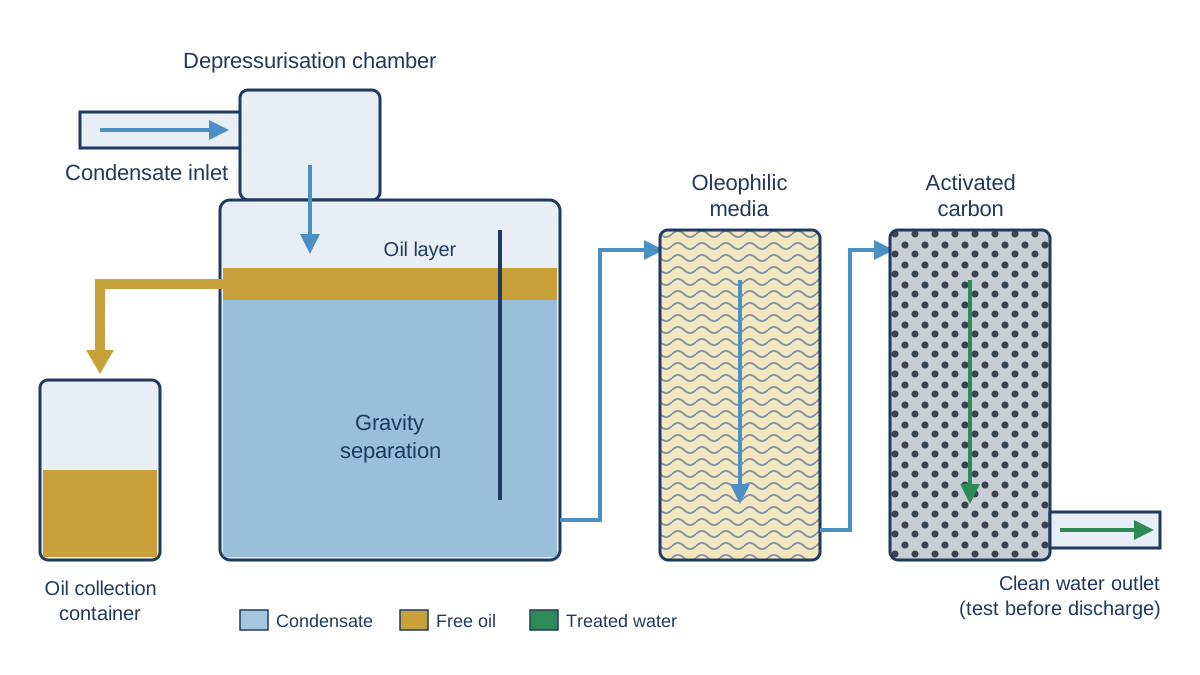
Most separators treat condensate in several stages in series. Each stage removes finer oil than the one before, so the coarse work happens early and the final media only handles what is left.
Relieving the pressure
Condensate arrives from the drains under system pressure, often in short bursts. If it entered the tank at that pressure, it would stir up the contents and remix oil that had already separated. The inlet therefore leads into a pressure relief chamber, which lets the pressure drop without creating turbulence in the separation tank (BEKO Technologies n.d.-a).
Letting gravity do the work
Most compressor oils are lighter than water. In a still tank, free oil rises and forms a layer on the surface, and a weir or overflow carries it into a separate collection container. The longer the condensate stays in the tank, the more oil has time to rise. As a result, tank volume and residence time play a significant role in how well this stage performs (BEKO Technologies n.d.-b).
Capturing fine oil with oleophilic media
Water drawn from the lower part of the tank still carries fine oil droplets. It next flows through oleophilic media, a material that attracts oil but lets water pass. Atlas Copco (n.d.), for example, uses a polypropylene filter that adsorbs the oil but not the water.
Polishing with activated carbon
A final activated carbon stage adsorbs the last fine oil droplets before the water leaves the unit. Carbon has a limited capacity, so the earlier stages exist partly to protect it. Parker Hannifin (2018) uses oil-absorbing pre-filters to take up the bulk contamination, which helps the carbon stage last longer.
Sizing an oil-water separator
An undersized separator can overload and pass oily water, so sizing deserves care. Three factors drive it: compressor capacity, climate zone and oil type (BEKO Technologies n.d.-b). Larger compressors produce more condensate. Hot, humid sites produce far more water than dry ones, which is why a unit sized in a mild season can struggle in summer. Different lubricants also separate differently and load the media at different rates.
Oil type needs extra thought where several compressors feed one separator. SA Performance (2020) cautions that mixing lubricant types in a single unit can reduce its efficiency, so a common lubricant across the connected compressors is preferable.
Stable emulsions need different treatment
Gravity separation relies on oil and water parting naturally. That happens with dispersed condensate, where oil rises over time, but not with emulsified condensate, which stays stable (BEKO Technologies n.d.-b). Some synthetic lubricants, such as polyalkylene glycols (PAGs), hold more water and tend to stay emulsified (SA Performance 2020).
BEKO Technologies (n.d.-a) states that its multi-stage gravity separators are not suitable for stable emulsions. Instead, emulsions typically need an emulsion-splitting unit or collection by a licensed waste contractor. The drain type plays a part too, because discharge through timer drains can cause emulsification (BEKO Technologies n.d.-a). That is one reason to pair a separator with zero air loss drains.
Trade waste and stormwater rules in Australia
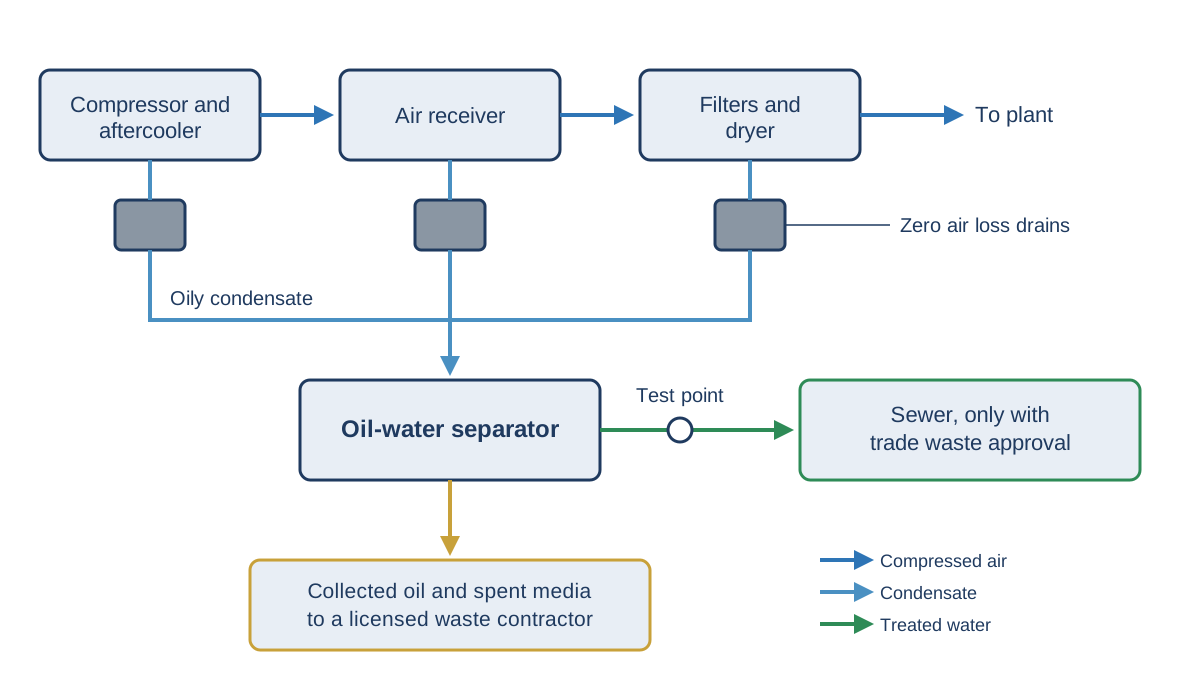
Australian water utilities control what businesses send to sewer. In Western Australia, Water Corporation (n.d.) defines trade waste as any wastewater discharged from a business other than from office facilities or staff amenities, and a permit is needed before discharge. Condensate from a workshop or plant typically falls within that kind of definition, so the separator outlet is part of the permit discussion.
Conditions in other states show what this can look like in practice. SA Water (2017) requires formal approval in the trade waste authorisation, expects pretreatment for traditional oils and does not allow spent compressor oil to go to sewer. In Sydney, pre-treatment equipment generally has to come from the utility's approved list and be installed and maintained to the manufacturer's instructions and the Plumbing Code of Australia (Sydney Water n.d.). Limits and conditions vary between utilities, so confirm the current requirements with your own utility before connecting a separator outlet to sewer.
Oily condensate does not belong in stormwater either. EPA Victoria (2025) applies the general environmental duty to stormwater, which means preventing waste from entering stormwater drains so far as reasonably practicable. Western Australian guidance for workshops that service machinery and industrial plant takes the same line: waste oils and lubricants should not go to soak wells, stormwater drains or land, and oil-bearing effluent should pass through a physical separator (Department of Water 2013).
Service and testing
A separator only protects the sewer while its media still has capacity, so routine checks matter. A simple turbidity test is common: draw a weekly sample from the test valve and compare it with a reference jar. If the sample is as cloudy as the reference, or cloudier, the filters are due for replacement (BEKO Technologies n.d.-a). Some units also carry a service indicator that shows when the filter is saturated, with a recommended service interval of 4,000 hours on certain models (Atlas Copco n.d.).
Visual checks have limits, because they can miss residual oil (SA Performance 2020). Where your permit requires it, a water testing laboratory can confirm the outlet quality. The collected oil and spent media are waste in their own right, so a licensed contractor should handle them.
Common mistakes
Most separator problems start when the unit is treated as an afterthought. Sizing on compressor power alone ignores summer humidity, when condensate loads are typically highest. Changing oil type without checking compatibility can leave the unit facing an emulsion it cannot split, and an outlet without a permit or test results leaves the business exposed.
Key takeaways
- Oil-water separators use gravity, oleophilic media and activated carbon in stages.
- Size the unit on compressor capacity, climate and oil type.
- Stable emulsions from some synthetic oils typically need other treatment.
- Sewer discharge needs trade waste approval, and oily condensate should stay out of stormwater.
- Test the outlet regularly and replace media on schedule.
Frequently asked questions
Do oil-free compressors need an oil-water separator?
Condensate from oil-free compressors contains little or no compressor oil, but it can still carry contaminants drawn in with the intake air. Check with your water utility about what treatment, if any, applies.
Can I use a biodegradable compressor oil instead?
Some utilities accept specific approved biodegradable coolants without separation, and SA Water (2017) publishes a list of approved products. Confirm approval with your own utility first.
How does filtration upstream affect the separator?
Coalescing filters remove oil aerosols from the air and drain them as condensate, so that oil also ends up at the separator. Read more in What is a coalescing filter?
Related Ultramax products
- Nano S oil-water separators: Ultramax condensate separators.
- Alternative condensate separator kits: replacement media to suit other separator brands.
- Condensate management systems: drains, separators and manifold kits.
References
- Atlas Copco. n.d. "OSC 625 Oil-Water Separator." Accessed 13 October 2026. https://shopct.atlascopco.com/en-GB/products/8102046706/osc-625.
- BEKO Technologies. n.d.-a. ÖWAMAT M1 and M2: Instructions for Installation and Operation. Neuss: BEKO Technologies. https://www.beko-technologies.com/fileadmin/beko-technologies.com/EN/manuals_en/oewamat/oewamat_m1_m2_manual_gb_02-061_0602.pdf.
- BEKO Technologies. n.d.-b. "The Right Treatment for Every Condensate." Accessed 13 October 2026. https://beko-technologies.com/en-en/magazine/detail/the-right-treatment-for-every-condensate.
- Department of Water. 2013. WQPN 28: Mechanical Servicing and Workshops. Water Quality Protection Note. Updated 23 June 2022. Published by the Department of Water and Environmental Regulation, Western Australia. https://www.wa.gov.au/system/files/2022-04/WQPN-28-Mechanical-servicing-and-workshops.pdf.
- EPA Victoria. 2025. "Stormwater." Updated 7 May 2025. Accessed 14 October 2026. https://www.epa.vic.gov.au/stormwater.
- Parker Hannifin. 2018. Zero Loss Condensate Drains and Oil/Water Separators. Brochure BROCONDENSATE-00-EN. https://pharmaceutical.yodify.com/Documentation/Document/XVwyR/BROCONDENSATE-00-EN.pdf.
- SA Performance. 2020. "Lubricant Chemistry and Oil/Water Separator Performance." Compressed Air Best Practices, 29 March 2020. Accessed 13 October 2026. https://www.airbestpractices.com/technology/air-treatment-n2/lubricant-chemistry-and-oilwater-separator-performance.
- SA Water. 2017. Air Compressor Condensate Water: Discharge to Sewer. Fact sheet. https://www.sawater.com.au/__data/assets/file/0003/11388/Air-compressor-condensate-water-discharge-to-sewer.pdf.
- Sydney Water. n.d. "Grease Traps and Other Pre-treatment." Accessed 14 October 2026. https://www.sydneywater.com.au/your-business/managing-trade-wastewater/grease-traps-treatment-equipment.html.
- US Department of Energy. 2016. Improving Compressed Air System Performance: A Sourcebook for Industry. 3rd ed. Washington, DC: US Department of Energy and Compressed Air Challenge. https://www.energy.gov/sites/prod/files/2016/03/f30/Improving%20Compressed%20Air%20Sourcebook%20version%203.pdf.
- Water Corporation. n.d. "Trade Waste." Accessed 13 October 2026. https://www.watercorporation.com.au/Help-and-advice/Trade-waste.
This article is general information only. Check manufacturer documentation and applicable Australian Standards for your installation.