
What is Free Air Delivery (FAD)?
Ultramax Systems on 15th Oct 2026
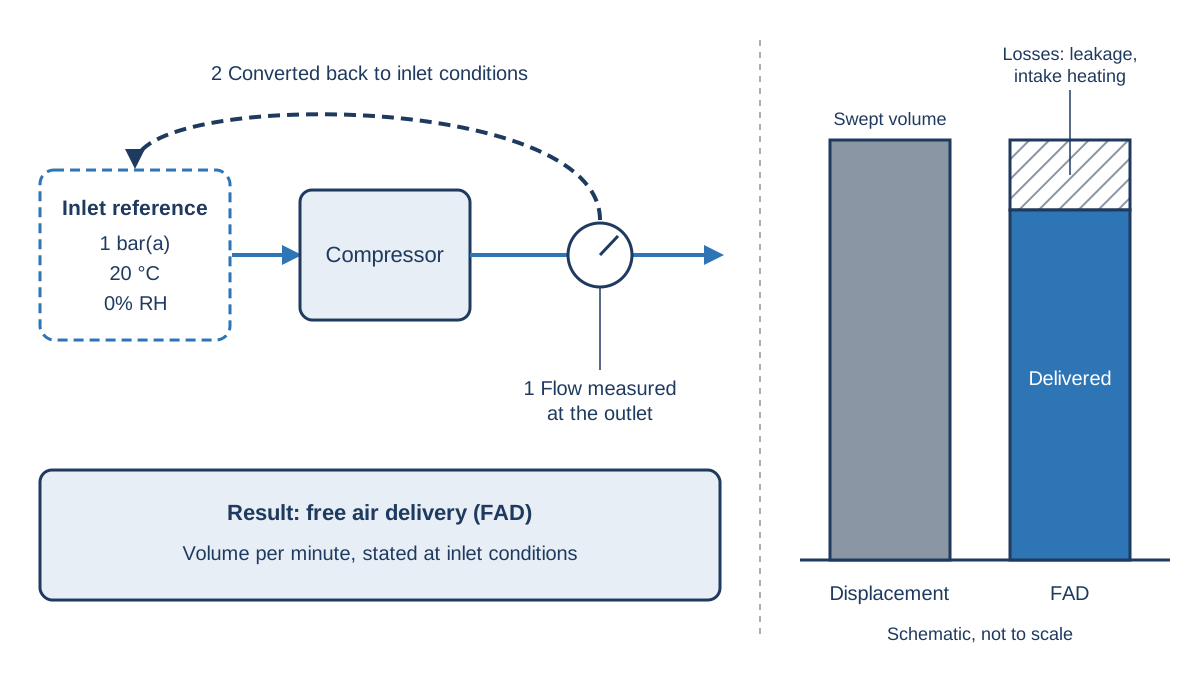
Short answer: Free air delivery (FAD) is the volume of air a compressor actually delivers, measured at its outlet and converted back to the conditions at its inlet. It is the figure to use when you size a compressor or compare two machines. Displacement, by contrast, is the swept volume of the rotors or pistons, and it is typically higher than FAD.
Definition
"Free air" is air at the compressor's inlet conditions, which are typically close to ambient temperature and pressure (Atlas Copco n.d.). FAD expresses the delivered flow in those terms, so it describes how much surrounding air the machine has taken in, not its compressed volume. It is usually quoted in litres per second (l/s), cubic metres per minute (m³/min) or cubic feet per minute (cfm).
Why it matters
FAD tells you how much useful air reaches your system. It is the number to match against what your tools and processes consume. Avoiding oversizing is key to getting the most from a high-efficiency replacement compressor (Australian Government n.d.). Every litre lost through a compressed air leak is FAD you have paid to produce.
A compressor's rated flow is also the starting point for a simple air audit. The NSW Office of Environment and Heritage (2017) estimates a compressor's average flow by multiplying its rated flow in m³/min by the share of time it runs loaded, timed with a stopwatch. If it is not on the data plate, the guide suggests checking the brochure or asking your service company.
How it is measured
Acceptance tests for the flow rate and power of displacement compressors, including rotary screw machines, follow ISO 1217 (ISO 1217:2009). The flow is measured at the outlet, not the inlet (Fischer 2018). Water vapour is then deducted to find the dry air flow, and the result is converted back to the stated inlet conditions (Atlas Copco n.d.).
Reference conditions matter, because the same air gives a different number at another temperature or pressure. Atlas Copco (n.d.) states that, unless noted otherwise, its data sheet FAD figures use reference inlet conditions of 1 bar(a), 20 °C and 0% relative humidity. Other makers may use other conditions, so check before you compare.
As Rauer (2013) explains, US members of the Compressed Air and Gas Institute (CAGI) publish rotary compressor data sheets based on ISO 1217, testing fixed-speed units to Annex C and variable-speed units to Annex E, with values open to third-party verification.
FAD versus displacement
Displacement is the volume swept by the first-stage compressing elements per unit of time (ISO 1217:2009). FAD is typically lower, because some air leaks back inside the compressor and the intake air warms as it enters. The ratio of actual delivered flow to displacement is the volumetric efficiency (ISO 1217:2009).
Why temperature and altitude matter
FAD is a volume, not a mass. A cubic metre of hot or thin air therefore holds less air than a cubic metre of cool, dense air. Humidity adds to the effect, because water vapour takes up part of the intake volume. Fischer (2018) gives the example of a hot tropical day of 32 °C and 75% relative humidity, when the dry air volume can be about 3.5% less than the intake volume. It is one reason to keep compressor inlet air from being unnecessarily warm or humid (Australian Government n.d.).
Altitude works in a similar way. Van Ormer and van Ormer (2022) report that an injected-cooled single-stage rotary loses only slightly more than 3% of its rated capacity at 10,000 ft (about 3,050 m). Each cubic metre still contains less air, though, so air tools consume more free air to do the same work at altitude (van Ormer and van Ormer 2022).
Worked example
Some data sheets quote normal flow (Nm³/min) at 0 °C and 1.013 bar(a) instead of FAD. Atlas Copco (n.d.) gives a simple conversion to FAD at 20 °C and 1.00 bar(a), which ignores humidity:
FAD = 1 Nm³/min × (293.15 K ÷ 273.15 K) × (1.013 bar ÷ 1.00 bar) ≈ 1.09 m³/min
The same air therefore appears about 9% larger when stated as FAD. Compare like with like before you choose a machine.
Related terms
- Normal flow (Nm³/min): flow referred to a fixed standard condition.
- Specific power: input power per unit of FAD, used to compare efficiency.
See where FAD comes from in How does a rotary screw compressor work?.
Related Ultramax products
- Flow meters: measure delivered air at the point of use.
- Pressure gauges: check discharge and line pressure.
- Compressor spare parts and service kits: keep rated output with timely servicing.
References
- Atlas Copco. n.d. "Understanding Air Compressor Measurements: Work, Power, and Flow." Accessed 13 October 2026. https://www.atlascopco.com/en-th/compressors/wiki/compressed-air-articles/physics-physicalunits2.
- Australian Government. n.d. "Compressed Air." energy.gov.au. Accessed 14 October 2026. https://www.energy.gov.au/business/equipment-guides/compressed-air.
- Fischer, Thomas. 2018. "Measuring Performance of Installed Air Compressors." Compressed Air Best Practices. Accessed 13 October 2026. https://www.airbestpractices.com/technology/air-compressors/measuring-performance-installed-air-compressors.
- ISO (International Organization for Standardization). 2009. ISO 1217:2009 Displacement Compressors: Acceptance Tests. 4th ed. Geneva: ISO. https://www.iso.org/standard/44769.html.
- NSW Office of Environment and Heritage. 2017. Low Capital Cost, Simple Solutions to Improve the Efficiency of Your Compressed Air System. Sydney: NSW Office of Environment and Heritage. https://www.energy.nsw.gov.au/sites/default/files/2022-08/2017_NSW_CompressedAirGuidepdf.pdf.
- Rauer, Werner. 2013. "CAGI Data Sheets: An Apples To Apples Performance Comparison." Industrial Maintenance and Plant Operation. Accessed 13 October 2026. https://www.impomag.com/home/article/13216400/cagi-data-sheets-an-apples-to-apples-performancecomparison.
- Van Ormer, Hank, and Don van Ormer. 2022. "The Impact of Altitude on Air Compressor and Tool Sizing." Compressed Air Best Practices. Accessed 13 October 2026. https://www.airbestpractices.com/technology/air-compressors/the-impact-of-altitude-on-air-compressor-and-tool-sizing.
This article is general information only. Check manufacturer documentation and applicable Australian Standards for your installation.