
What is a Hopcalite Filter and how does it remove Carbon Monoxide?
Ultramax Systems on 15th Oct 2026
Short answer: A hopcalite filter is a bed of copper and manganese oxide catalyst that converts carbon monoxide (CO) into carbon dioxide (CO2) at room temperature. In a breathing air purifier it sits after the dryer, because water vapour deactivates the catalyst. It does not remove CO2, and it does not replace a CO monitor.
What is hopcalite?
Hopcalite is the name given to a family of catalysts made mainly from copper and manganese oxides. Chemically it is a copper manganese mixed oxide, and its value lies in one useful ability: it can oxidise carbon monoxide under ambient conditions (Biemelt et al. 2015). That matters because breathing air equipment runs at normal plant temperatures, with no heater to drive the reaction. The chemistry is also far from new. Lamb, Bray, and Frazer (1920) published on the removal of carbon monoxide from air more than a century ago, and a catalyst stage for CO is still part of modern breathing air purifiers (Parker Hannifin 2015).
How a hopcalite filter removes carbon monoxide
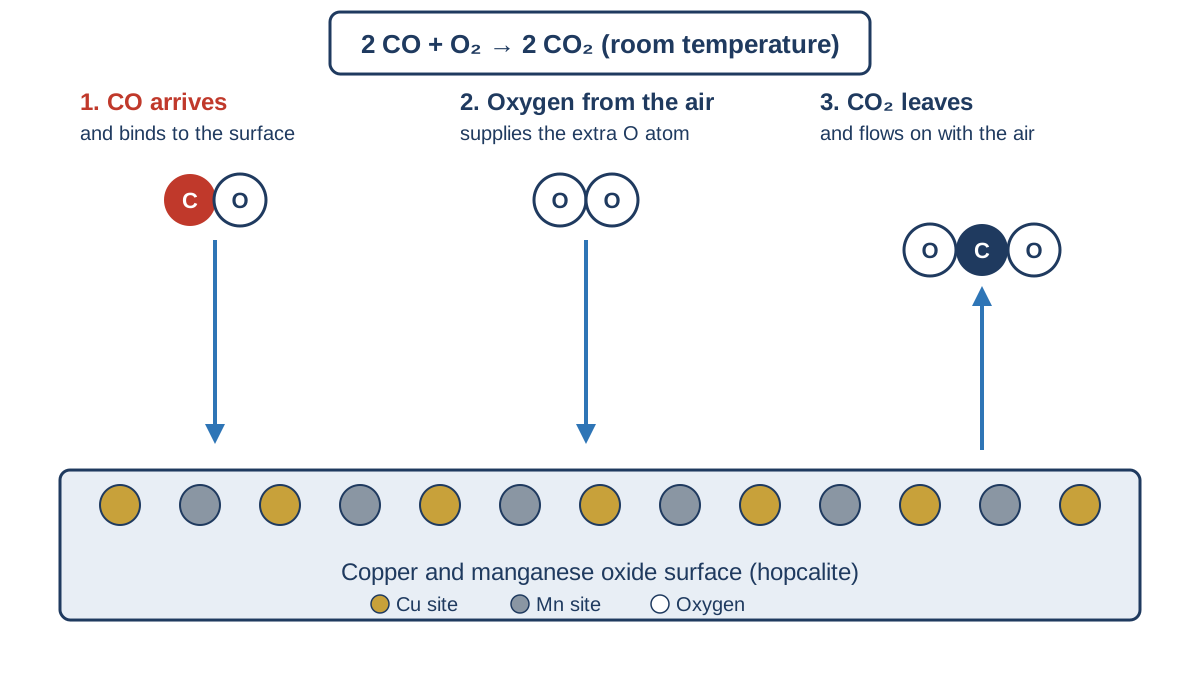
A purifier does not trap CO the way it traps oil or dust. In the purifier design that Parker Hannifin (2015) describes, activated carbon handles oil vapour and odours, while a separate catalyst stage deals with CO. Hopcalite works as a catalyst, not a trap. CO molecules attach to the oxide surface, react with oxygen already present in the air and leave as CO2. The catalyst is not used up, although it can lose activity over time.
Why moisture matters
Water vapour is the main threat to a hopcalite bed. As Biemelt et al. (2016) report, conventional commercial hopcalites "immediately deactivate under humid conditions". As a result, the catalyst only works reliably when the air reaching it is already dry. That is why designers place a drying stage, usually an adsorption (desiccant) dryer, upstream of the bed.
Where the hopcalite bed sits in a breathing air purifier
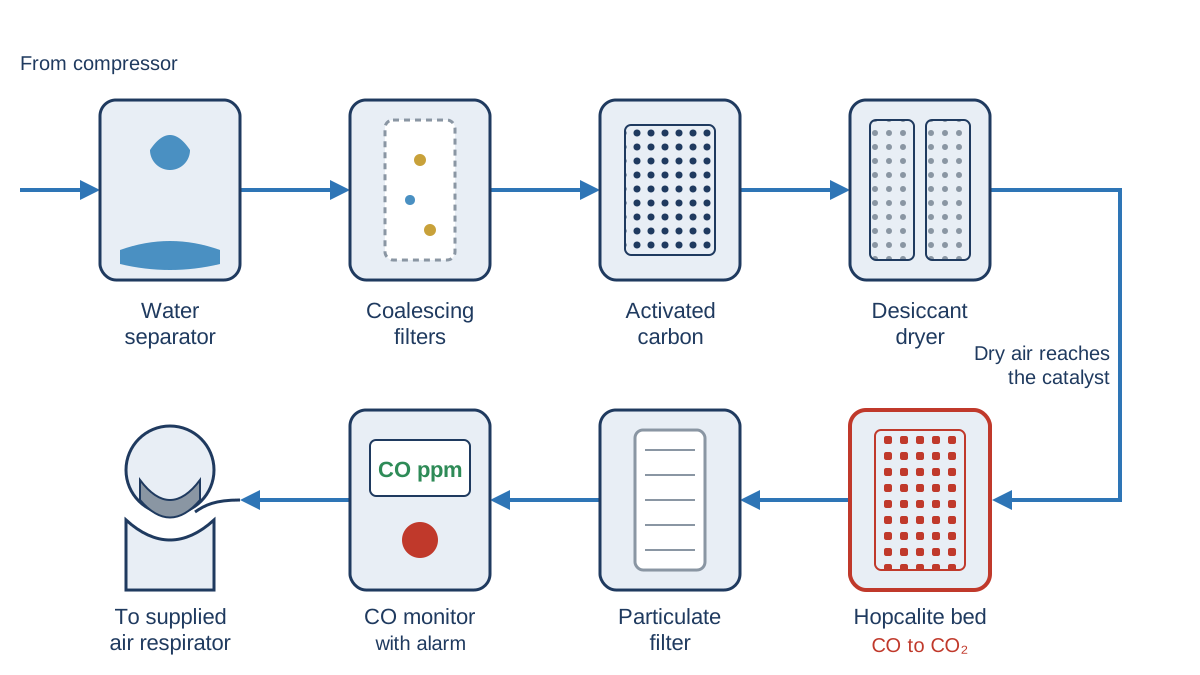
A breathing air purifier treats air from a standard industrial compressor in stages, and each stage protects the next. In one six-stage layout, an inlet filter or water separator first removes bulk water and dirt. A high efficiency coalescing filter then takes out oil and water aerosols, and an activated carbon stage removes oil vapour and odours. Next comes an adsorption dryer, rated to a -40 °C pressure dew point in that design. The catalyst stage follows and converts CO to CO2, and a final dry particulate filter catches dust carried over from the adsorbent beds (Parker Hannifin 2015).
Other designs order some stages differently, but the catalyst normally follows the dryer. A CO monitor with an alarm then checks the treated air before it reaches the user.
Where does CO in compressed air come from?
Carbon monoxide usually reaches breathing air by one of three routes. Lubricating oil in an overheating oil-lubricated compressor can break down and form CO, and petrol or diesel engines on portable compressors produce it in their exhaust. A poorly placed intake can also draw in exhaust from the compressor's own engine, from vehicles or from nearby plant (WorkSafe Queensland n.d.). That is why WorkSafe WA (2022) wants breathing air compressor intakes well away from contaminant sources, particularly exhaust from mobile liquid fuel engines. The danger is that the person on the end of the hose gets no warning, because CO has no odour (SafeWork NSW 2023).
Australian rules for supplied breathing air
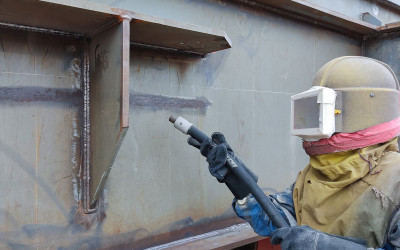
Hopcalite matters most where people breathe compressed air for a whole shift. The model Codes of Practice from Safe Work Australia (n.d.-a, n.d.-b) call for airline positive pressure hoods or helmets in abrasive blasting, and for supplied air respirators in many spray painting tasks with two-part epoxy and polyurethane paints. Western Australia's abrasive blasting code adds more detail. Respirator helmets must receive breathing air of adequate quality, air-fed respirators should have an alarm that warns and logs carbon monoxide, and breathing air quality should be tested regularly (WorkSafe WA 2022).
For the air quality itself, these codes point to AS/NZS 1715 (AS/NZS 1715:2009). According to WorkSafe Queensland (n.d.), the standard sets air quality requirements for compressors that supply air respirators, covering CO, CO2, oxygen, moisture and temperature. The same guidance recommends a continuously operating CO monitor with an alarm on oil-lubricated compressors, placed as close to the user as practicable and calibrated as the manufacturer recommends.
The standards are also changing. Standards Australia (2025) is replacing AS/NZS 1715:2009 and AS/NZS 1716:2012 with a suite of 30 ISO-based respiratory standards, and old and new will run in parallel until 2030. Check which edition your regulator or contract refers to, and use a competent person to confirm compliance.
Common mistakes
The most common misunderstanding is that the catalyst removes CO2. It does the opposite: it converts CO into CO2, so any control of CO2 has to come from other stages or from clean intake air. A second mistake is letting the dryer fail, because wet air can quickly reduce the bed's activity and nothing on the housing shows it.
Purifiers are also sometimes treated as the only control, yet intake location, compressor temperature control and maintenance stop CO forming in the first place. Finally, not every breathing air unit handles gases. Some smaller breathing air filter units do not remove CO or CO2 (Parker Hannifin 2015), so check what each unit is rated for. The catalyst and the monitor also do different jobs: a hopcalite bed reduces CO, but only a monitor tells you whether it is still working.
Key takeaways
- Hopcalite is a copper and manganese oxide catalyst that turns CO into CO2.
- Water vapour deactivates it, so it sits after the dryer.
- CO in compressed air commonly comes from hot oil or engine exhaust near the intake.
- AS/NZS 1715 sets breathing air requirements and is moving to ISO-based standards by 2030. Use a competent person to confirm compliance.
- Fit a CO monitor with an alarm. The catalyst does not show when it has failed.
Frequently asked questions
Does a hopcalite filter remove CO2?
No. It converts CO into CO2, so it adds a small amount of CO2. In the six-stage design described above, the adsorption dryer is the stage that reduces CO2 levels (Parker Hannifin 2015).
Can activated carbon remove carbon monoxide?
Not effectively. Activated carbon targets oil vapour and odours. CO needs a catalyst such as hopcalite.
How often should I replace the hopcalite?
Follow the purifier manufacturer's service interval. Replace the catalyst sooner if the CO monitor shows rising readings or if wet air has reached the bed.
Related Ultramax products
- Breathing air systems: complete purification for supplied-air respirators.
- Hopcalite breathing air filters: CO conversion stages and replacement cartridges.
- Breathing air dryers: dry the air ahead of the catalyst.
- Preassembled breathing air filters: ready-to-install filter trains.
Related reading: What is a coalescing filter? and ISO 8573-1 purity classes explained.
References
- Biemelt, T., K. Wegner, J. Teichert, and S. Kaskel. 2015. "Microemulsion Flame Pyrolysis for Hopcalite Nanoparticle Synthesis: A New Concept for Catalyst Preparation." Chemical Communications 51 (27): 5872-5875. https://pubs.rsc.org/en/content/articlehtml/2015/cc/c5cc00481k.
- Biemelt, T., K. Wegner, J. Teichert, M. R. Lohe, J. Martin, J. Grothe, and S. Kaskel. 2016. "Hopcalite Nanoparticle Catalysts with High Water Vapour Stability for Catalytic Oxidation of Carbon Monoxide." Applied Catalysis B: Environmental 184: 208-215. https://doi.org/10.1016/j.apcatb.2015.11.008.
- Lamb, A. B., W. C. Bray, and J. C. W. Frazer. 1920. "The Removal of Carbon Monoxide from Air." Industrial and Engineering Chemistry 12 (3): 213-221. https://doi.org/10.1021/ie50123a007.
- Parker Hannifin. 2015. Breathable Compressed Air. Brochure 174004470_02_EN. Parker domnick hunter. https://iacserv.com/content/IAC_PDF_Files/Brochure/PARKER_BREATHABLE_COMPRESSED_AIR_BROCHURE.pdf.
- Safe Work Australia. n.d.-a. "Model Code of Practice: Abrasive Blasting." Accessed 14 October 2026. https://www.safeworkaustralia.gov.au/doc/model-code-practice-abrasive-blasting.
- Safe Work Australia. n.d.-b. "Model Code of Practice: Spray Painting and Powder Coating." Accessed 14 October 2026. https://www.safeworkaustralia.gov.au/doc/model-code-practice-spray-painting-and-powder-coating.
- SafeWork NSW. 2023. "Carbon Monoxide Technical Fact Sheet." Accessed 13 October 2026. https://www.safework.nsw.gov.au/resource-library/hazardous-chemicals/carbon-monoxide-technical-fact-sheet.
- Standards Australia. 2009. AS/NZS 1715:2009 Selection, Use and Maintenance of Respiratory Protective Equipment. Standards Australia and Standards New Zealand. https://store.standards.org.au/product/as-nzs-1715-2009.
- Standards Australia. 2025. "What You Need to Know: Australia's New Respiratory Protection Standards." 28 April 2025. Accessed 14 October 2026. https://www.standards.org.au/blog/what-you-need-to-know-australias-new-respiratory-protection-standards.
- WorkSafe Queensland. n.d. "Carbon Monoxide in Breathing Air During Air Compressor Use." Accessed 13 October 2026. https://www.worksafe.qld.gov.au/safety-and-prevention/hazards/hazardous-exposures/carbon-monoxide-in-breathing-air-during-air-compressor-use.
- WorkSafe WA. 2022. Abrasive Blasting: Code of Practice. Perth: Department of Mines, Industry Regulation and Safety. https://www.worksafe.wa.gov.au/publications/code-practice-abrasive-blasting-0.
This article is general information only. Check manufacturer documentation and applicable Australian Standards for your installation.