
What is HDPE (PE100) Pipe?
Ultramax Systems on 16th Oct 2026
Short answer: HDPE (PE100) pipe is high-density polyethylene pressure pipe made from a compound rated for a minimum required strength of 10 MPa at 20 °C over 50 years. In compressed air, that class, together with the pipe's SDR and the air temperature, sets how much pressure the pipe can safely carry.
Why it matters
Polyethylene is a common choice for compressed air mains because it does not rust and it is light to handle. Steel pipe can shed rust and scale that ends up loading filters and tools. PIPA (2026a) notes that PE has good chemical resistance and suits most compressor oils. Because it does not conduct electricity, it can also share cable trays with electrical cables. Fusion joints turn pipe and fittings into one continuous system, which removes many of the threaded joints where compressed air leaks usually start. Ultramax stocks poly pipe in coils and straight lengths for this kind of work.
What "PE100" actually means
"HDPE" describes the density family of the plastic. "PE100" is a strength class. The number comes from the compound's minimum required strength (MRS): 10 MPa for PE100 and 8 MPa for the older PE80 grade. As the PE100+ Association (n.d.) explains, makers find it by pressure testing pipe for long periods and extrapolating the results, under ISO 9080, to predict the minimum strength at 20 °C after 50 years. A higher MRS lets a thinner wall carry the same pressure, or the same wall carry more.
PE100-RC is a variant with the same MRS but much higher resistance to slow crack growth, which matters where pipe may be scratched or point loaded. In Australia, PIPA keeps a list of PE80 and PE100 compounds that a panel of pipe makers has assessed against AS/NZS 4131. PIPA (2026b) notes that the listing is a desktop review, not formal product certification.
Australian standards and pipe markings
AS/NZS 4130 is the Australian and New Zealand specification for polyethylene pipe used in pressure applications (AS/NZS 4130:2018). Its companion, AS/NZS 4129:2020, covers fittings for that pipe and names compressed air among the fluids in scope. Design and installation fall under AS/NZS 2033, which the 2024 edition widened from polyethylene to all polyolefin pipe systems (AS/NZS 2033:2024).
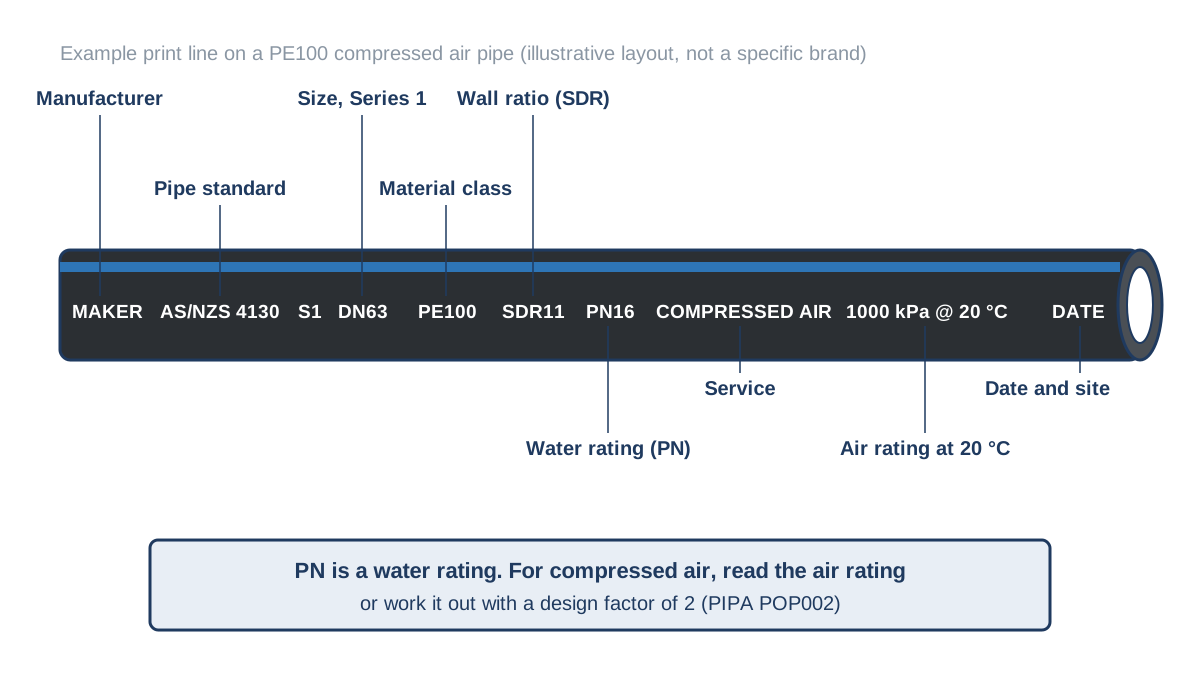
For compressed air, PIPA's industry guideline POP002 asks for pipe with AS/NZS 4130 Series 1 dimensions. The print line should state the service ("Compressed Air") and the operating pressure at 20 °C, along with the size, SDR, PE grade, standard and date (PIPA 2026a). Read the marking before you install the pipe, not after.
Where PE suits a compressed air system
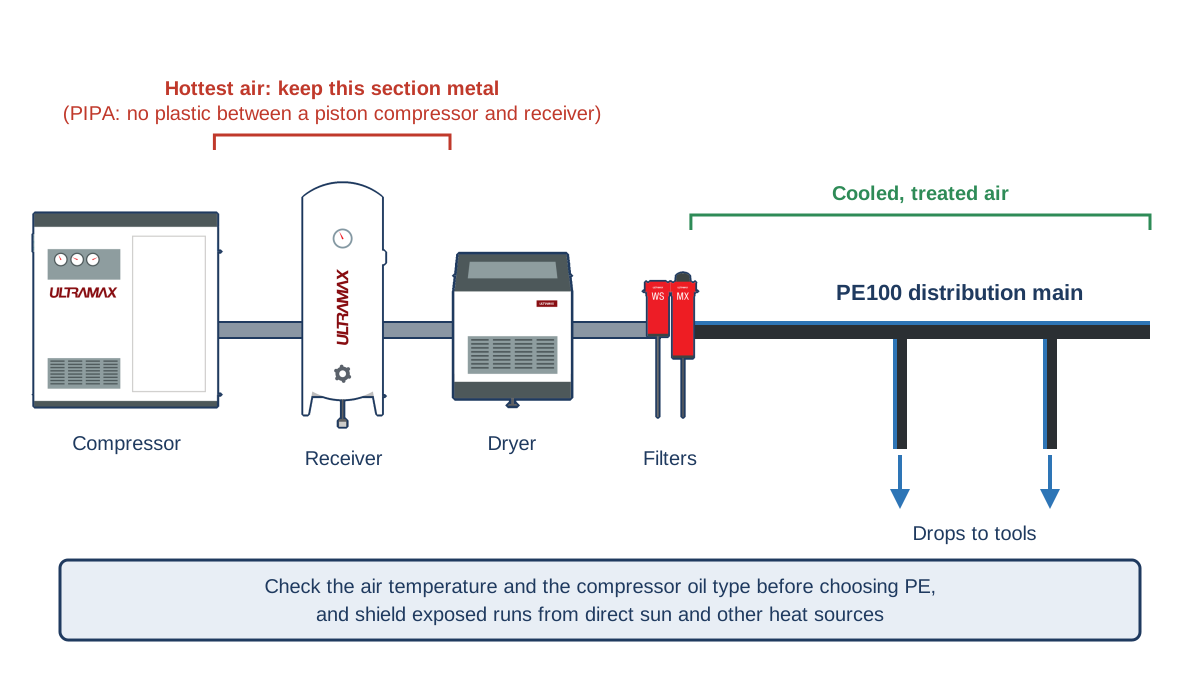
Heat is the main limit. Air leaving a compressor can be well above room temperature, so PIPA advises against plastic between a piston compressor and its receiver. Shield exposed runs from direct sun and other heat sources too. Up to 40 °C, PIPA (2026a) expects a system life of more than 50 years, but allowable pressure drops as temperature rises. An aftercooler that is working properly helps here. So does fixing a compressor that runs hot.
Oil type matters as well. Some synthetic compressor oils, including aromatic, polyester and di-ester types, may not suit PE, so check with the pipe maker if you are unsure. Black pipe copes with outdoor UV better than coloured pipe, which carries less effective stabilisers (PIPA 2026a).
What to check
- Pressure rating: the PN figure on the pipe is a water rating. Compressed air ratings are lower, as What is SDR in Poly Pipe? explains.
- Joints: use fusion fittings or mechanical fittings the maker rates for compressed air, and avoid fabricated fittings (PIPA 2026a). See What is Electrofusion Welding?
- Connections to valves and plant: flanged joints need a PE stub and a metal backing ring. See What is a Stub Flange?
- Installers: PIPA expects suitably qualified people working to the manufacturer's instructions.
Related terms
- SDR: the ratio of outside diameter to wall thickness. See What is SDR in Poly Pipe?
- Electrofusion: joining PE with fittings that carry their own heating wire. See What is Electrofusion Welding?
- Stub flange: the PE end that lets poly pipe bolt to a valve or metal flange. See What is a Stub Flange?
References
- PE100+ Association. n.d. "What Is the Meaning of the Designations PE80, PE100 and PE100-RC?" Accessed 16 October 2026. https://www.pe100plus.com/PE-Pipes/Technical-guidance/model/Materials/mrs/What-is-the-meaning-of-the-designations-PE80-and-PE100-i254.html.
- Plastics Industry Pipe Association of Australia (PIPA). 2026a. Polyethylene (PE) Pipes and Fittings for Compressed Air. Industry Guideline POP002, Issue 7. https://pipa.com.au/wp-content/uploads/2026/06/POP002_PE_pipes_and_fittings_for_compressed_air_V7_June_26.pdf.
- Plastics Industry Pipe Association of Australia (PIPA). 2026b. Polyethylene Pipe and Fittings Compounds. Industry Guideline POP004, Issue 51. https://pipa.com.au/wp-content/uploads/2026/10/PIPA_POP004_Polyethylene_Pipe_and_Fittings_Compound_Issue_51_Oct_2026.pdf.
- Standards Australia. 2018. AS/NZS 4130:2018 Polyethylene (PE) Pipes for Pressure Applications. Standards Australia and Standards New Zealand. https://store.standards.org.au/product/as-nzs-4130-2018.
- Standards Australia. 2020. AS/NZS 4129:2020 Fittings for Polyethylene (PE) Pipes for Pressure Applications. Standards Australia and Standards New Zealand. https://store.standards.org.au/product/as-nzs-4129-2020.
- Standards Australia. 2024. AS/NZS 2033:2024 Design and Installation of Polyolefin Pipe Systems. Standards Australia and Standards New Zealand. https://store.standards.org.au/product/as-nzs-2033-2024.
This article is general information only. Check manufacturer documentation and applicable Australian Standards for your installation.