

Compressor Overheating: Causes and Fixes
Ultramax Systems on 16th Oct 2026
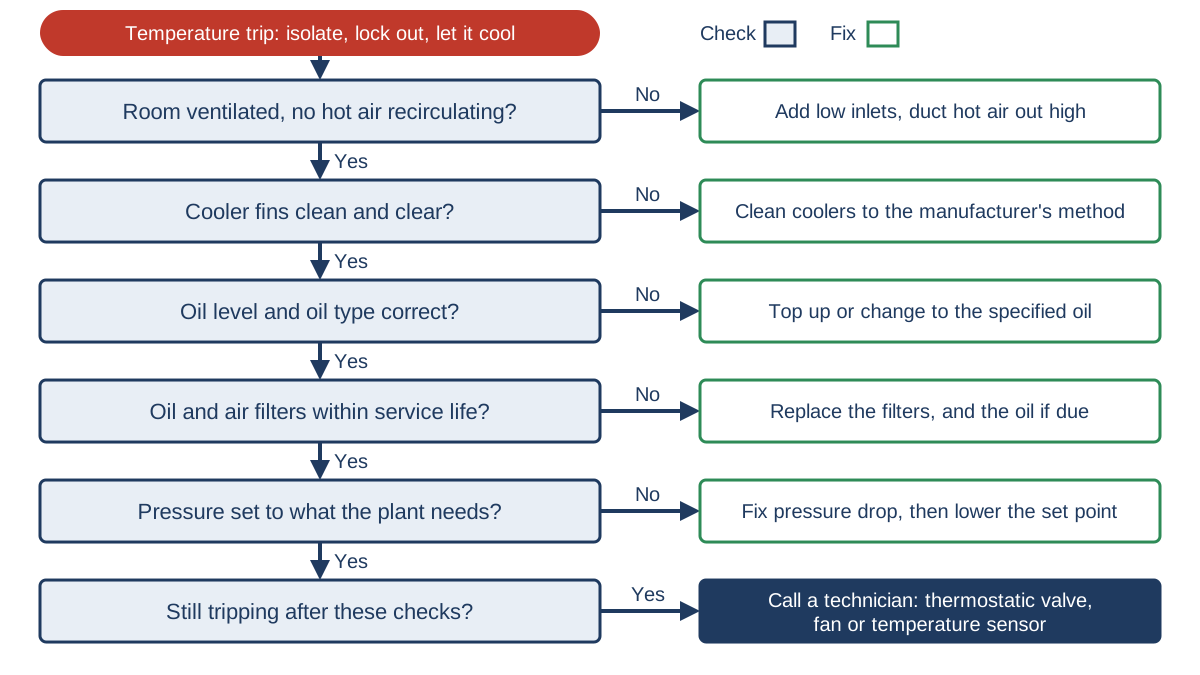
Short answer: Compressor overheating happens when the machine makes more heat than its cooling system can remove. In most cases the cause is hot or poorly ventilated surroundings, dirty coolers, an oil problem or a machine working harder than it should. Start with the room and the coolers, then check oil level, filters and settings. Leave internal faults such as thermostatic valves to a qualified technician.
What the symptom tells you
Compressing air turns most of the motor's energy into heat. In an oil-injected screw compressor, the oil carries much of that heat away from the airend before it passes through a cooler (US Department of Energy 2016). Fans then push room air across the oil and air coolers. If any link in that chain weakens, discharge temperature rises. As Atlas Copco (n.d.-b) explains, most packages protect themselves with a discharge temperature switch that shuts the compressor down when heat becomes excessive.
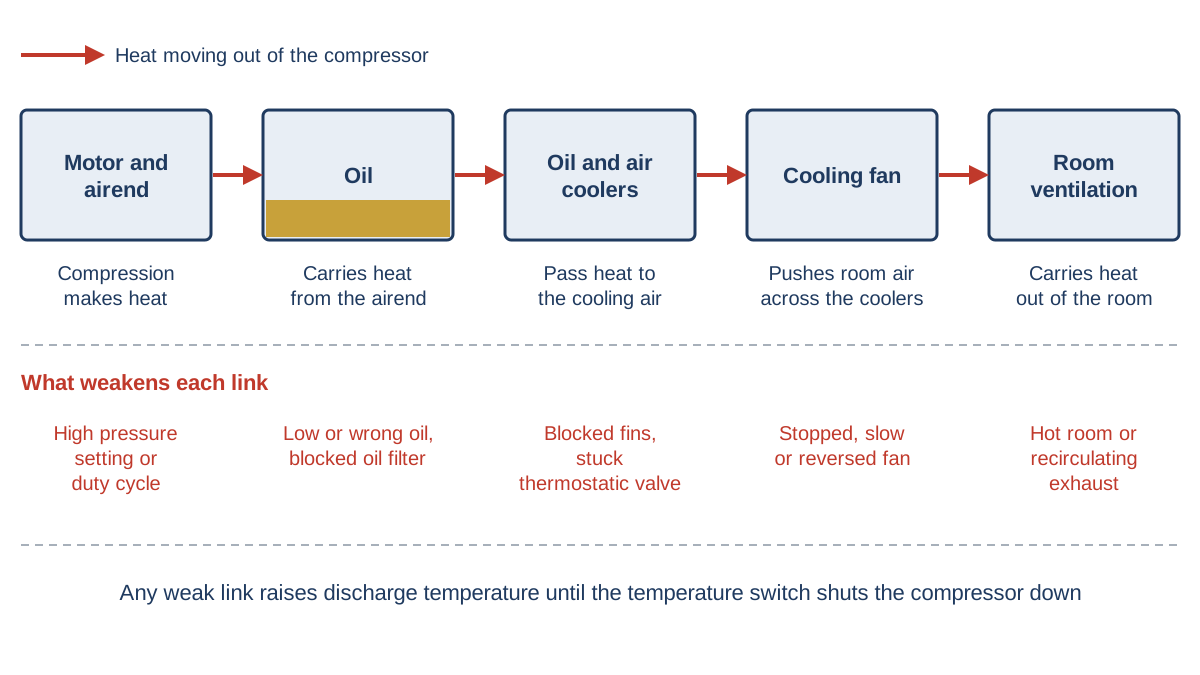
Australian conditions make this a common summer problem. Atlas Copco (n.d.-c) notes that some areas reach up to 50 °C at the peak of the Australian summer in January, and a compressor room is usually hotter still. For how the oil circuit works, see How does a Rotary Screw Compressor work?
Quick-check table
| Likely cause | How to check | Fix |
|---|---|---|
| Hot or poorly ventilated room | Compare room temperature with outside air; look for blocked vents or recirculating exhaust | Add low inlets, duct hot air out high, clear obstructions |
| Blocked coolers | Inspect cooler fins for dust, oil mist and debris | Clean coolers to the manufacturer's method |
| Low or wrong oil | Check the sight glass with the machine stopped; confirm oil type | Top up or change to the specified lubricant |
| Blocked oil filter | Check the service hours or filter differential indicator | Replace the oil filter, and the oil if it is due |
| Faulty thermostatic valve | Oil cooler stays cool while discharge temperature climbs | Technician to test and replace the valve element |
| High discharge pressure | Compare set pressure with what the plant really needs | Lower the setting and fix pressure drop downstream |
| Fan fault | Listen and look for a stopped, slow or reversed fan | Technician to repair motor, belt, wiring or blades |
| High duty cycle | Review load hours against total running hours | Reduce demand and leaks, or add capacity |
Causes in detail
Poor ventilation or a hot compressor room
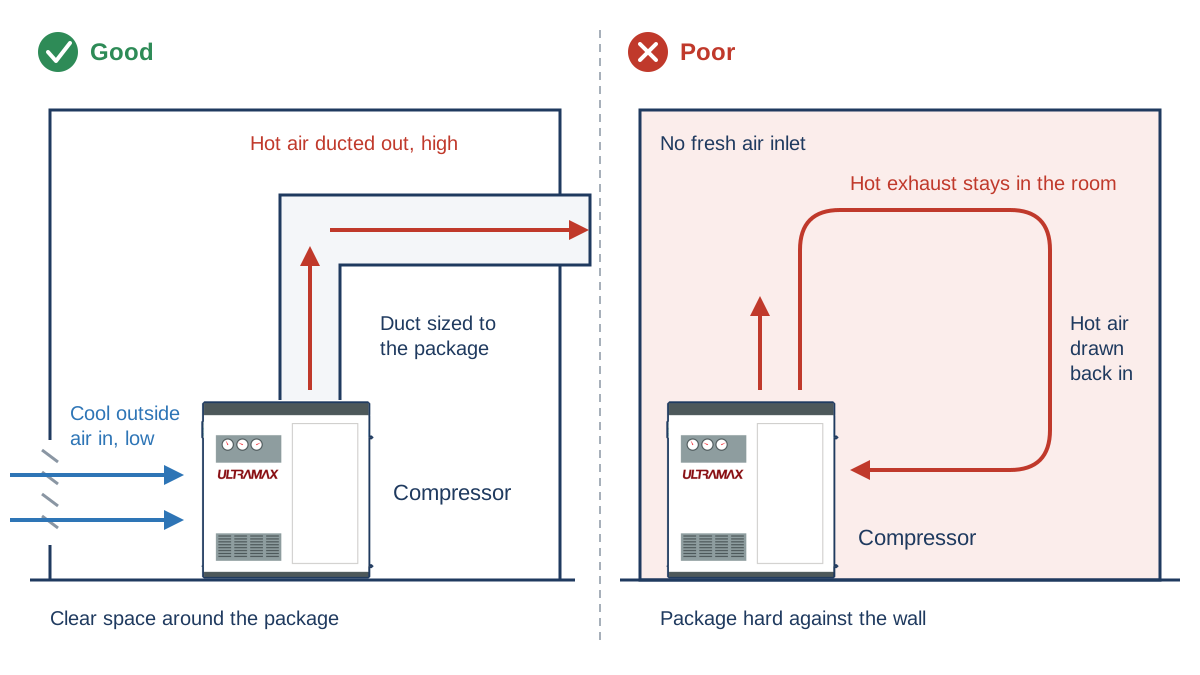
An air-cooled compressor releases nearly all of its motor's energy as heat into the cooling air, so the room must carry that heat away (Atlas Copco n.d.-a). Atlas Copco's room design guidance suggests enough ventilation to limit the temperature rise in the room to about 7 to 10 °C. It places the inlet low on one wall and thermostat-controlled fans high on the opposite wall, with inlet air velocity no more than 4 m/s. Hot exhaust that recirculates back into the cooler inlet is a frequent culprit (Atlas Copco n.d.-d). The energy.gov.au equipment guide also advises keeping compressor inlet air from being unnecessarily warm, humid or dirty (Australian Government n.d.).
Blocked coolers
Oil and air coolers are fine-finned radiators. Dust, lint and oil mist build up on the fins and cut airflow through them. Atlas Copco (n.d.-c) warns that blocked coolers can make a compressor overheat on hot summer days and recommends cleaning them before peak temperatures arrive. Dusty sites such as mines and sawmills may need more frequent cleaning.
Low or wrong oil
Oil is the main coolant in a screw compressor, so a low level shows up quickly as heat. The wrong oil can do the same. Atlas Copco (n.d.-b) lists insufficient lubrication and oils with poor heat transfer among the causes of overheating. Use the compressor lubricant the manufacturer specifies for your model and duty, and check the level at the sight glass with the machine stopped. Thin or watery-looking oil can be a sign the machine is already running too hot (Atlas Copco n.d.-c).
Blocked oil filter
A clogged oil filter restricts flow to the airend. Less oil means less cooling, and many filters open an internal bypass when blocked, which then lets unfiltered oil through. Replace oil filters at the service interval, or sooner if a differential indicator shows they are loading up. A dirty compressor air filter also makes the machine work harder for the same output, so change both together.
Faulty thermostatic valve
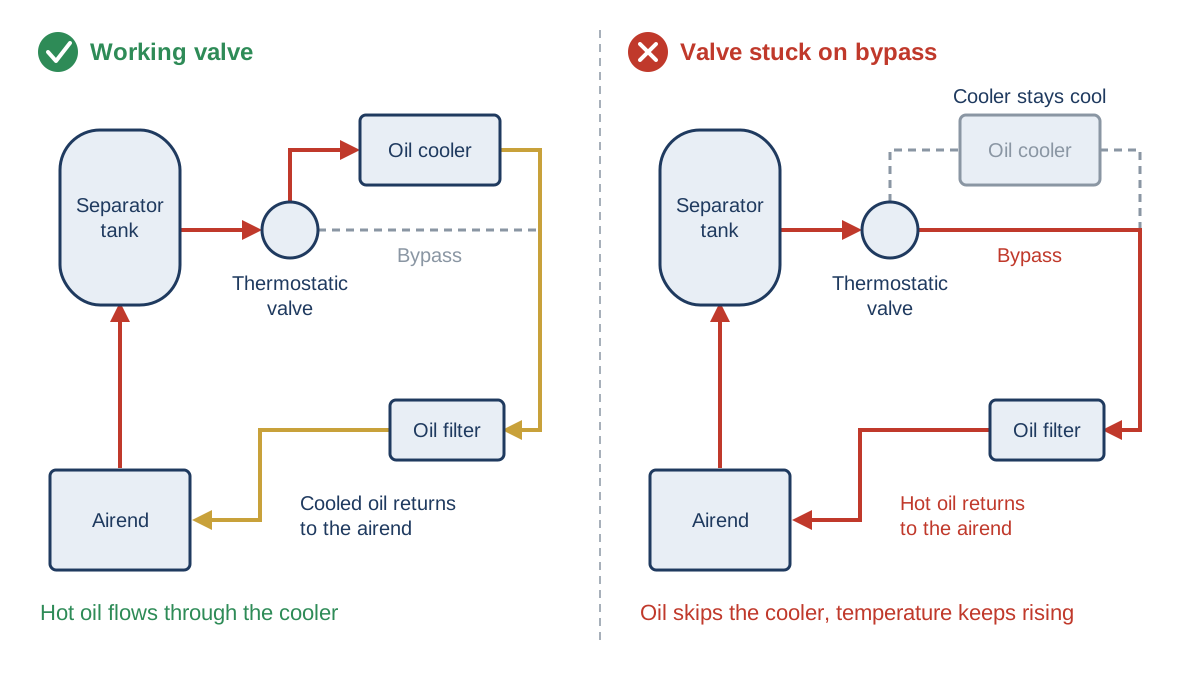
The thermostatic valve controls oil temperature by varying how much oil flows through the cooler (Hoerbiger n.d.). When cold, it sends oil around the cooler so the machine warms up quickly. If the element sticks in that position, hot oil bypasses the cooler and temperature keeps rising. A useful clue is a cool oil cooler on a hot machine. Diagnosing and replacing the valve is a job for a technician.
High discharge pressure
The higher the pressure setting, the more work the compressor does and the more heat it makes. Plants often raise pressure to make up for drops across dirty filters or undersized pipework. Choosing the right pressure band can save around 2 to 15 per cent of compressor energy, according to the NSW Office of Environment and Heritage (2017). Fix the pressure drop, then lower the set point to what the plant actually needs.
Fan faults
A failed fan motor, slipping belt, damaged blade or wiring fault cuts cooling airflow even when the coolers are clean.
High duty cycle
Continuous heavy use in a hot environment leaves the cooling system little margin (Atlas Copco n.d.-d). A compressor that rarely unloads may be undersized for the plant, or it may be feeding leaks. Fixing leaks is often the cheapest way to cut load hours, and our article on what compressed air leaks cost shows how quickly they add up.
Prevention
Most overheating trips can be avoided with planned maintenance. Before each summer, clean the coolers, check ventilation fans and louvres, and confirm the oil and filters are within their service life. Fit a matched service kit so filters and separators are changed together. Keep the space around the package clear and watch discharge temperature trends.
Safety: isolate before you investigate
An overheated compressor is hot, pressurised and can restart automatically. Safe Work Australia (2016), in its model Code of Practice on managing risks of plant, says plant should be isolated before maintenance or cleaning starts and describes lock-out as the most effective isolation procedure. The lock-out steps include controlling or releasing stored energy, which for a compressor means venting the separator tank and lines. SafeWork NSW (n.d.) adds that a tag on its own is not an isolation device. In Western Australia the approved plant code also flags contact with hot surfaces as a hazard and includes releasing stored energy among its isolation controls (WorkSafe WA 2022). Let the machine cool before touching coolers, pipework or the oil filler, because hot oil under pressure can cause serious burns.
When to call a technician
Call a qualified compressor technician if the machine trips again after you have cleaned the coolers and checked the oil, if you suspect the thermostatic valve, fan motor or temperature sensor, or if the oil looks dark, foamy or burnt. Repeated trips shorten oil and airend life, so an early service visit usually costs less.
Key takeaways
- Overheating means the compressor makes more heat than its cooling system can remove.
- Check the room and coolers first, then oil level, oil type and filters.
- Bring cool air in low and duct hot air out high, with no recirculation.
- Lower pressure settings reduce heat and save energy.
- Isolate, lock out and depressurise before any work, and let hot parts cool.
Frequently asked questions
Can I keep resetting a high temperature trip?
Resetting without finding the cause risks damaging the oil and airend. Investigate with the quick-check table first, and call a technician if the trip returns.
Why does my compressor only overheat in summer?
The cooling system has less margin when the air entering the room is hot. Dirty coolers or weak ventilation that go unnoticed in winter become a problem on hot days.
Does a water-cooled compressor avoid these problems?
It moves most heat into the cooling water instead of the room air, but it can still overheat if water flow or temperature is wrong or the heat exchanger fouls (Atlas Copco n.d.-a, n.d.-b).
Related reading
- How does a Rotary Screw Compressor work?
- What is an Aftercooler and why does it matter?
- How to size an Air Compressor for your Application
- How much do Compressed Air Leaks cost?
References
- Atlas Copco. n.d.-a. "Air Compressor Room Design: Optimal Working Conditions." Atlas Copco Australia. Accessed 15 October 2026. https://www.atlascopco.com/en-au/compressors/wiki/compressed-air-articles/optimal-working-conditions-compressor-room.
- Atlas Copco. n.d.-b. "Causes of Compressor Overheating and How to Prevent It." Atlas Copco Australia. Accessed 15 October 2026. https://www.atlascopco.com/en-au/compressors/air-compressor-blog/compressor-overheating.
- Atlas Copco. n.d.-c. "Essential Tips to Maintain Air Compressor During Summer." Atlas Copco Australia. Accessed 15 October 2026. https://www.atlascopco.com/en-au/compressors/air-compressor-blog/tips-to-maintain-compressor-during-summer.
- Atlas Copco. n.d.-d. "Preventing Overheating in Compressors at High Temperatures." Accessed 15 October 2026. https://www.atlascopco.com/en-ae/compressors/air-compressor-blog/prevent-overheating-air-compressor.
- Australian Government. n.d. "Compressed Air." energy.gov.au. Accessed 15 October 2026. https://www.energy.gov.au/business/equipment-guides/compressed-air.
- Hoerbiger. n.d. "Oil Circuit: Components for Rotary Screw Compressors." Accessed 15 October 2026. https://www.hoerbiger.com/en/products-and-services/components-for-rotary-screw-compressors/oil-circuit-for-oil-injected-screw-compressors.html.
- NSW Office of Environment and Heritage. 2017. Low Capital Cost, Simple Solutions to Improve the Efficiency of Your Compressed Air System. OEH2017/0257. Hosted by Energy NSW. https://www.energy.nsw.gov.au/sites/default/files/2022-08/2017_NSW_CompressedAirGuidepdf.pdf.
- Safe Work Australia. 2016. Managing Risks of Plant in the Workplace: Code of Practice. Canberra: Safe Work Australia. https://www.safeworkaustralia.gov.au/system/files/documents/1705/mcop-managing-risks-of-plant-in-the-workplace-v3.pdf.
- SafeWork NSW. n.d. Isolation of Plant: Lock-Out / Tag-Out. Fact sheet SW09240. https://www.safework.nsw.gov.au/__data/assets/pdf_file/0010/586342/factsheet-isolation-of-plant.pdf.
- US Department of Energy. 2016. Improving Compressed Air System Performance: A Sourcebook for Industry. 3rd ed. Washington, DC: US Department of Energy and Compressed Air Challenge. https://www.energy.gov/sites/prod/files/2016/03/f30/Improving%20Compressed%20Air%20Sourcebook%20version%203.pdf.
- WorkSafe WA. 2022. Managing Risks of Plant in the Workplace: Code of Practice. Perth: Department of Mines, Industry Regulation and Safety. https://www.worksafe.wa.gov.au/system/files/migrated/sites/default/files/atoms/files/221185_cp_manageriskplant1.pdf.
This article is general information only. Check manufacturer documentation and applicable Australian Standards for your installation.