
What is SDR in Poly Pipe?
Ultramax Systems on 16th Oct 2026
Short answer: SDR (standard dimension ratio) is a poly pipe's outside diameter divided by its wall thickness, so a lower SDR means a thicker wall. Together with the PE grade it sets the pressure rating, and on compressed air that rating is lower than the PN figure printed for water.
Why it matters
A poly air line is only as safe as the rating it was chosen on. The same length of poly pipe can carry very different pressures depending on its SDR, its material class and the air temperature. If you pick the pipe by the PN marking alone, you can end up running a compressed air main above what the pipe is meant to carry. SDR is the number that connects the pipe's dimensions to its strength.
How SDR is worked out
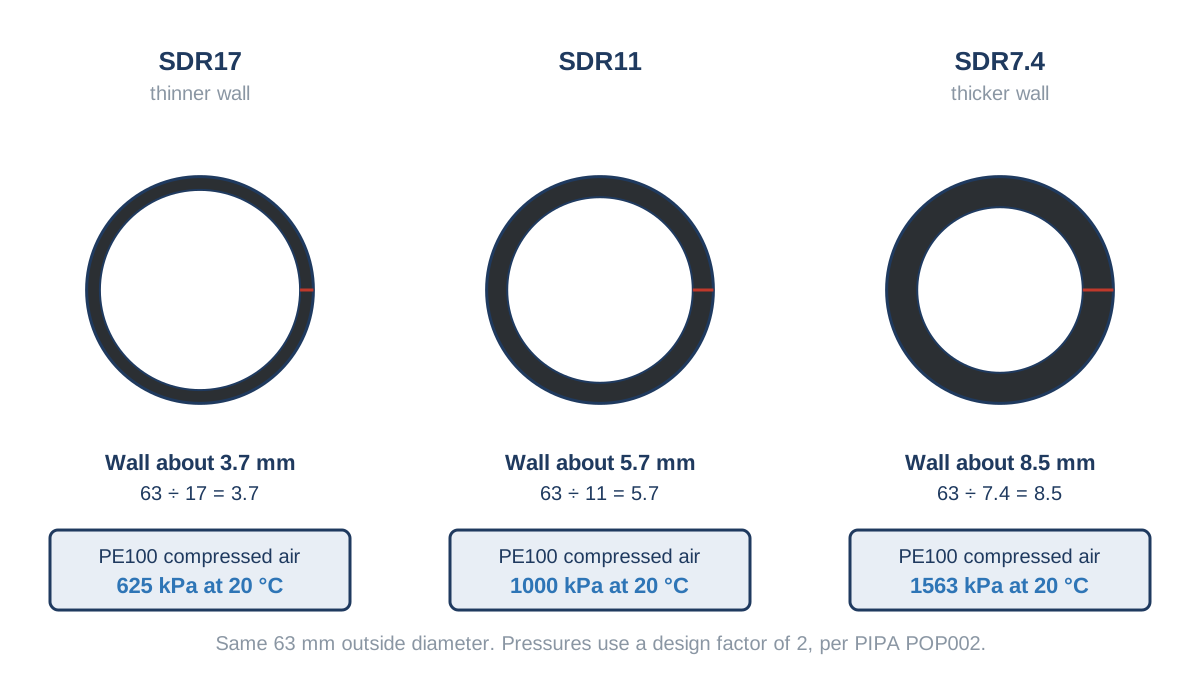
SDR is the ratio of the nominal outside diameter to the nominal wall thickness, so a higher SDR means a thinner wall at any given diameter (PE100+ Association n.d.-a). A 63 mm pipe at SDR11 has a wall of about 63 ÷ 11 = 5.7 mm. At SDR17 the wall is about 3.7 mm, and at SDR7.4 it is about 8.5 mm. The published dimension tables in AS/NZS 4130:2018 set the exact minimum wall for each size and SDR, so use those, not the rounded ratio, when you check pipe on site.
Because SDR is a ratio, every size of pipe in one SDR and grade carries the same pressure rating. A 25 mm SDR11 pipe and a 110 mm SDR11 pipe in PE100 share a rating. That is why suppliers quote pipe as "PE100 SDR11" rather than listing a wall thickness for every size.
How SDR sets the pressure rating
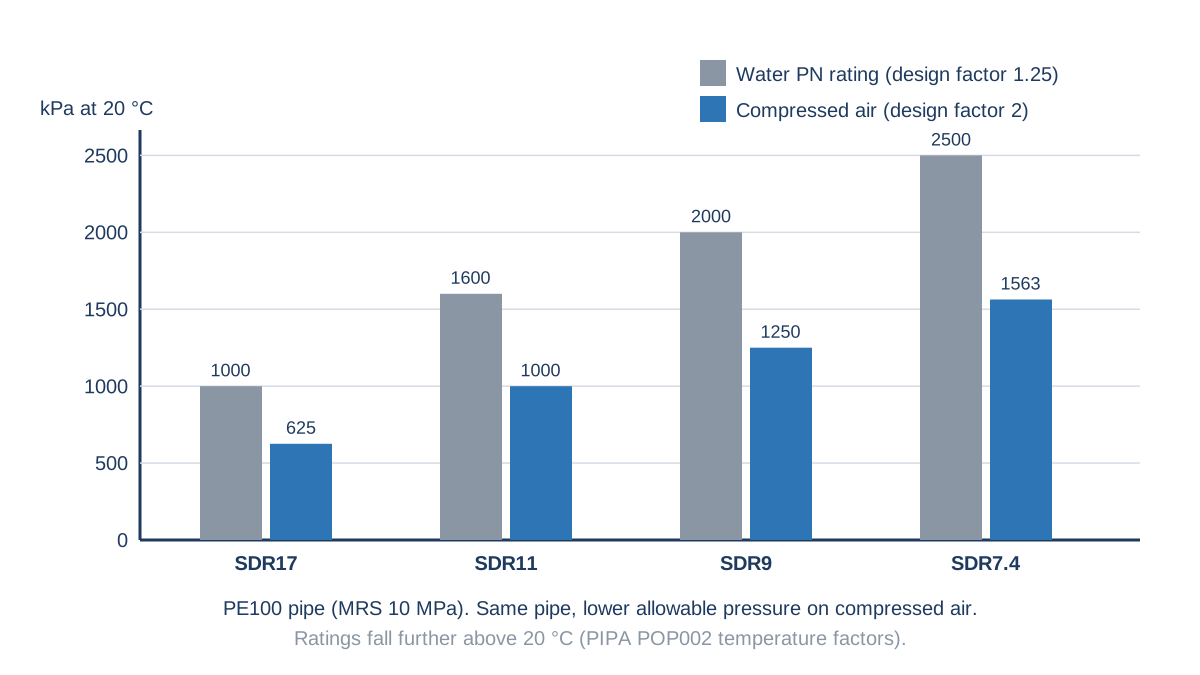
Pipe designers start from the material's minimum required strength (MRS), which is 10 MPa for PE100. The PE100+ Association (n.d.-b) gives the maximum operating pressure in bar as 20 × MRS ÷ (C × (SDR − 1)), where C is a design coefficient. For water, C is at least 1.25. That gives 16 bar (1600 kPa) for PE100 SDR11, which is the familiar PN16 class.
Compressed air is treated differently. PIPA (2026) derives compressed air ratings with a design factor of 2, because of the energy stored in compressed air and the potential for pressure spikes. The same PE100 SDR11 pipe is therefore rated at 1000 kPa (10 bar) for air at 20 °C. SDR17 drops to 625 kPa, while SDR9 reaches 1250 kPa and SDR7.4 about 1563 kPa.
Temperature changes the answer
These ratings apply at 20 °C. POP002 applies a temperature factor above that. At 40 °C, for example, PE100 SDR11 falls to about 833 kPa (PIPA 2026). Air leaving a compressor, pipe in a hot roof space and runs in direct sun can all sit well above 20 °C. Check the factor for your highest likely temperature, and ask the pipe maker about anything hotter.
Common mistakes
- Reading PN16 as 1600 kPa on air. It is a water rating.
- Assuming a bigger SDR number means a stronger pipe. It means a thinner wall.
- Sizing to normal working pressure only. Compare the rating with the highest pressure the system can reach, such as the relief valve set pressure.
- Using PE80 figures for PE100 pipe, or the reverse. Grade and SDR always go together.
- Mixing SDRs in one line without planning the joints. Fusion methods handle wall differences in different ways.
Related terms
- PE100: the material class behind the MRS of 10 MPa. See What is HDPE (PE100) Pipe?
- Electrofusion: a joining method that suits pipes of different wall thickness. See What is Electrofusion Welding?
- Stub flange: the fused PE end used for bolted connections. See What is a Stub Flange?
- Free air delivery: how compressor output is measured. See What is Free Air Delivery (FAD)?
References
- PE100+ Association. n.d.-a. "SDR Pipe or MOP Calculator." Accessed 16 October 2026. https://pe100plus.com/PE-Pipes/Technical-guidance/Pipe-dimensioning/SDR-MOP-i1017.html.
- PE100+ Association. n.d.-b. "How Is PE Pipe Designed for Given Operating Conditions?" Accessed 16 October 2026. https://www.pe100plus.com/PE-Pipes/Technical-guidance/model/Design/PE-pressure-pipe/PE-pipe-design-i244.html.
- Plastics Industry Pipe Association of Australia (PIPA). 2026. Polyethylene (PE) Pipes and Fittings for Compressed Air. Industry Guideline POP002, Issue 7. https://pipa.com.au/wp-content/uploads/2026/06/POP002_PE_pipes_and_fittings_for_compressed_air_V7_June_26.pdf.
- Standards Australia. 2018. AS/NZS 4130:2018 Polyethylene (PE) Pipes for Pressure Applications. Standards Australia and Standards New Zealand. https://store.standards.org.au/product/as-nzs-4130-2018.
This article is general information only. Check manufacturer documentation and applicable Australian Standards for your installation.