
What is Electrofusion Welding?
Ultramax Systems on 16th Oct 2026
Short answer: Electrofusion welding joins polyethylene pipe using fittings with a heating wire built into the bore, powered by a control unit that melts the fitting and pipe surface together. Done well, it makes a fused joint rated with the pipe, but the result depends almost entirely on how the pipe is prepared.
Why it matters
On a PE compressed air main, the joints carry the same duty as the pipe. PIPA (2026) rates fusion fittings for compressed air to the same pressure tables as the pipe itself. Electrofusion is often the practical way to get there. The welder does not need to move the pipe ends, so it works in trenches, along walls and on repairs. Electrofusion fittings cover couplers, elbows, tees, reducers, end caps and tapping saddles. Where two pipes have different wall thicknesses, PIPA (2025) suggests electrofusion or other fittings instead of butt welding them together.
How it works
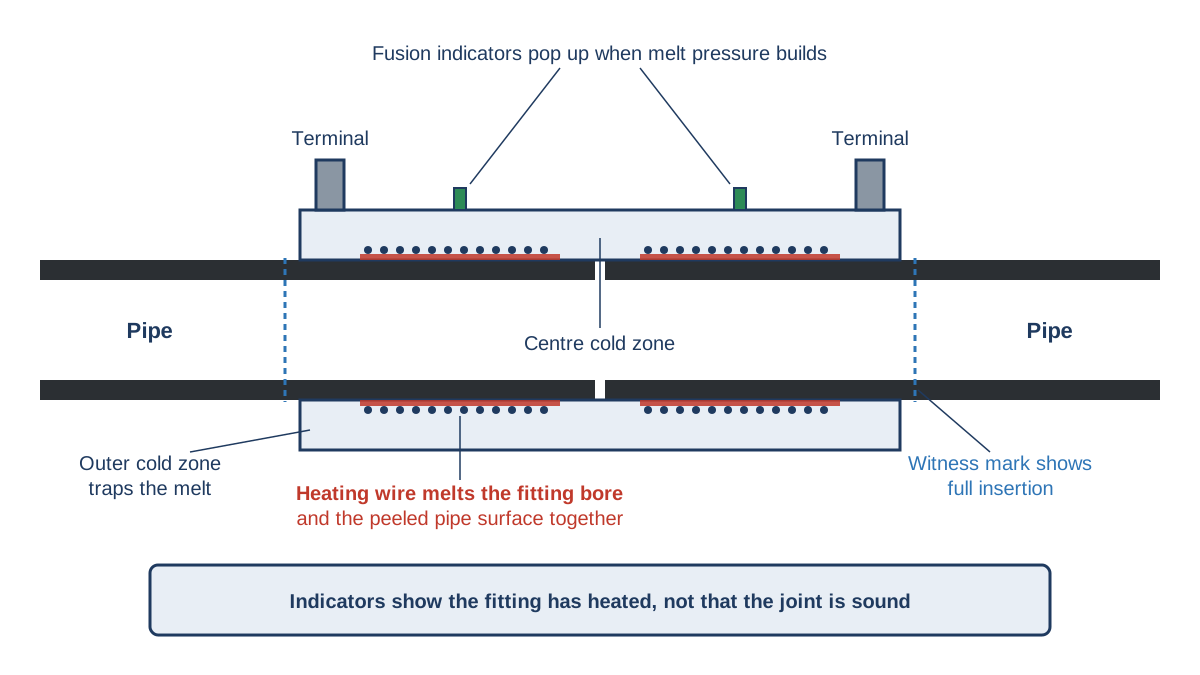
Each fitting has resistance wire embedded at or near its internal surface. The control unit passes current through that wire for a set fusion time. The heat melts the PE in the fitting bore and on the pipe surface, and cooler zones at each end of the fitting trap the melt so that pressure builds and the surfaces fuse (PIPA 2024). Most fittings carry a barcode that sets the weld parameters on the control unit. PIPA advises checking that the displayed time and voltage match the fitting label.
Fusion indicators on the fitting rise when melt pressure develops. They show that the fitting heated, not that the joint is sound. The joint then needs its full cooling time, undisturbed, before it is moved or pressurised.
Making the joint
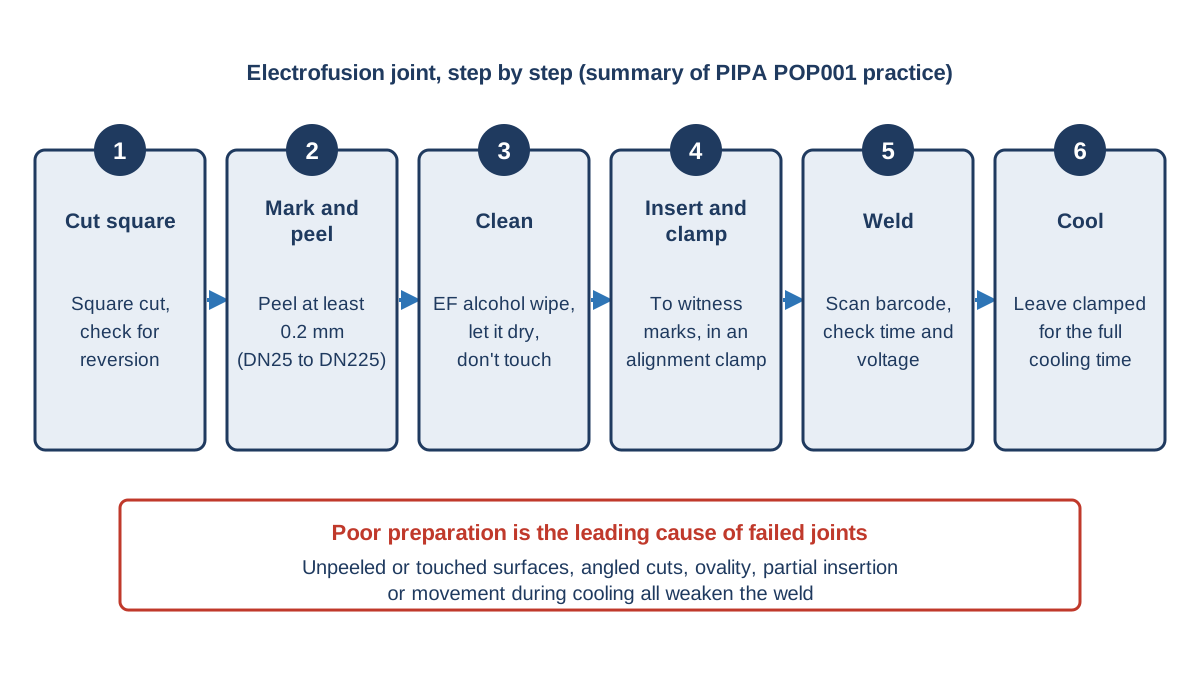
PIPA's POP001 guideline sets out the preparation. Cut the pipe square and mark the peel length, which is half the fitting length plus 20 mm. Peel the oxidised surface with a mechanical peeler to a depth of at least 0.2 mm for DN25 to DN225, or 0.3 mm above DN225. Clean with electrofusion alcohol wipes, not rags, methylated spirits or acetone, and let the alcohol evaporate. Insert to the witness marks and hold the joint in alignment clamps through the weld and the cooling time (PIPA 2024).
Pipe shape matters too. Below DN315, ovality must be less than 1.5% of the diameter or 3 mm, whichever is smaller. Site conditions matter as well: pipe in direct sun can reach 70 °C, so PIPA recommends shading it to 45 °C or less, and sheltering the weld from rain and dust.
Australian standards and practice
Fittings for PE pressure pipe, including electrofusion fittings, are covered by AS/NZS 4129:2020, and design and installation fall under AS/NZS 2033:2024. PIPA (2024) notes that AS/NZS 2033 requires installers to hold a current certificate for the PMBWELD302E unit, and it recommends reaccreditation every 2 to 3 years. The welding machine needs regular calibration too, and an electrofusion welder should match the fitting sizes you use.
Common mistakes
PIPA describes poor pipe preparation as overwhelmingly the leading cause of failed joints. The usual culprits are skipped or uneven peeling, blunt peeler blades, and surfaces touched after cleaning, since sweat, sunscreen and soap all contaminate the weld zone. Angled cuts, flat spots, partial insertion and movement during cooling cause problems too. So does a generator that drops out mid-weld (PIPA 2024). A weak joint may hold at first and leak later, adding to the cost of compressed air leaks.
Related terms
- PE100: the pipe material class. See What is HDPE (PE100) Pipe?
- SDR: the wall thickness ratio that sets the rating. See What is SDR in Poly Pipe?
- Butt fusion: heating two pipe ends on a plate and pressing them together, normally for pipes of the same diameter and wall thickness (PIPA 2025).
- Stub flange: a fused PE end for bolted joints. See What is a Stub Flange?
References
- Plastics Industry Pipe Association of Australia (PIPA). 2024. Electrofusion Jointing of PE Pipes and Fittings for Pressure Applications. Industry Guideline POP001, Issue 9. https://pipa.com.au/wp-content/uploads/2024/11/PIPA-POP001-Electrofusion-Jointing-of-PE-Pipes-and-Fittings-for-Pressure-Applications-Issue-9.pdf.
- Plastics Industry Pipe Association of Australia (PIPA). 2025. Butt Fusion Jointing of PE Pipes and Fittings: Recommended Parameters and Practices. Industry Guideline POP003, Issue 8.1. https://pipa.com.au/wp-content/uploads/2025/04/PIPA_POP003_Butt_Fusion_Jointing_of_PE_Pipes_and_Fittings_Issue_8.1_March_2025.pdf.
- Plastics Industry Pipe Association of Australia (PIPA). 2026. Polyethylene (PE) Pipes and Fittings for Compressed Air. Industry Guideline POP002, Issue 7. https://pipa.com.au/wp-content/uploads/2026/06/POP002_PE_pipes_and_fittings_for_compressed_air_V7_June_26.pdf.
- Standards Australia. 2020. AS/NZS 4129:2020 Fittings for Polyethylene (PE) Pipes for Pressure Applications. Standards Australia and Standards New Zealand. https://store.standards.org.au/product/as-nzs-4129-2020.
- Standards Australia. 2024. AS/NZS 2033:2024 Design and Installation of Polyolefin Pipe Systems. Standards Australia and Standards New Zealand. https://store.standards.org.au/product/as-nzs-2033-2024.
This article is general information only. Check manufacturer documentation and applicable Australian Standards for your installation.