
What is a Stub Flange?
Ultramax Systems on 16th Oct 2026
Short answer: A stub flange is a short polyethylene fitting with a raised collar that is fused onto the end of a poly pipe, so a loose metal backing ring can bolt it to a valve, pump or metal flange. It is the usual way to make a removable connection in a PE line, and how it is assembled decides whether it seals.
Why it matters
You cannot weld a steel flange to polyethylene, and PIPA advises against threaded outlets above 50 mm on PE compressed air systems (PIPA 2026a). The stub flange solves this. PIPA (2026b) describes it as the transition from PE to metal flanges and to equipment such as valves and pumps. It also lets you take out a valve, meter or filter housing without cutting the pipe. The Ultramax stub flange kits range covers backing rings, drilled flanges and gaskets, as well as stub flange adaptors.
How the joint goes together
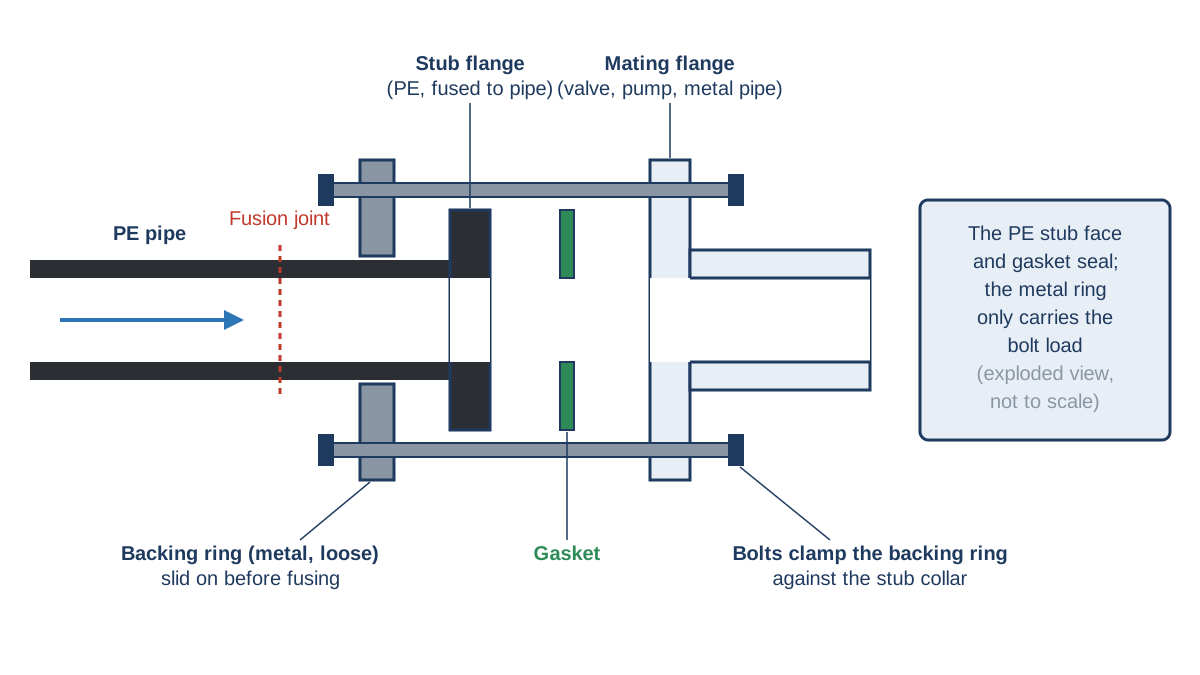
A flanged PE joint has four parts. The PE stub is fused to the pipe, so it becomes part of the pipeline. In compressed air service, fusion fittings are rated to the same pressure tables as the pipe (PIPA 2026a). The backing ring is a loose metal ring that sits behind the stub collar. Bolts pass through it and the mating flange, clamping the collar and a gasket between them. The ring carries the bolt load, while the PE face and gasket form the seal.
The backing ring must go onto the pipe before the stub is fused on. PIPA lists fitting it afterwards among the mistakes to avoid (PIPA 2026b). PE pipe with fused joints is also end-load bearing. Where it meets a joint that is not, such as some mechanical couplings, it needs restraint so it cannot pull out.
Backing rings, drillings and gaskets
The backing ring's bolt pattern must match the flange it meets. In Australia that is often AS 2129, which covers flanges for pipes, valves and fittings from DN15 to DN3000, including for compressed air service (AS 2129-2000). PIPA's POP007 guideline gives nominal limits of 700 kPa at 50 °C for Table D and 1400 kPa at 50 °C for Table E. It also covers AS/NZS 4087 and ISO 7005-1 drillings, and it tells installers to confirm the actual assembly rating with the flange maker (PIPA 2026b). What are Table D and Table E Flange Drillings? covers the drilling tables in more detail.
Rings are typically galvanised, stainless steel or polymer coated. Elastomeric gaskets are specified up to 16 bar, with compressed fibre gaskets used above that (PIPA 2026b). For compressed air, the rating of the whole joint is the lowest of the pipe, the stub and the ring. Check the pipe's air rating in What is SDR in Poly Pipe?
Tightening the bolts
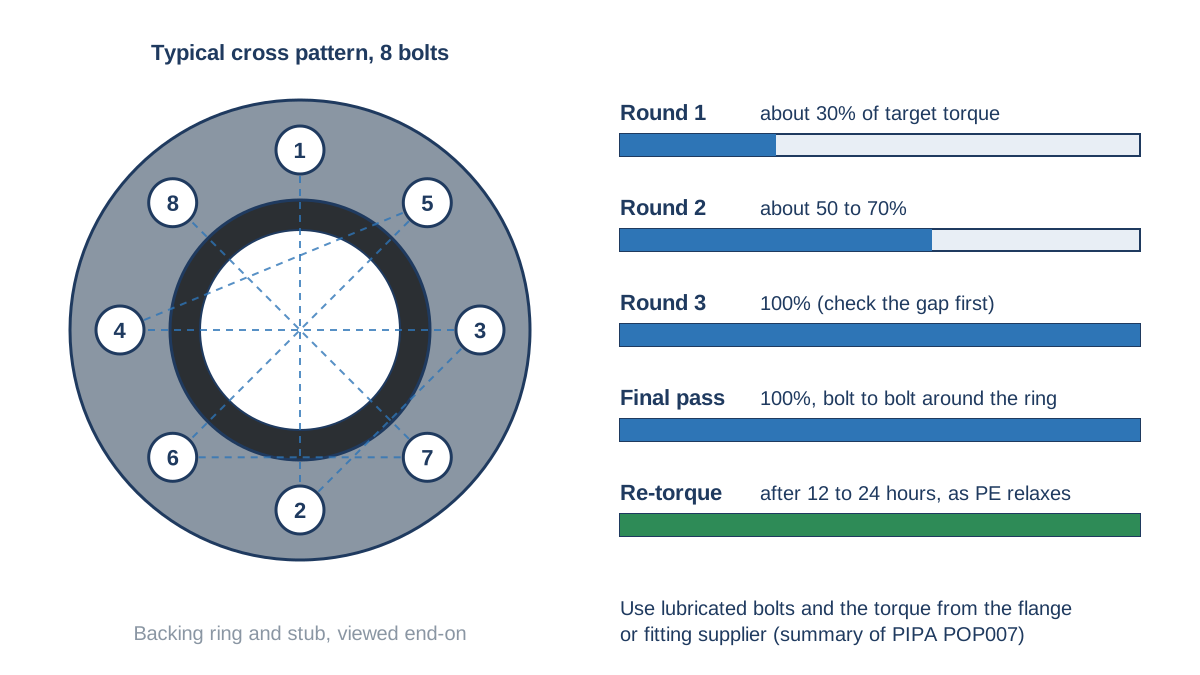
PE creeps under load, so the bolts need a set sequence and a second visit. PIPA (2026b) describes tightening in a cross pattern over three rounds: about 30% of target torque, then about 50 to 70%, then 100%. Check the gap between the faces at eight points before the last round, then do a final pass bolt to bolt around the ring. Bolts should be well lubricated, and the guideline recommends re-tightening after 12 to 24 hours, once the PE has relaxed.
Common mistakes
- Over-tightening until the PE yields, which PIPA calls a common cause of flange joint leakage.
- Faces that are misaligned, dirty or damaged, or a gasket that sits off centre.
- Dry bolts, which lose clamping force to friction.
- Heavy valves hanging off the joint without support, which adds bending the torque tables do not allow for.
- Skipping the re-torque.
Related terms
- Electrofusion: one way to fuse the stub to the pipe. See What is Electrofusion Welding?
- PE100: the usual pipe material class. See What is HDPE (PE100) Pipe?
- Table D and Table E: common Australian flange drillings. See What are Table D and Table E Flange Drillings?
References
- Plastics Industry Pipe Association of Australia (PIPA). 2026a. Polyethylene (PE) Pipes and Fittings for Compressed Air. Industry Guideline POP002, Issue 7. https://pipa.com.au/wp-content/uploads/2026/06/POP002_PE_pipes_and_fittings_for_compressed_air_V7_June_26.pdf.
- Plastics Industry Pipe Association of Australia (PIPA). 2026b. Flanged Joints for Polyethylene (PE) Pipe. Industry Guideline POP007, Issue 3.2. https://pipa.com.au/wp-content/uploads/2026/07/POP007_Flanged_Joints_for_PE_Pipe_V3.2-July-26.pdf.
- Standards Australia. 2000. AS 2129-2000 (R2025) Flanges for Pipes, Valves and Fittings. Sydney: Standards Australia. Listing via ANSI Webstore. https://webstore.ansi.org/standards/sai/21292000r2025.
This article is general information only. Check manufacturer documentation and applicable Australian Standards for your installation.