
What is an Aftercooler and why does it matter?
Ultramax Systems on 16th Oct 2026
Short answer: An aftercooler is a heat exchanger that cools hot compressed air as it leaves the compressor, so much of its water vapour condenses into liquid. A moisture separator and drain then remove that liquid before the air reaches the receiver, filters and dryer.
What an aftercooler does
Compression heats air, and hot air can carry a lot of water vapour. An aftercooler sits after the final stage of compression and brings the air temperature down, so the vapour condenses and can be separated and drained (US Department of Energy 2016). The US Department of Energy (2016) notes that almost all industrial systems need aftercooling, apart from those supplying heated process air. It may be built into the compressor package or fitted as a separate unit.
Why it matters
Hot, wet air causes trouble downstream. It loads up filters and dryers, carries liquid into pipework and tools, and speeds up corrosion. A properly installed aftercooler collects most of the condensation from the compressor and can allow a smaller dryer (Atlas Copco n.d.-a).
Air-cooled and water-cooled aftercoolers
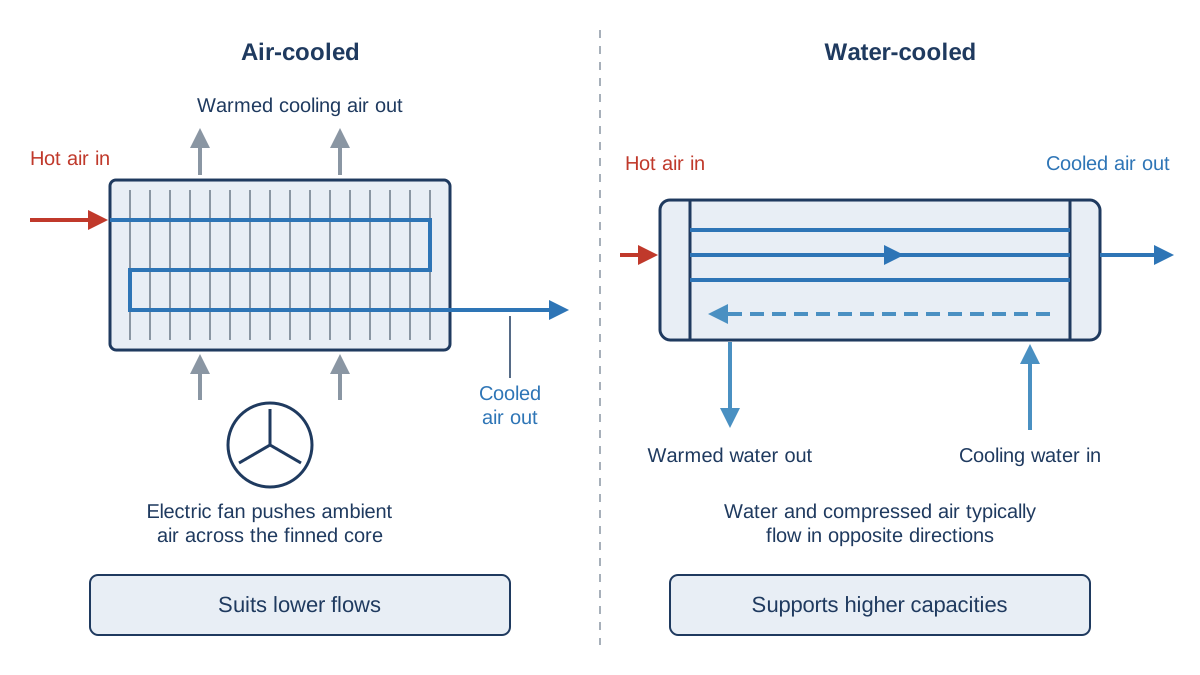
Aftercoolers come in two main types. An air-cooled unit uses an electric fan to push ambient air across a finned core, much like a car radiator. A water-cooled unit passes cooling water through the exchanger, with the water and compressed air typically flowing in opposite directions. As Atlas Copco (n.d.-a) explains, air-cooled models suit lower flows, while water-cooled models support higher capacities.
Approach temperature
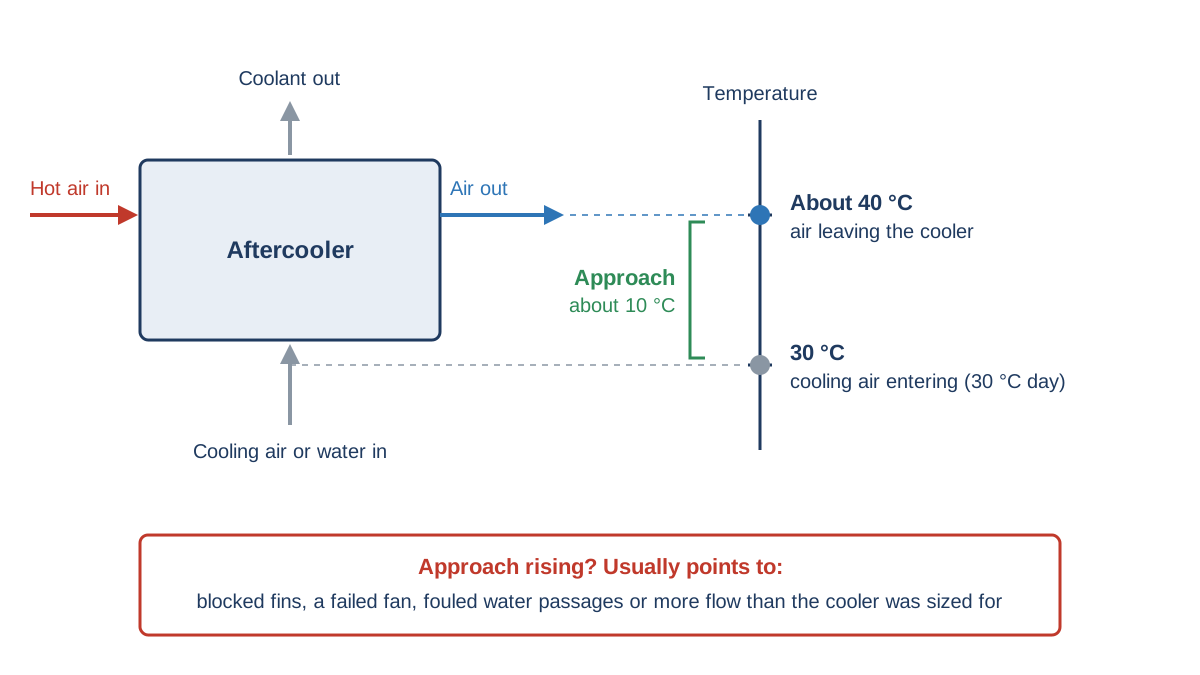
Approach temperature is the difference between the air leaving the aftercooler and the cooling air or water entering it. It is the simplest way to judge how well a cooler is working. Outlet air is typically about 10 °C above the coolant temperature (Atlas Copco n.d.-a). On a 30 °C day, a healthy air-cooled unit would therefore deliver air at around 40 °C. A rising approach usually points to blocked fins, a failed fan, fouled water passages or more flow than the cooler was sized for.
How much water it removes
An integrated aftercooler can remove up to 70% of the moisture, according to Atlas Copco (n.d.-b). Our estimate agrees. It assumes intake air at 30 °C and 70% relative humidity, a 10 °C approach, 700 kPa (7 bar) line pressure, saturated air at the cooler outlet and ideal gas behaviour, with saturation vapour pressure from the Magnus formula published by the National Physical Laboratory (n.d.).
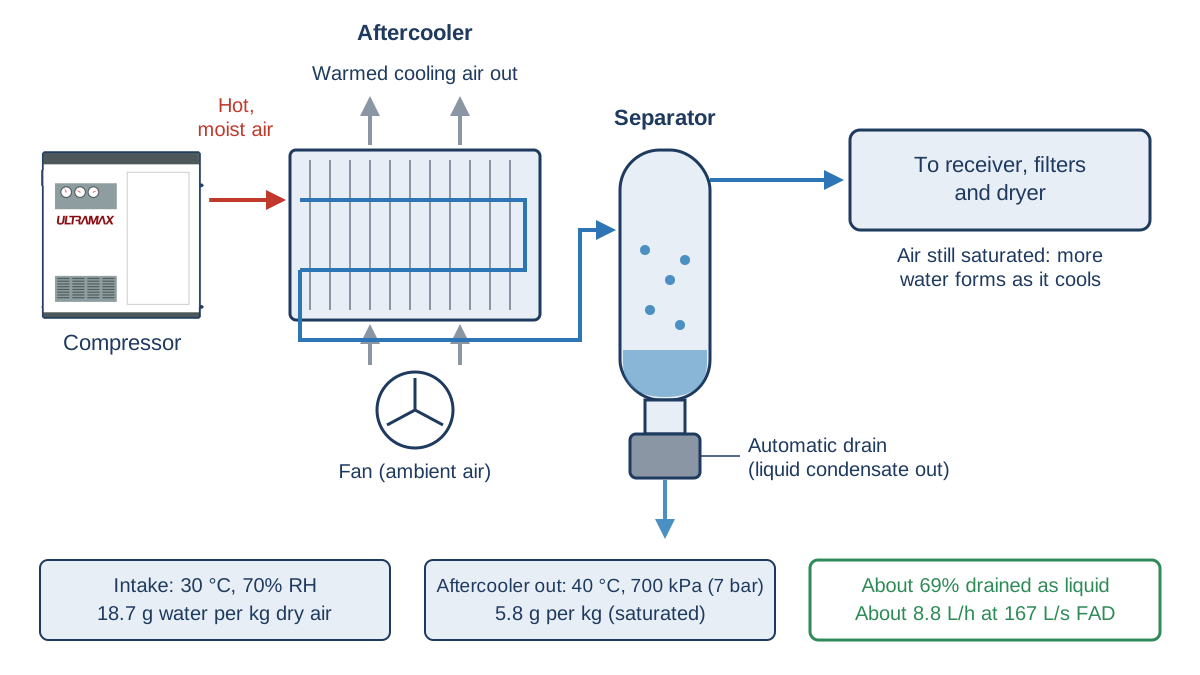
On those assumptions, the intake air carries about 18.7 g of water per kilogram of dry air. Saturated air at 40 °C and 700 kPa (7 bar) can hold only about 5.8 g/kg, so about 69% condenses in the cooler. For a compressor delivering 167 L/s (10 m³/min) of free air, that is roughly 8.8 litres of water an hour, or about 70 litres over an 8-hour shift. The air that leaves is still saturated, so more water forms wherever it cools further. That is why an aftercooler does not replace a dryer, and why pressure dew point matters downstream.
The separator and drain that must follow
Cooling turns vapour into droplets, but droplets left in the air stream simply travel on. A moisture separator with an automatic drain therefore follows the aftercooler (US Department of Energy 2016). Water separators typically spin or redirect the flow so heavy droplets drop out into a bowl, where a drain discharges them.
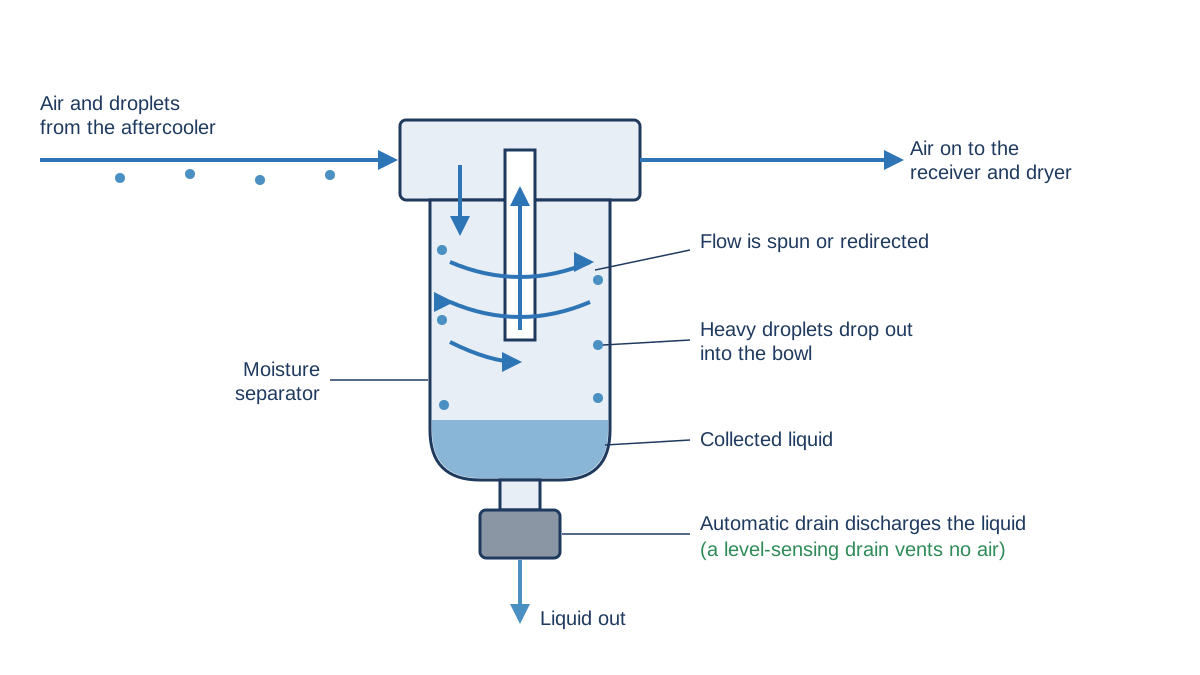
The drain deserves as much attention as the cooler. The NSW Office of Environment and Heritage (2017) recommends servicing the aftercooler drain at each scheduled compressor service. It also warns that water left behind can cause false pressure readings at the compressor outlet and frequent load and unload cycling. A level-sensing condensate drain removes liquid without venting air, as explained in How does a Zero Air Loss Drain work? Keep fins and fans clean, and replace worn parts with compressor spare parts and service kits.
Related terms
- Intercooler: a cooler between stages of a multistage compressor. Most condensate from an intercooled machine leaves at the intercoolers, and the rest at the aftercooler (US Department of Energy 2016).
- Pressure dew point: the temperature at which water condenses at line pressure. See What is Pressure Dew Point?
- Condensate: water and oil drained from coolers, receivers and filters. See How does an Oil-Water Separator work?
Related reading
- What is Pressure Dew Point?
- How does a Zero Air Loss Drain work?
- Refrigerated vs Desiccant Dryers: Which do you need?
- Water in Air Tools: Causes and Fixes
References
- Atlas Copco. n.d.-a. "What Is Air Compressor Aftercooler." Accessed 15 October 2026. https://www.atlascopco.com/en-us/compressors/wiki/compressed-air-articles/aftercooler.
- Atlas Copco. n.d.-b. "Why Dry Compressed Air Is Essential." Accessed 15 October 2026. https://www.atlascopco.com/en-uk/compressors/wiki/compressed-air-articles/drying-compressed-air.
- National Physical Laboratory. n.d. "Dew Point and Relative Humidity." Accessed 13 October 2026. https://npl.co.uk/resources/q-a/dew-point-and-relative-humidity.
- NSW Office of Environment and Heritage. 2017. Low Capital Cost, Simple Solutions to Improve the Efficiency of Your Compressed Air System. OEH2017/0257. Hosted by Energy NSW. https://www.energy.nsw.gov.au/sites/default/files/2022-08/2017_NSW_CompressedAirGuidepdf.pdf.
- US Department of Energy. 2016. Improving Compressed Air System Performance: A Sourcebook for Industry. 3rd ed. Washington, DC: US Department of Energy and Compressed Air Challenge. https://www.energy.gov/sites/prod/files/2016/03/f30/Improving%20Compressed%20Air%20Sourcebook%20version%203.pdf.
This article is general information only. Check manufacturer documentation and applicable Australian Standards for your installation.