
Screw vs Piston Compressor: Which suits your Workshop?
Ultramax Systems on 16th Oct 2026
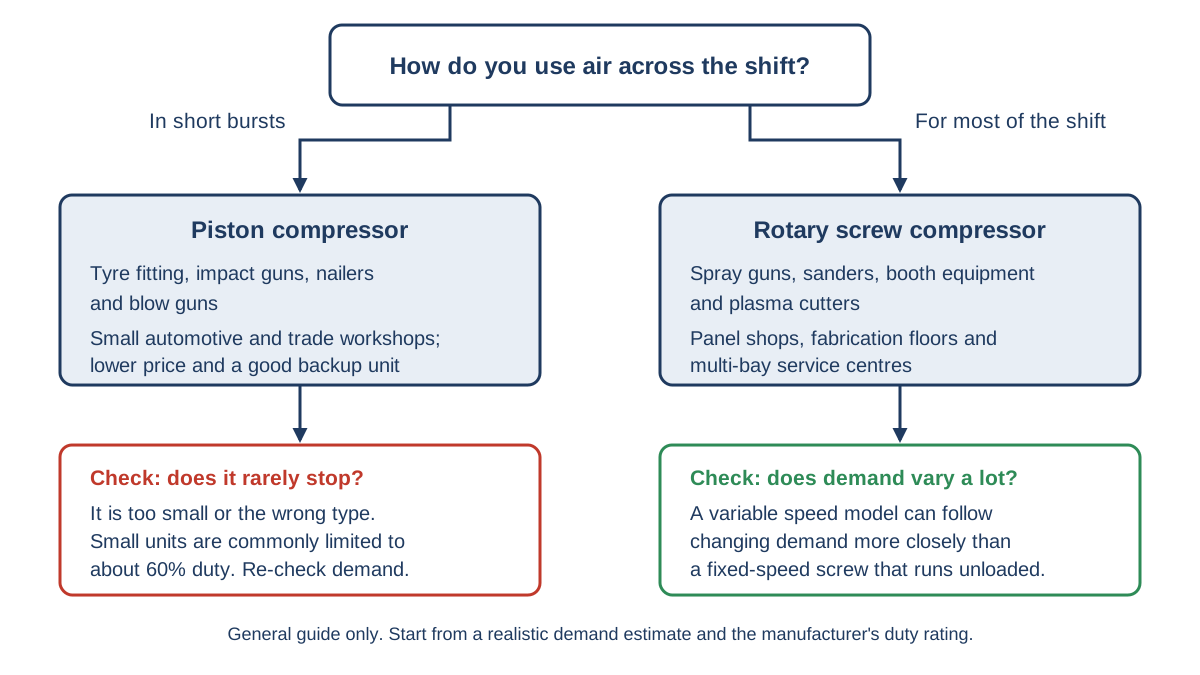
Short answer: A piston compressor suits a workshop that uses air in short bursts, such as tyre fitting, impact guns and occasional blow-down. A rotary screw compressor suits a workshop that needs air for most of the shift, such as a busy panel shop or fabrication floor. Screws cost more to buy, but energy dominates lifetime cost, so steady demand usually favours the screw.
How each type works
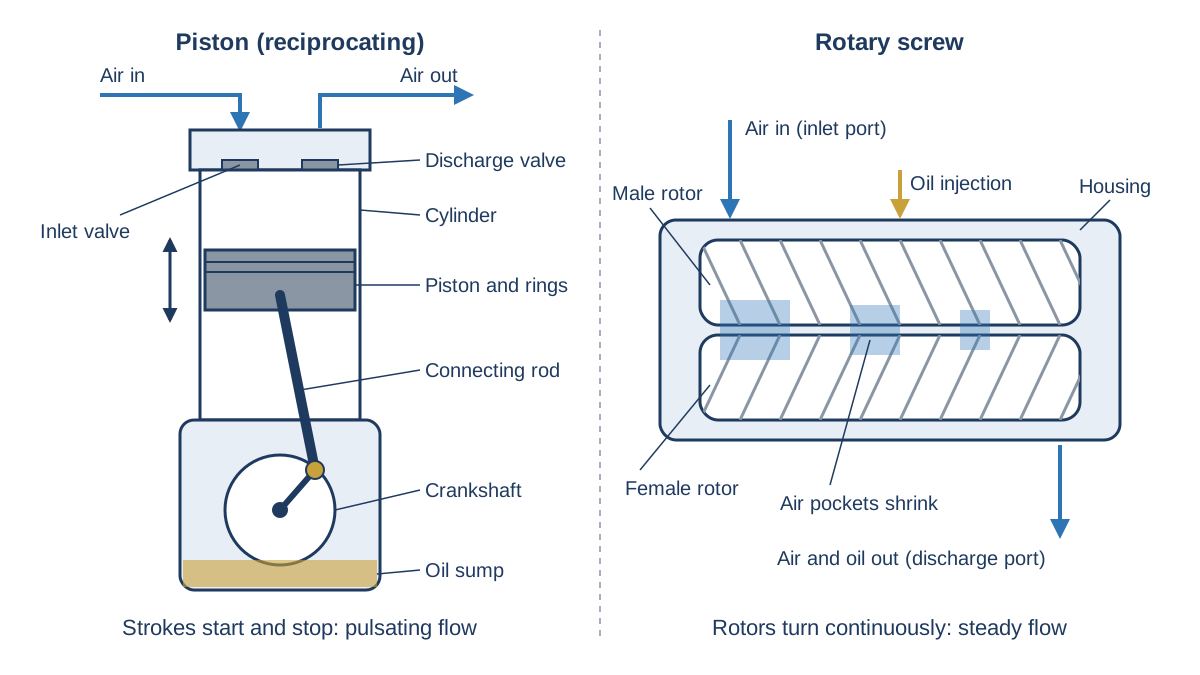
A piston compressor works like a small engine running in reverse. A crankshaft drives a piston up and down inside a cylinder. On the down stroke an inlet valve opens and air flows in, and on the up stroke the air is squeezed and pushed out through a discharge valve. Most workshop units are single-acting and air-cooled, meaning each piston compresses only on one side (US Department of Energy 2016).
A rotary screw compressor uses two meshing helical rotors instead. Air is trapped between the rotor lobes and the housing, and each pocket shrinks as it moves towards the discharge port. In the common oil-injected design, oil cools and seals the rotors and is then separated from the air. For the full mechanism, see How does a Rotary Screw Compressor work?
Screw vs piston compressor at a glance
| Factor | Piston (reciprocating) | Rotary screw (oil-injected) |
|---|---|---|
| Duty cycle | Commonly limited to about 60% on time | Designed for continuous running |
| Noise | Louder, with more vibration | Quieter, usually in an acoustic enclosure |
| Efficiency | Good at low, intermittent demand with start/stop control | Higher output per kW at steady load; poor when lightly loaded |
| Discharge air | Hotter, with more oil carryover in lubricated designs | Cooler, with lubricant carryover of a few ppm |
| Maintenance | Valves, rings, belts and oil changes | Oil, oil filter, air filter and separator element |
| Purchase price | Lower | Higher |
| Footprint | Larger for the same output (Atlas Copco 2020) | Compact package |
| Typical workshop fit | Small automotive and trade workshops | Busy panel shops, fabrication, multi-bay service centres |
Duty cycle
Duty cycle is the share of time a compressor can run under load before it needs to rest. It is the biggest practical difference between the two types. Natural Resources Canada (2014) notes that a rotary screw can run at full load continuously, while a reciprocating compressor must be used at a 60% duty cycle or below. The NSW Office of Environment and Heritage (2017) likewise describes small piston compressors as machines that are not rated for continuous duty.
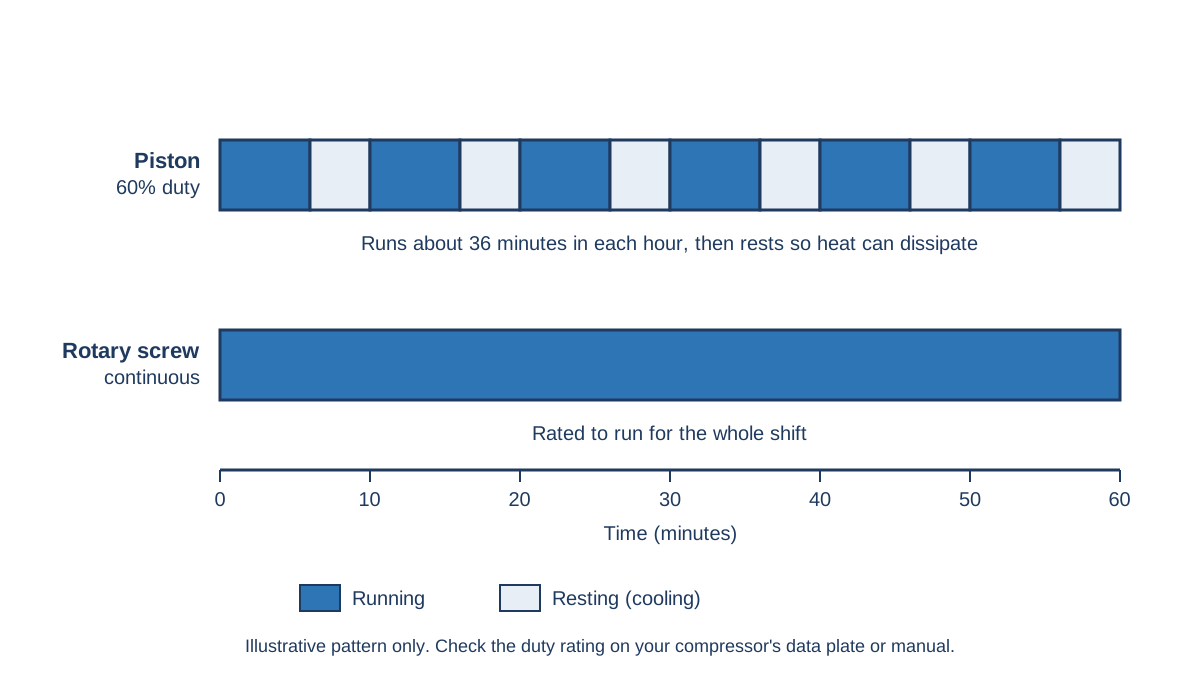
If your piston unit rarely stops, it is either too small or the wrong type for the job. Start with a realistic demand estimate, as covered in How to size an Air Compressor for your Application.
Noise and Australian WHS limits
Piston compressors are generally louder and vibrate more than screw compressors (Atlas Copco 2020). That matters in a workshop where staff work near the compressor all day. Safe Work Australia (2015) notes that the WHS Regulations set the exposure standard for noise at an LAeq,8h of 85 dB(A) or a peak of 140 dB(C). Its code also gives a simple warning sign: if you must raise your voice to talk to someone about one metre away, the noise is likely to be hazardous.
The same code asks businesses to buy the quietest plant suited to the job and to request noise emission data from suppliers. It also lists distance, barriers and enclosures as engineering controls (Safe Work Australia 2015). In practice, that might mean an enclosed screw unit, or a piston unit moved to a separate room or a ventilated enclosure outside. Check the version of the code adopted in your state or territory.
Efficiency and energy
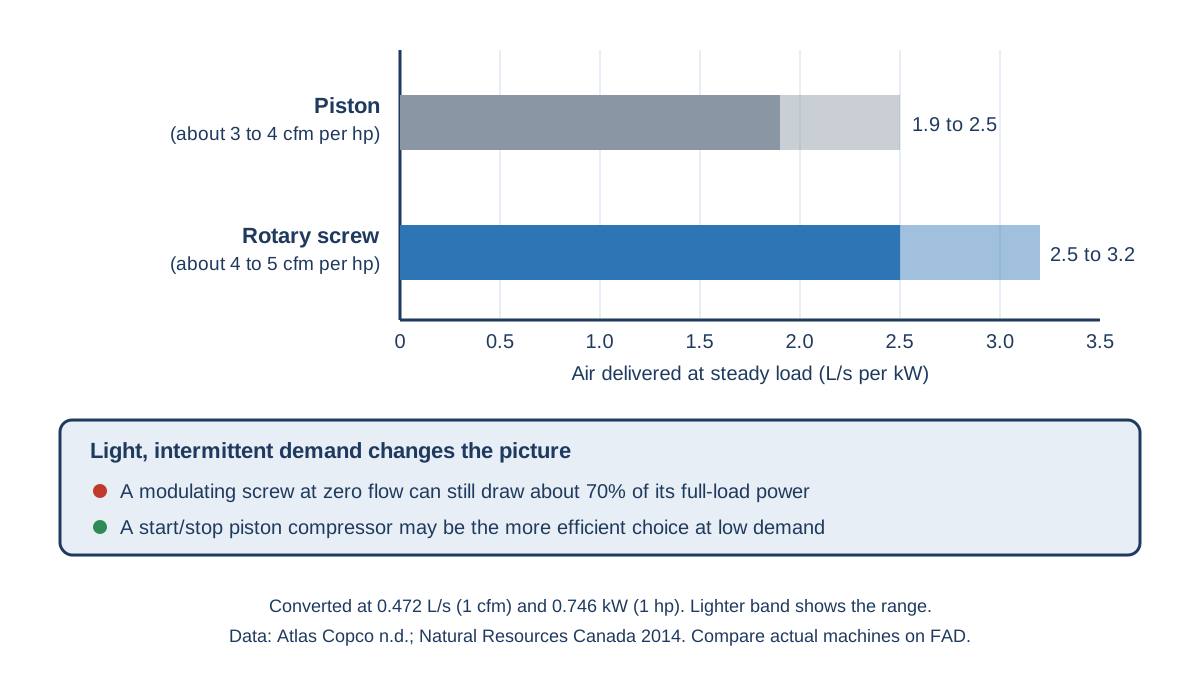
At steady load, screw compressors typically deliver more air per kilowatt. One manufacturer puts piston output at about 1.9 to 2.5 L/s per kW (3 to 4 cfm per hp) and screw output at about 2.5 to 3.2 L/s per kW (4 to 5 cfm per hp; Atlas Copco n.d.).
Light, intermittent demand changes the picture. A modulating screw at zero flow can still draw about 70% of its full-load power, and a start/stop piston compressor may be the more efficient choice at low demand (Natural Resources Canada 2014). Compare machines on free air delivery (FAD), not motor size.
Air temperature and oil carryover
A piston compressor runs much hotter than a screw and, in lubricated designs, tends to pass more oil into the air (Atlas Copco 2020). Hotter air also carries more water vapour to the dryer. Lubricant-injected screws typically carry over 2 to 5 ppm of oil (US Department of Energy 2016). Either way, plan for filtration, drying and receiver drainage. Safe Work Australia (2015) advises draining a receiver daily unless an automatic drain is fitted, and condensate drains take care of that job.
Maintenance
As Atlas Copco (2020) points out, pistons have more moving parts and more wear points, which tends to mean more frequent servicing. Typical items include valves, piston rings, drive belts and oil. A screw compressor's routine service centres on oil, the oil filter, the intake air filter and the air-oil separator element. Either way, servicing on the manufacturer's schedule protects output and efficiency. Maintenance service kits group these parts by compressor model.
When to choose a piston compressor
A piston compressor is a sensible choice when air use is intermittent. Small automotive workshops, tyre shops and trades using impact guns, nailers and blow guns often fall into this group. It also makes a sensible backup unit. The lower purchase price is a genuine advantage here.
When to choose a screw compressor
A screw compressor makes sense when demand is steady for most of the day. Panel shops running spray guns, sanders and booth equipment fit this pattern, as do fabrication shops with plasma cutters and multi-bay service centres. Variable speed models can also follow changing demand more closely.
Cost of ownership
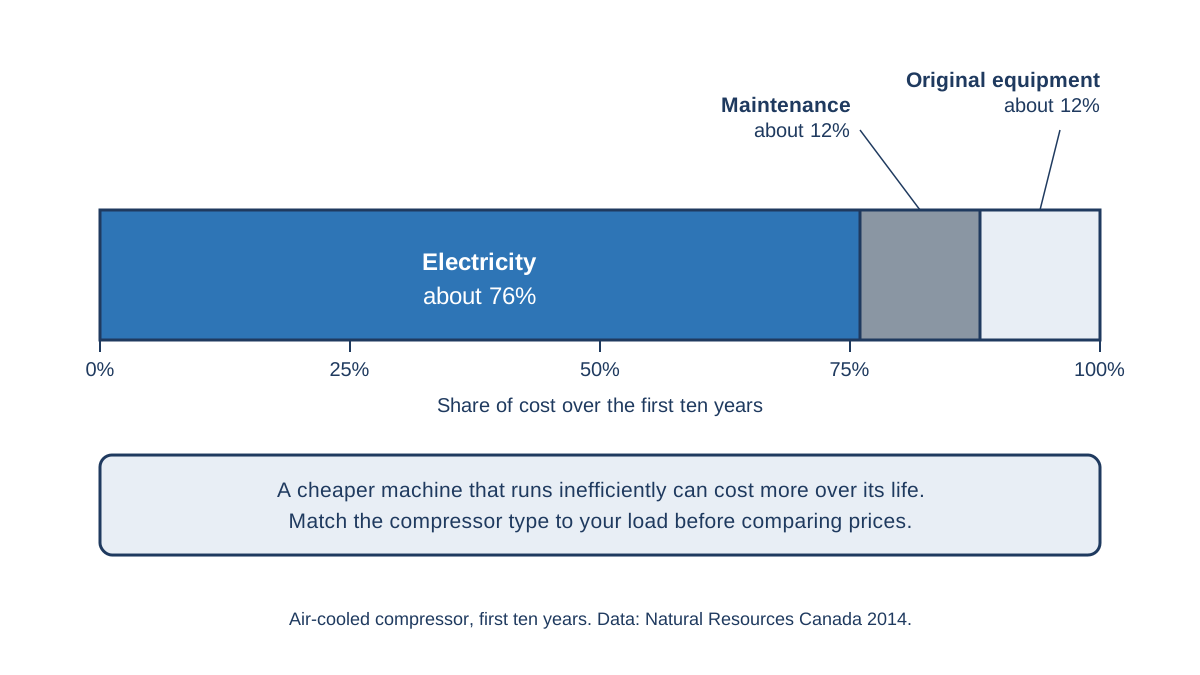
Purchase price is only a small part of the story. Natural Resources Canada (2014) estimates that over the first ten years of an air-cooled compressor, electricity makes up about 76% of lifetime cost, with maintenance and the original equipment each around 12%. Compressed air can also account for up to 30% of a site's electricity use (Australian Government n.d.). So a cheaper machine that runs inefficiently can cost more over its life, and so can compressed air leaks.
Key takeaways
- Piston compressors suit intermittent demand; rotary screws suit air use across most of the shift.
- Small piston units are commonly limited to about 60% duty; screws are designed to run continuously.
- Energy is typically around three quarters of a compressor's ten-year cost, so match the type to your load.
- Screws are usually quieter. Check noise against the 85 dB(A) exposure standard and the WHS noise code.
- Both types need drainage, filtration and drying to suit the air quality your tools require.
Frequently asked questions
Can a piston compressor run all day if it is large enough?
Large industrial piston compressors are a different class of machine: they are typically double-acting and water-cooled (US Department of Energy 2016). Small workshop units are not, so check the manufacturer's duty rating before relying on one for continuous use.
Is a screw compressor wasteful in a small workshop?
It can be. A fixed-speed screw that spends most of its time unloaded still draws significant power. If demand is low and patchy, a piston unit or a smaller variable speed screw may cost less to run.
Which type gives drier air?
The screw's cooler discharge helps, but neither type delivers dry air without treatment. Fit a dryer sized for your conditions. See Refrigerated vs Desiccant Dryers: Which do you need?
Related reading
- How does a Rotary Screw Compressor work?
- How to size an Air Compressor for your Application
- What is Free Air Delivery (FAD)?
- How does a Zero Air Loss Drain work?
References
- Atlas Copco. n.d. "Piston vs Screw Compressor: Factors to Consider." Atlas Copco Kuwait. Accessed 15 October 2026. https://atlascopco.com/en-kw/compressors/air-compressor-blog/piston-vs-screw-compressor.
- Atlas Copco. 2020. "Rotary Screw vs Piston Compressor: What's the Best Solution? (Part 2 of 2)." Atlas Copco India, 26 August 2020. Accessed 15 October 2026. https://www.atlascopco.com/en-in/compressors/air-compressor-blog/rotary-screw-vs-piston-air-compressor-which-one-is-best-part-2.
- Australian Government. n.d. "Compressed Air." energy.gov.au. Accessed 15 October 2026. https://www.energy.gov.au/business/equipment-guides/compressed-air.
- Natural Resources Canada. 2014. "Energy Efficiency Reference Guide: Compressed Air." Last modified 14 January 2025. Accessed 15 October 2026. https://natural-resources.canada.ca/energy-efficiency/energy-star/energy-efficiency-reference-guide-compressed-air.
- NSW Office of Environment and Heritage. 2017. Low Capital Cost, Simple Solutions to Improve the Efficiency of Your Compressed Air System. OEH2017/0257. Hosted by Energy NSW. https://www.energy.nsw.gov.au/sites/default/files/2022-08/2017_NSW_CompressedAirGuidepdf.pdf.
- Safe Work Australia. 2015. Compressed Air and Air Receiver Information Sheet. https://www.safeworkaustralia.gov.au/system/files/documents/1703/compressed-air-information-sheet.pdf.
- Safe Work Australia. 2015. Managing Noise and Preventing Hearing Loss at Work: Code of Practice. Work Health and Safety (Managing Noise and Preventing Hearing Loss at Work) Code of Practice 2015, F2016L00426. Canberra: Federal Register of Legislation. https://legislation.gov.au/F2016L00426/asmade/2016-03-30/text/original/pdf.
- US Department of Energy. 2016. Improving Compressed Air System Performance: A Sourcebook for Industry. 3rd ed. Washington, DC: US Department of Energy and Compressed Air Challenge. https://www.energy.gov/sites/prod/files/2016/03/f30/Improving%20Compressed%20Air%20Sourcebook%20version%203.pdf.
This article is general information only. Check manufacturer documentation and applicable Australian Standards for your installation.