

How does a Rotary Screw Compressor work?
Ultramax Systems on 15th Oct 2026
Short answer: A rotary screw compressor traps air between two meshing helical rotors and their housing. As the rotors turn, each trapped pocket moves along the rotors and gets smaller, so the air pressure rises until the pocket opens to the discharge port. In oil-injected machines, oil cools, seals and lubricates the process, and a separator removes most of it afterwards.
How a rotary screw compressor works
The heart of the machine is the airend. The US Department of Energy (2016) describes it as two intermeshing rotors turning inside a machined housing. One is the male rotor and the other the female rotor, and they rotate in opposite directions (Atlas Copco n.d.).
Air moves through the airend in small pockets, and each goes through the same four stages. First, the lobes unmesh near the inlet port and air flows in to fill the space between them. Further rotation then closes that pocket off from the inlet, trapping the air. As the meshing line moves along the rotors, the pocket shrinks and its pressure rises. Finally, the pocket reaches the discharge port and the compressed air leaves the airend.
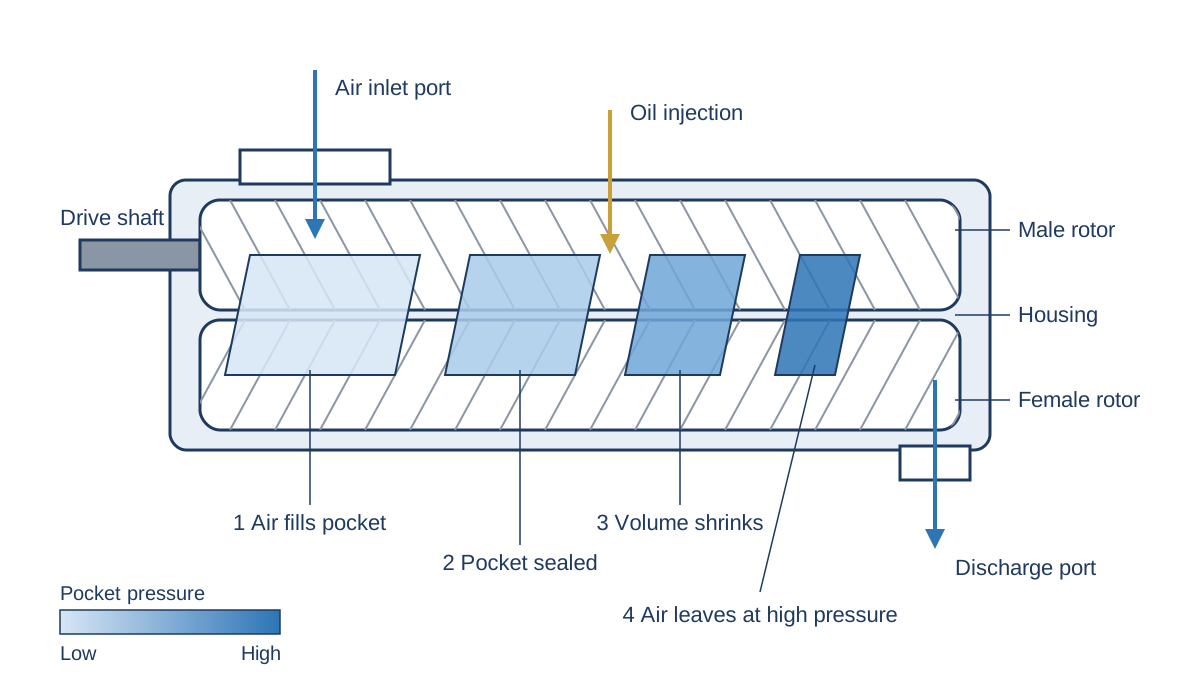
Because the discharge port sits at a fixed position, every airend has a built-in pressure ratio. As Atlas Copco (n.d.) explains, rotor length and pitch set that ratio, and the design of the discharge port also plays a part. Efficiency is typically highest when the built-in ratio suits the working pressure, so a machine run well away from its design pressure does extra work for the same air.
Key components of an oil-injected package
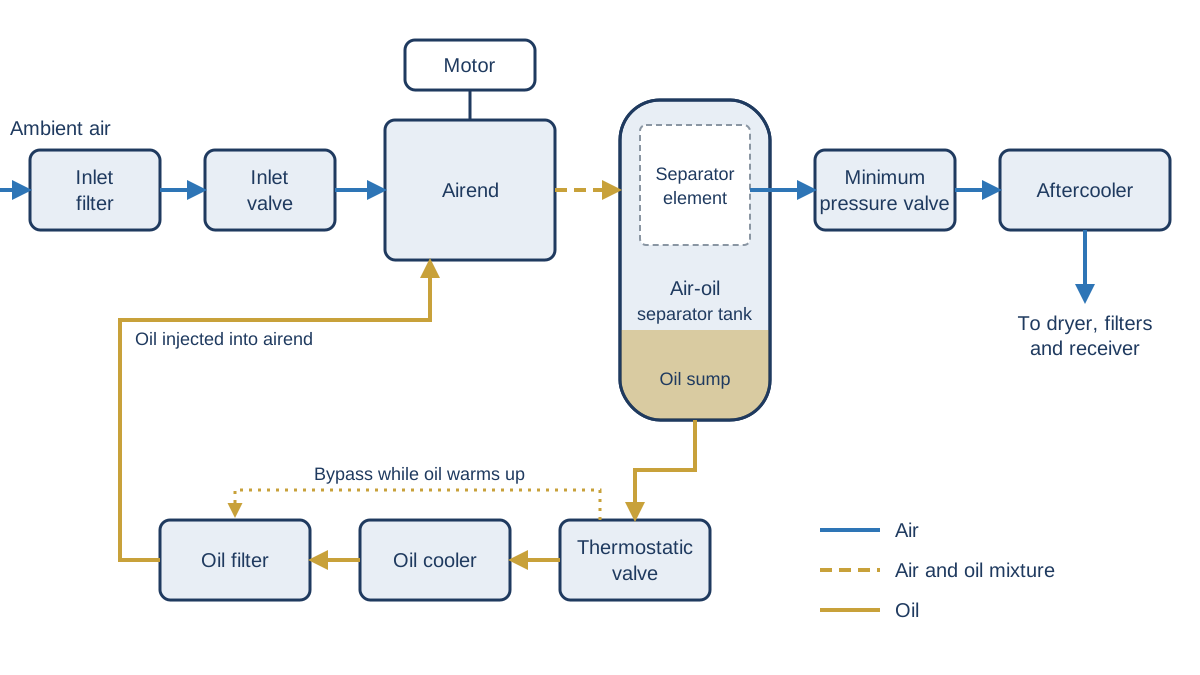
Around the airend sits an air path and a separate oil circuit. Figure 2 shows how air and oil travel through a typical package, and the table summarises each part.
| Component | What it does |
|---|---|
| Inlet filter | Stops dust in the intake air from reaching the rotors and the oil. |
| Inlet valve | Controls how much air the airend draws in, so the machine can load, unload or modulate. |
| Airend | Compresses the air. Oil is injected into the compression space. |
| Air-oil separator tank and element | The tank drops out most of the oil. The separator element then removes most of what remains. |
| Minimum pressure valve | Holds pressure in the separator tank at start-up and is often combined with a check valve. |
| Aftercooler | Cools the compressed air, so much of its water vapour condenses before the air leaves the package. |
| Thermostatic valve and oil cooler | Keep oil within its design temperature range by varying how much oil passes through the cooler. |
| Oil filter | Removes particles from the oil before it returns to the airend. |
Oil is injected for three reasons. It lubricates the rotors and bearings, it carries away the heat of compression, and it seals the small internal clearances so less air slips back (US Department of Energy 2016). During start-up, a minimum pressure device stops air rushing through the separator too fast and carrying oil with it (US Department of Energy 2016). Oil temperature needs control too. Hoerbiger (n.d.) describes a thermostatic valve that holds it in the design range by varying how much oil passes through the cooler, and some versions combine this valve with a spin-on oil filter.
Oil-injected and oil-free screw compressors
Oil-injected units are the common choice for general industry. Single-stage lubricant-injected packages range from about 3 to 900 hp, with discharge pressures from 50 to 250 psig, which is roughly 3.4 to 17 bar(g) (US Department of Energy 2016). In practice, oil-injected screw elements typically reach up to 13 bar in a single stage (Atlas Copco n.d.).
Oil-free screw compressors have no oil in the compression chamber, so external timing gears keep the rotors in step instead, and the rotors do not touch each other or the housing. Atlas Copco (n.d.) notes that, without oil to absorb heat, these machines typically split the job into two or more stages with cooling between them to reach higher pressures.
Where rotary screw compressors are used
The lubricant-injected screw has become a dominant type of industrial compressor (US Department of Energy 2016). One reason is duty cycle: rotary screw units are designed for continuous operation (Atlas Copco n.d.), which suits sites that need air across long shifts. Compressed air systems can use up to 30% of a site's electricity (Australian Government n.d.), so control and maintenance show up on the power bill.
Pressure vessel rules in Australia
The separator tank holds air and oil at discharge pressure, so it is a pressure vessel, as is the air receiver downstream. Australian regulators rank pressure vessels from hazard level A, the most hazardous, to E, the least, using AS 4343 (SafeWork SA 2021). WorkSafe WA (2022) lists pressure vessels at hazard level A, B or C as plant requiring registration, while gas cylinders and serially produced vessels are among the exclusions. Separately, SafeWork SA (2021) requires regular inspection of pressure equipment by a competent person in line with AS/NZS 3788. Confirm the status of your own vessels with your state regulator or a competent person.
Common mistakes
Many screw compressor problems start with service parts left too long. A loaded or damaged separator element can raise pressure drop and let more oil pass downstream. A blocked inlet filter restricts intake, so the machine delivers less air than it should, and inlet air should not be unnecessarily warm, humid or dirty either (Australian Government n.d.). Follow the manufacturer's oil specification and change interval too.
Another common mistake is assuming the air leaving the package is clean. Typical lubricant carryover from an oil-injected machine is 2 to 5 ppm (US Department of Energy 2016), and the air still carries water and particles. That is why most sites need dryers and filters chosen for the purity class they require (ISO 8573-1:2010). A coalescing filter is the usual next step for oil aerosols.
The NSW Office of Environment and Heritage (2017) notes that the shorter a compressor's load and unload cycles are, the higher its average unloaded power. Finally, avoid comparing machines on motor size alone. Compare free air delivery (FAD) and specific power at the same conditions instead.
Key takeaways
- Two meshing rotors trap air in pockets that shrink as they move toward the discharge port.
- In oil-injected units, oil cools, seals and lubricates, then the separator recovers most of it.
- Air leaving the package still needs drying and filtering to suit your required air quality.
- The separator tank and air receiver are pressure vessels, so check registration and inspection duties with your state regulator.
Frequently asked questions
Do oil-free screw compressors still need filters?
In most systems, yes. They still deliver water vapour and particles from the intake air. Select dryers and filters for the purity class your application requires (ISO 8573-1:2010), and confirm the choice with a qualified person.
How often should screw compressor filters be changed?
Intervals depend on the model, running hours and site conditions. Follow the manufacturer's service schedule and check differential pressure indicators where fitted.
Related Ultramax products
- Air-oil separator kits: replacement separators for oil-injected screw compressors.
- Maintenance service kits: filters, separators and seals by compressor model.
- Compressor spare parts and service kits: the full range of service parts.
- Filter Finder: match a replacement element by OEM part number.
References
- Atlas Copco. n.d. "Screw Compressor Working Principle: How It Works." Accessed 13 October 2026. https://www.atlascopco.com/en-in/compressors/wiki/compressed-air-articles/twin-screw-compressors.
- Australian Government. n.d. "Compressed Air." energy.gov.au. Accessed 14 October 2026. https://www.energy.gov.au/business/equipment-guides/compressed-air.
- Hoerbiger. n.d. "Oil Circuit: Components for Rotary Screw Compressors." Accessed 13 October 2026. https://www.hoerbiger.com/en/products-and-services/components-for-rotary-screw-compressors/oil-circuit-for-oil-injected-screw-compressors.html.
- ISO (International Organization for Standardization). 2010. ISO 8573-1:2010 Compressed Air, Part 1: Contaminants and Purity Classes. Geneva: ISO. https://www.iso.org/standard/46418.html.
- NSW Office of Environment and Heritage. 2017. Low Capital Cost, Simple Solutions to Improve the Efficiency of Your Compressed Air System. Sydney: NSW Office of Environment and Heritage. https://www.energy.nsw.gov.au/sites/default/files/2022-08/2017_NSW_CompressedAirGuidepdf.pdf.
- SafeWork SA. 2021. "Pressure Plant and Equipment." Last modified 3 March 2026. Accessed 14 October 2026. https://safework.sa.gov.au/workplaces/plant-tools-and-vehicles/pressure-vessels.
- US Department of Energy. 2016. Improving Compressed Air System Performance: A Sourcebook for Industry. 3rd ed. Washington, DC: US Department of Energy and Compressed Air Challenge. https://www.energy.gov/sites/prod/files/2016/03/f30/Improving%20Compressed%20Air%20Sourcebook%20version%203.pdf.
- WorkSafe WA. 2022. "What Kinds of Plant Require Registration." Last updated 30 March 2022. Accessed 14 October 2026. https://www.worksafe.wa.gov.au/what-kinds-plant-require-registration.
This article is general information only. Check manufacturer documentation and applicable Australian Standards for your installation.