
What is Set Pressure on a Safety Relief Valve?
Ultramax Systems on 16th Oct 2026
Short answer: Set pressure is the gauge pressure at which a safety relief valve starts to open and vent. It matters because the set pressure must never be higher than the design pressure of the vessel the valve protects, such as an air receiver.
Why set pressure matters
An air receiver stores a large amount of energy. If a pressure switch or unloader fails, the compressor can keep pumping until something gives way. The safety relief valve is the last line of defence, and its set pressure decides when it acts. Safe Work Australia (2015) states that the set pressure of the relief valve must never exceed the design pressure of the air receiver. Set too high, the valve leaves the vessel unprotected. Set too close to working pressure, it weeps or pops during normal running.
How a safety relief valve holds its set pressure
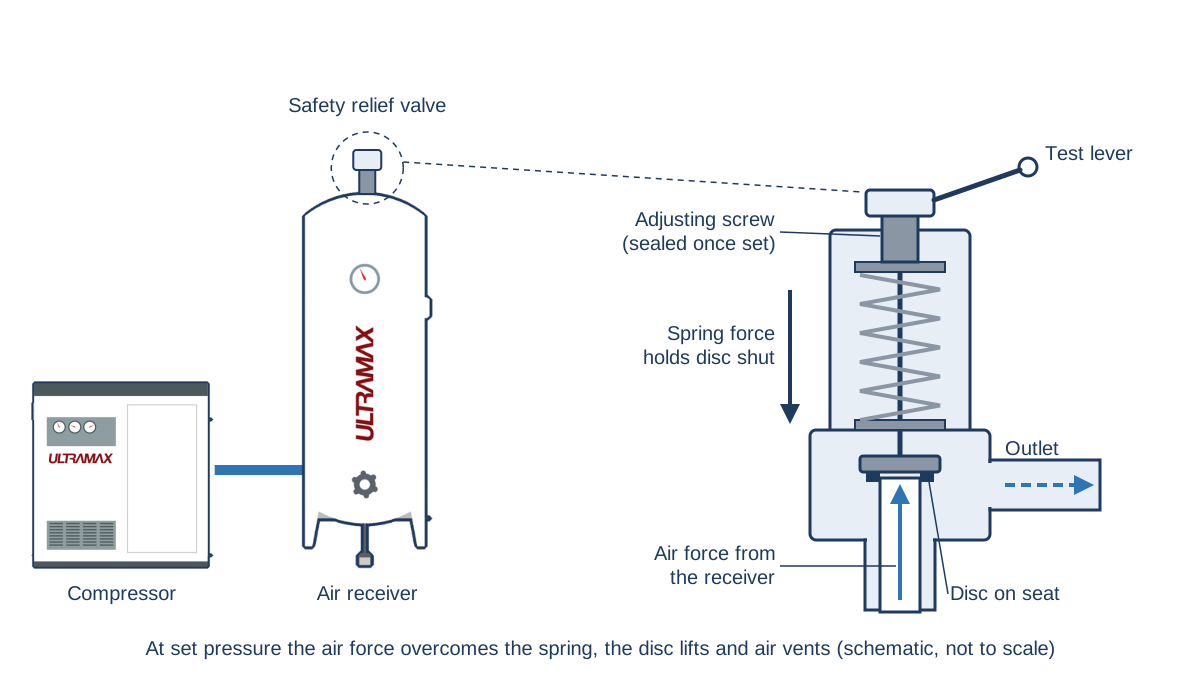
Most safety relief valves on compressed air plant are direct spring loaded. A spring presses a disc onto a seat, and an adjusting screw sets the spring load. Air pressure under the disc pushes upwards. Set pressure is the point where that air force starts to overcome the spring and the valve begins to lift (Spirax Sarco n.d.). The maker sets the release pressure and usually seals the valve, so nobody can wind the spring down to stop it blowing (Safe Work Australia 2015).
Set pressure, overpressure and blowdown
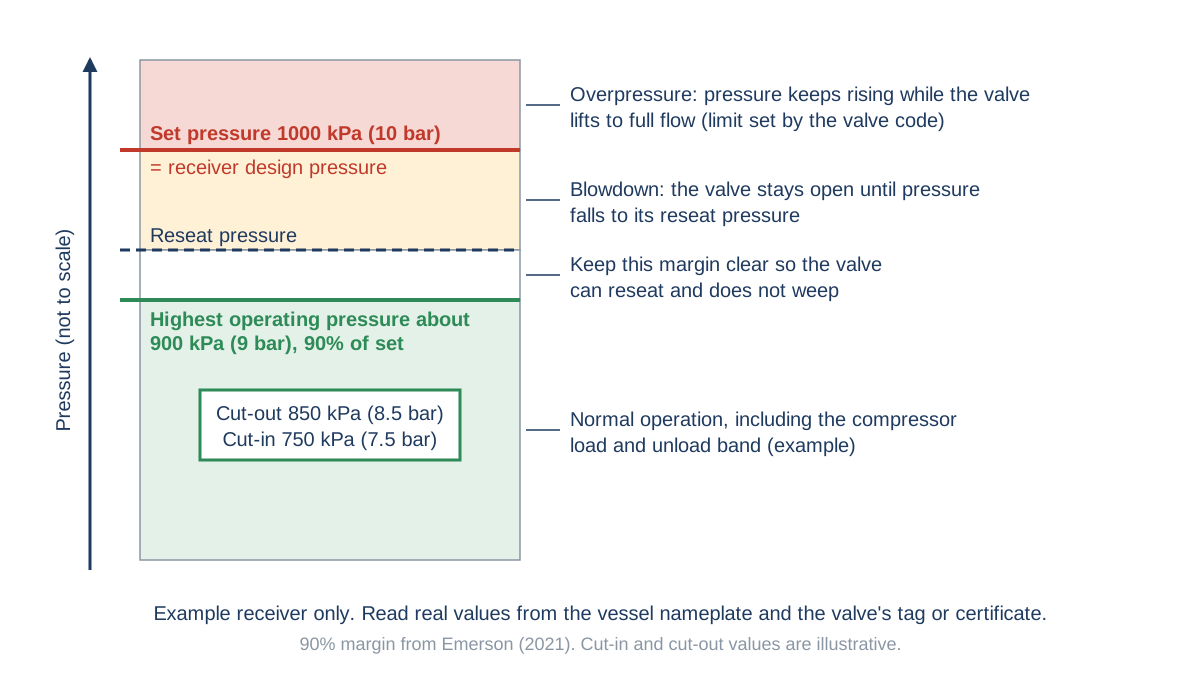
Set pressure is only the start of the valve's cycle. Once the valve opens, pressure can keep rising for a short time while the disc lifts to full flow. That rise above set pressure is called overpressure (Spirax Sarco n.d.). The valve then stays open until pressure falls to its reseat pressure. The difference between opening and reclosing pressure is called blowdown. Just below set pressure, some valves weep or simmer before they pop fully open (Emerson 2021).
Two more terms appear on data sheets. Cold differential test pressure is the pressure used to set a valve on a test rig at ambient temperature (Spirax Sarco n.d.). Maximum allowable working pressure (MAWP) is the highest pressure the vessel is permitted to see, and the lowest set safety valve must not be set above it.
Typical margins between set and working pressure
Leave a clear gap between the highest normal working pressure and the set pressure. One valve maker recommends that operating pressure stays at or below 90 per cent of the set pressure. It also recommends a minimum differential of 10 per cent or about 35 kPa (5 psi), whichever is greater (Emerson 2021). For a receiver with a valve set at 1000 kPa (10 bar), that puts the compressor's cut-out at no more than about 900 kPa (9 bar). The gap lets the valve reseat cleanly and stops normal pressure swings from lifting it.
Australian standards and practice
AS 1271 covers the design, construction and testing of safety valves and other fittings for boilers and unfired pressure vessels (Standards Australia 2003). The vessel itself is covered by AS 1210, which includes the fittings needed for safe functioning (Standards Australia 2010). Safe Work Australia (2015) also says the valve must have a lever or ring to test that it can open and reseat. It suggests checking that mechanism periodically, for example monthly, and never tampering with the valve.
Common mistakes and what to check
The most common mistake is fitting a replacement valve by thread size alone. Check that the stamped set pressure does not exceed the receiver's design pressure on its nameplate. Then make sure its rated capacity covers the full compressor output. Other faults include raising the compressor cut-out without checking the valve, and painting over or restricting the outlet. If a valve weeps, do not adjust it on site. Replace it, or have a competent person reset and retest it. Seat type also affects tightness, as explained in What are Hard Seat and Soft Seat Valves?
Related terms
- Design pressure: the maximum pressure the receiver is designed to work at. See Air receiver sizing formula with a worked example.
- Blowdown: the pressure drop between opening and reclosing.
- AS-coded valve: a valve made and marked to the Australian standard. See What does AS-coded mean?
- Cut-in and cut-out: the pressures where the compressor loads and unloads. See How to size an Air Compressor.
References
- Emerson. 2021. Kunkle Safety and Relief Products Technical Reference. VCTDS-00398-EN. https://emerson.com/documents/automation/product-brochure-technical-reference-for-safety-relief-products-kunkle-valve-en-en-5197464.pdf.
- Safe Work Australia. 2015. Compressed Air and Air Receiver Information Sheet. https://www.safeworkaustralia.gov.au/system/files/documents/1703/compressed-air-information-sheet.pdf.
- Spirax Sarco. n.d. "Alternative Plant Protection Devices and Terminology." Learn About Steam. Accessed 16 October 2026. https://spiraxsarco.com/learn-about-steam/safety-valves/alternative-plant-protection-devices-and-terminology.
- Standards Australia. 2003. AS 1271-2003 (R2025) Safety Valves, Other Valves, Liquid Level Gauges and Other Fittings for Boilers and Unfired Pressure Vessels. Listing accessed via ANSI Webstore, 16 October 2026. https://webstore.ansi.org/standards/sai/12712003r2025.
- Standards Australia. 2010. AS 1210-2010 Pressure Vessels. Reaffirmed 2021. Listing accessed via MBIE Codehub, 16 October 2026. https://codehub.building.govt.nz/resources/as-1210-2010-r2021.
This article is general information only. Check manufacturer documentation, applicable Australian Standards and your state or territory WHS regulator's guidance for your installation.