

Water in Air Tools: Causes and Fixes
Ultramax Systems on 16th Oct 2026
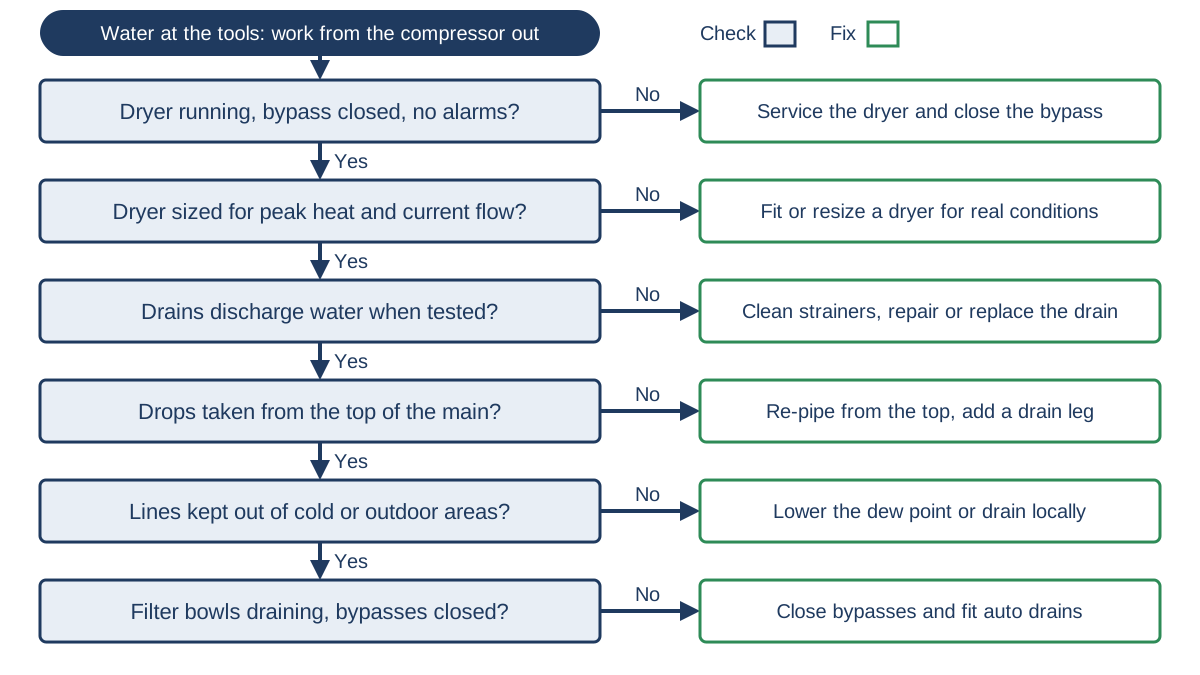
Short answer: Water in air tools means liquid is getting past the treatment equipment or forming in the pipework after it. The usual causes are a missing, undersized or faulty dryer, failed drains, branch lines taken from the bottom of the main, and hot, humid weather that loads the system with more moisture than it was set up for. Most cases can be found with a few simple checks, starting at the compressor and working towards the tool.
What the symptom tells you
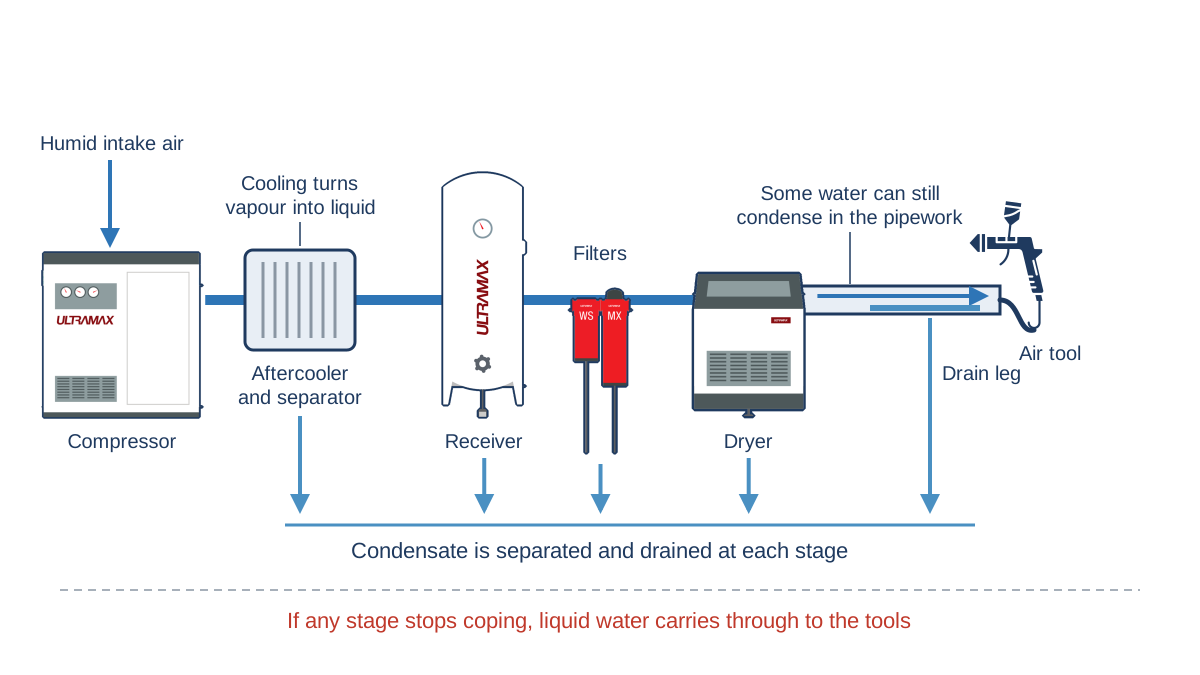
Every compressor draws in water vapour with its intake air. Compression concentrates that vapour, and as the hot air cools it condenses into liquid. A healthy system removes most of it in the aftercooler, separators, receiver, filters and dryer, and drains it away. When you see water spitting from a blow gun, rust in a tool's exhaust or milky oil in a lubricator, one of those stages has stopped coping.
Even a well-run system makes some water downstream of the compressor room. The NSW Office of Environment and Heritage (2017) notes that some water will condense in the distribution pipework even with a fully working dryer.
Quick-check table
| Likely cause | How to check | Fix |
|---|---|---|
| No dryer, or dryer too small | Compare dryer capacity with compressor output at your site temperature | Fit or resize a dryer to suit the real flow and ambient conditions |
| Dryer fault or bypass open | Check dryer alarms, dew point reading and bypass valve position | Service the dryer and close the bypass |
| Failed or stuck drains | Press the drain test button or open the manual valve and watch for water | Clean strainers, repair or replace the drain |
| Branch lines from the bottom of the main | Look at where each drop leaves the header | Re-pipe takeoffs from the top, with a drain leg below each outlet |
| Hot, humid weather | Problems appear in summer or after storms | Check dryer sizing and drain capacity for peak conditions |
| Pipes cooling below the dew point | Water appears in lines that run outside or through cold areas | Lower the dew point or reroute and drain those lines |
| Filters bypassed or flooded | Check bypass valves and look at bowl levels | Close bypasses, fit auto drains and service elements |
Causes in detail
No dryer, or a dryer that is too small
An aftercooler and receiver remove a lot of liquid, but the air leaving them is still saturated. Without a dryer, any further cooling in the pipework produces more water. A dryer can also be undersized for today's conditions, especially when a larger compressor has been added or the plant has grown. A dryer that copes in winter can be overloaded on a hot afternoon. Read What is Pressure Dew Point? to see how dryer performance is specified.
Dryer fault or bypass left open
Refrigerated dryers depend on a clean condenser, a working refrigeration circuit and a drain that clears the separated water. A blocked condenser, a tripped fan or a failed drain lets wet air pass straight through. Bypass valves opened for servicing and then forgotten send the whole flow around the dryer, so check them first.
Failed or stuck drains
Drains are the most common single cause of water at the tools. A blocked strainer, a stuck float or a timer set for winter loads lets condensate build up until it carries over into the air stream. Timer drains also open on a schedule whether condensate is present or not (US Department of Energy 2016). The NSW compressed air guide recommends checking drain performance by hand every month, and it points out that a poorly drained aftercooler can even upset pressure readings at the compressor outlet (NSW Office of Environment and Heritage 2017). For the receiver, Safe Work Australia (2015) advises draining condensate daily unless an automatic drain is fitted, with the drain at the lowest point of the vessel. Level-sensing condensate drains remove liquid only when it is present, and our article on zero air loss drains explains how they work.
Drops taken from the bottom of the main
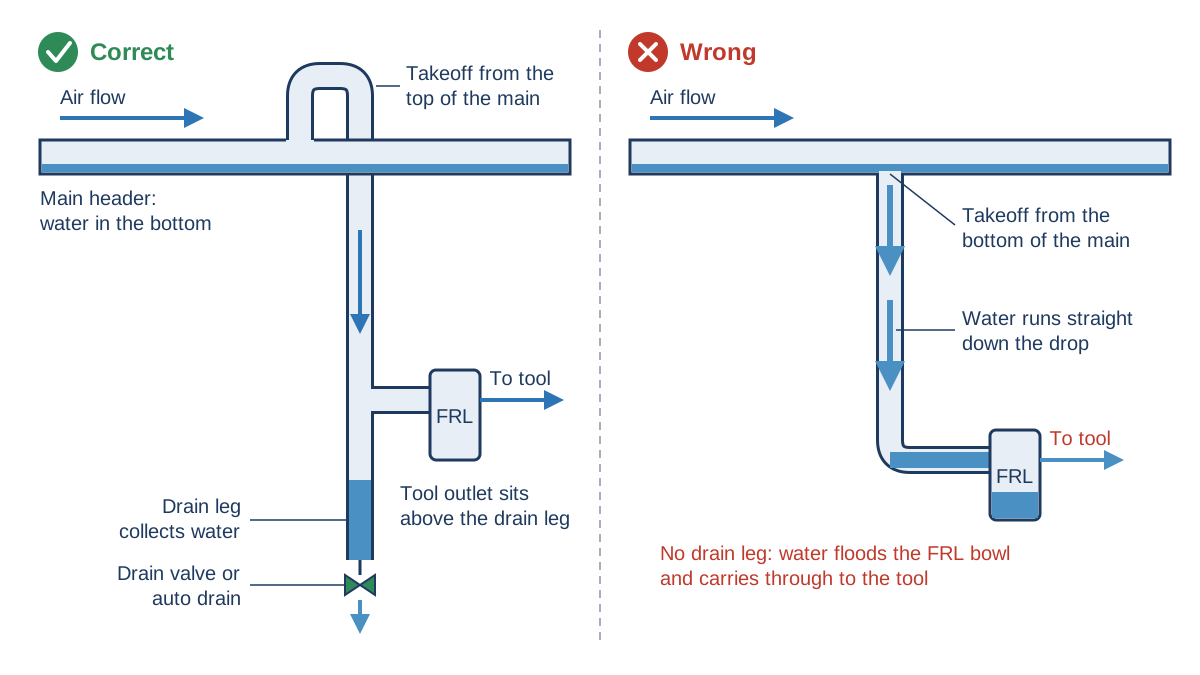
Condensate that forms in the main header runs along the bottom of the pipe. A branch taken from the underside acts like a drain and sends that water straight down to the tool. Sullair's piping guidance treats connection at the top of the main header as good practice (Thielemann 2022), and Parker Hannifin (n.d.) suggests drilling drop outlets in the top of the pipe to keep moisture and debris out of the drop line. The drop should then continue past the tool outlet into a short drain leg with a valve or automatic drain at the bottom, as shown below.
Hot, humid conditions
Warm air holds more moisture than cool air, so a compressor in a hot, humid location takes in more water with every cubic metre. The Bureau of Meteorology (2017) notes that tropical dew points are commonly above 24 °C in spring and summer, so compressors at many northern Australian sites work with heavy moisture loads for much of the year. Southern sites see the same effect in summer storms and heatwaves. Atlas Copco (n.d.) points out that higher summer humidity produces more condensate and that drains need to handle the extra flow. The energy.gov.au equipment guide also recommends keeping compressor inlet air from being unnecessarily warm, humid or dirty (Australian Government n.d.).
Pipework cooling below the dew point
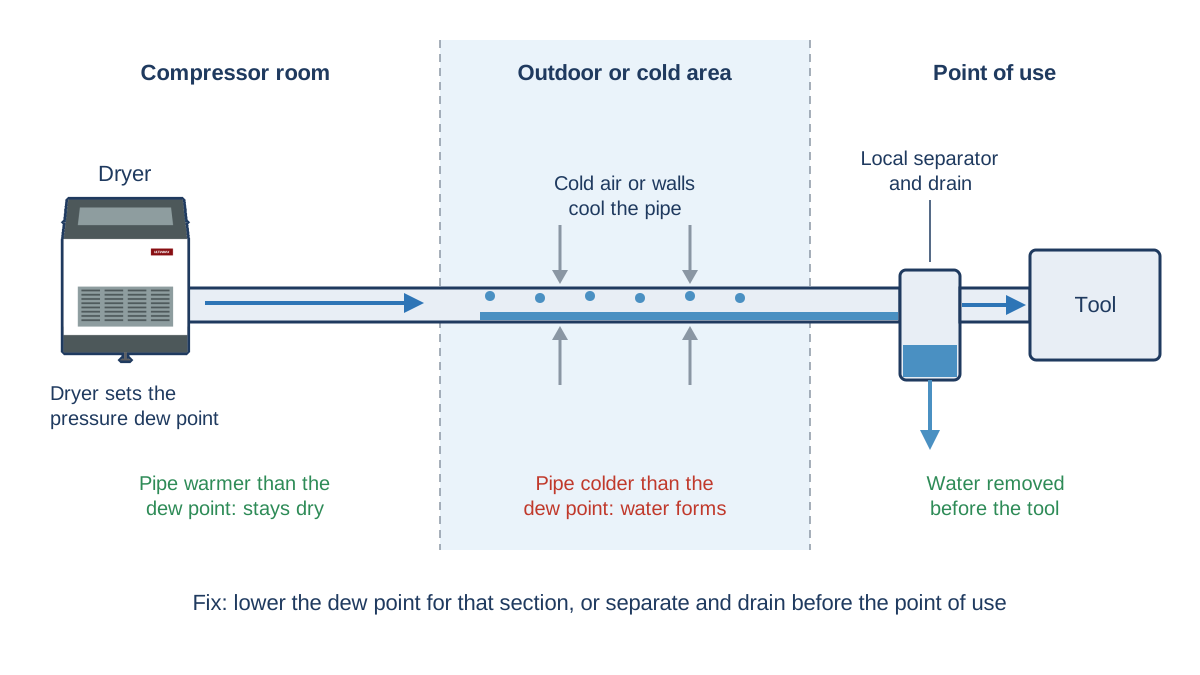
Water forms wherever the air temperature falls below its pressure dew point. Lines that run outdoors, along cold walls or into air-conditioned or refrigerated areas can cool well below compressor room temperature, and water condenses wherever a pipe is colder than the dryer's dew point. The fix is either a lower dew point for that part of the system or local separation and drainage before the point of use.
Bypassed or flooded filters
Coalescing filters and water separators remove liquid only if it can drain away. Once the housing fills, collected water is picked up and carried downstream. Point-of-use bowls are small, so this happens quickly. SMC's AF series catalogue, for example, lists a drain capacity of only 8 cm³ for an AF20 filter bowl (SMC Corporation n.d.). A manual drain on a busy line can overflow between checks, so an auto drain on the filter regulator lubricator (FRL) is worth considering. Running a filter above its rated flow can also splash collected liquid to the outlet side.
Prevention
A simple routine prevents most water problems. Check every drain monthly and before summer. Confirm the dryer suits peak ambient temperature and current compressor output, and log its dew point if it has a display. Keep bypass valves closed and labelled. Take every new drop from the top of the main with a drain leg, and fit point-of-use filtration at moisture-sensitive tools such as spray guns.
Safety note
Drains, filter bowls and dryers hold compressed air. Isolate and depressurise the section before removing a bowl or opening a drain body, and follow the manufacturer's instructions. Condensate from lubricated compressors contains oil, so collect it for treatment and check your water utility's trade waste rules before any discharge.
Key takeaways
- Water at the tools means liquid is passing the dryer or drains, or forming in cold pipework after them.
- Failed drains and open bypass valves are quick to check and common causes.
- Take drops from the top of the main and fit a drain leg below each tool outlet.
- Size dryers and drains for hot, humid peak conditions, not average ones.
- Small FRL bowls fill quickly, so automatic drains help on busy lines.
Frequently asked questions
Why is there more water in my air lines in summer?
Warm, humid intake air carries more water vapour, so the compressor makes more condensate. Dryers and drains that cope in winter can be overloaded on hot days.
Will an FRL alone stop water reaching my tools?
An FRL filter removes liquid that reaches it, but it is a last line of defence with a small bowl. It works well alongside a dryer, working drains and correct drop legs, not in place of them.
Is water in the air bad for pneumatic tools?
It can be. Water can wash out lubrication, promote rust inside the tool and spoil spray-painted or blown-off surfaces, which adds to maintenance and downtime.
Related reading
- What is Pressure Dew Point?
- What is an Aftercooler and why does it matter?
- How does a Zero Air Loss Drain work?
- Coalescing filters explained
References
- Atlas Copco. n.d. "Essential Tips to Maintain Air Compressor During Summer." Atlas Copco Australia. Accessed 15 October 2026. https://www.atlascopco.com/en-au/compressors/air-compressor-blog/tips-to-maintain-compressor-during-summer.
- Australian Government. n.d. "Compressed Air." energy.gov.au. Accessed 15 October 2026. https://www.energy.gov.au/business/equipment-guides/compressed-air.
- Bureau of Meteorology. 2017. "Feeling Hot and Bothered? It's Not the Humidity, It's the Dew Point." Social Media Blog, 19 April 2017. https://media.bom.gov.au/social/blog/1324/feeling-hot-and-bothered-its-not-the-humidity-its-the-dew-point.
- NSW Office of Environment and Heritage. 2017. Low Capital Cost, Simple Solutions to Improve the Efficiency of Your Compressed Air System. OEH2017/0257. Hosted by Energy NSW. https://www.energy.nsw.gov.au/sites/default/files/2022-08/2017_NSW_CompressedAirGuidepdf.pdf.
- Parker Hannifin. n.d. "Transair Drop Brackets for Aluminum Pipe." Accessed 15 October 2026. https://ph.parker.com/us/en/transair-drop-brackets.
- Safe Work Australia. 2015. Compressed Air and Air Receiver Information Sheet. https://www.safeworkaustralia.gov.au/system/files/documents/1703/compressed-air-information-sheet.pdf.
- SMC Corporation. n.d. Air Filter AF10 to 60. Product catalogue. Hosted by SMC Pneumatics. Accessed 15 October 2026. https://smcpneumatics.com/pdfs/af_series_filter_regulators.pdf.
- Thielemann, Brit. 2022. "Compressed Air Piping Recommendations." Sullair. https://america.sullair.com/sites/default/files/2022-04/Compressed%20Air%20Piping%20Recommendations.pdf.
- US Department of Energy. 2016. Improving Compressed Air System Performance: A Sourcebook for Industry. 3rd ed. Washington, DC: US Department of Energy and Compressed Air Challenge. https://www.energy.gov/sites/prod/files/2016/03/f30/Improving%20Compressed%20Air%20Sourcebook%20version%203.pdf.
This article is general information only. Check manufacturer documentation and applicable Australian Standards for your installation.