
What is an Auto Drain on a Filter Housing?
Ultramax Systems on 16th Oct 2026
Short answer: An auto drain is a small valve in or under the bowl of a compressed air filter that empties the water and oil the filter collects, without anyone opening a tap. Without one, liquid builds up in the bowl until the air stream picks it up again and carries it through the element and down the line.
Why it matters
Water separators and coalescing filters turn droplets and aerosols into liquid that runs down into the bowl. If the bowl fills, air passing over the pool picks the liquid up again and carries it downstream, flooding the element, pipework and tools. The NSW Office of Environment and Heritage (2017) lists clogged or damaged filters and liquid reaching production equipment among the results of poor condensate removal. It includes servicing the housing drain in routine filter maintenance. The Australian Government's energy guide for business makes the same point in fewer words: make sure condensate drainage is working (Australian Government n.d.).
How an internal float drain works
Most filter housings leave the factory with an internal float drain built into the bottom of the bowl. A light float sits in the collected liquid and is linked to a small valve. As the level rises, the float lifts and opens the valve, and line pressure pushes the liquid out through the drain port. When the level falls, the float drops and the valve closes while some liquid still covers the seat, so compressed air does not follow it out.
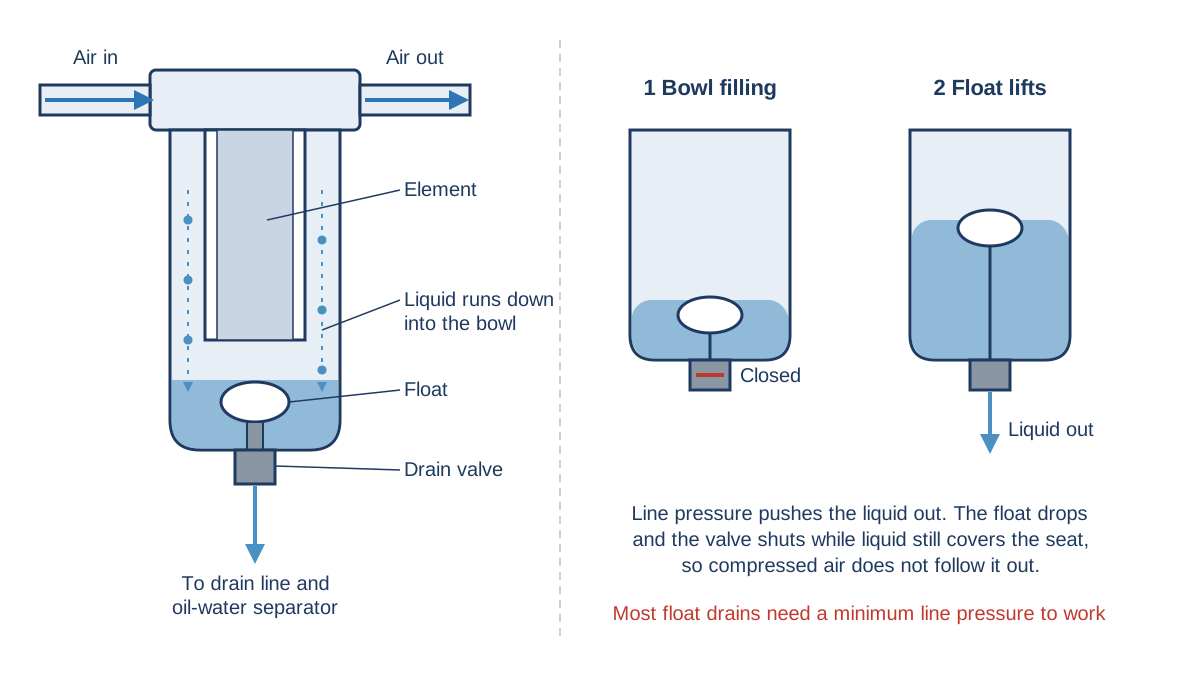
A float drain relies on line pressure. Parker Hannifin (2019) lists a minimum operating pressure of 100 kPa (1 bar) for the float drain on its die-cast filters and specifies a manual drain above 1,600 kPa (16 bar). SMC (n.d.) also offers two behaviours when the air is off. A normally closed drain keeps its port shut without pressure, so liquid that has not lifted the float stays in the bowl until the next start. A normally open drain opens when pressure falls, so the bowl empties at shutdown. SMC lists minimum pressures of 150 kPa and 100 kPa for these two versions. It also notes that a normally open drain on a small compressor can leak air at start-up.
Types of auto drain for filters
Filters can be drained by more than one type of valve, and the choice depends on how much liquid arrives and how dirty it is. The Ultramax range of condensate drains covers both internal and external float types.
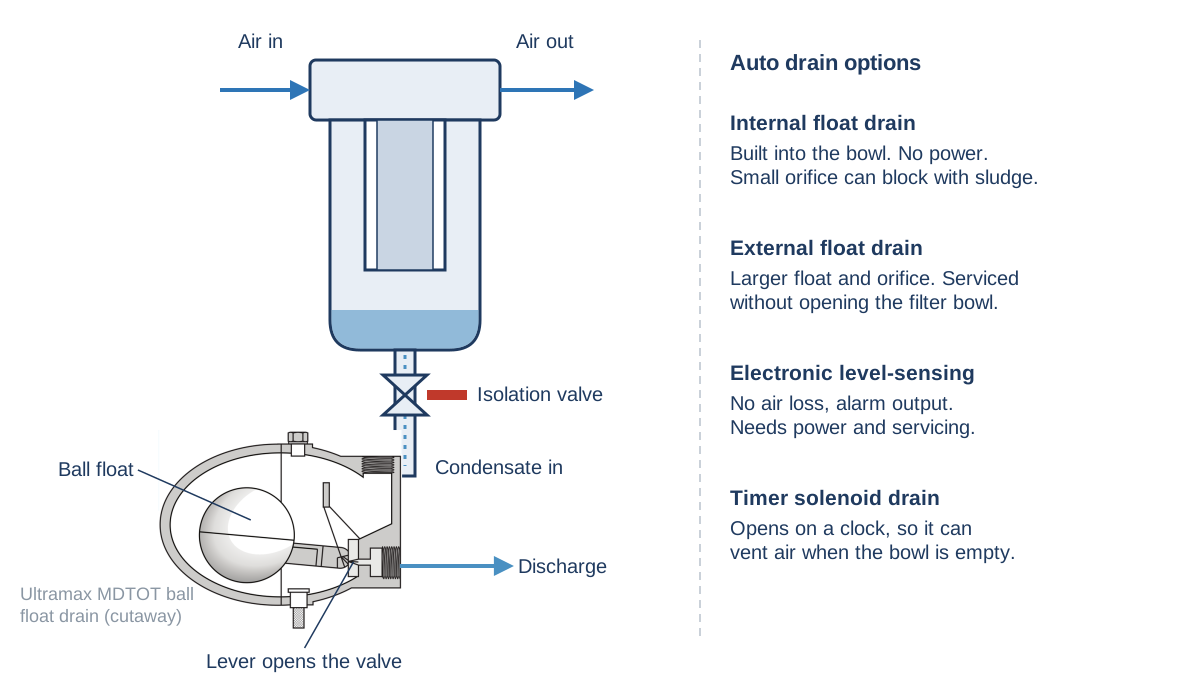
An internal float drain is cheap and needs no power, but its small orifice can block with rust, scale and oil sludge. Float traps waste no air when they work, but they often need a lot of maintenance and are prone to blockage from sediment (US Department of Energy 2016). An external float drain has a larger float and orifice and can be isolated and serviced without opening the filter. An electronic level-sensing drain wastes no air and can raise an alarm, which suits heavily loaded filters. The way it works is covered in How does a Zero Air Loss Drain work?, so it is not repeated here. A timed solenoid drain opens on a clock and can vent air when there is nothing to drain (US Department of Energy 2016).
Common mistakes and what to check
- Assuming the drain works. Check drain performance by hand each month, and listen for drains that leak air (NSW Office of Environment and Heritage 2017).
- A bowl that stays full or a drain that hisses, both signs of a stuck valve.
- Running below the drain's minimum pressure, for example on low-pressure lines or long start-ups.
- Fitting a float drain above its pressure rating.
- No isolation valve, so the drain cannot be serviced without depressurising the line.
- Discharging oily condensate to the floor or stormwater. Pipe it to an oil-water separator.
- Changing the element but not the drain. Service both together.
Related terms
- Coalescing filter: the filter that produces most of the liquid in the bowl. See Coalescing filters explained.
- Zero air loss drain: a level-sensing drain that discharges only liquid. See How does a Zero Air Loss Drain work?
- Timed solenoid drain: a drain that opens at set intervals. See What is a Timed Solenoid Drain?
- Water in air tools: what happens when drains fail. See Water in Air Tools: Causes and Fixes.
References
- Australian Government. n.d. "Compressed Air." Business Equipment Guides, energy.gov.au. Accessed 16 October 2026. https://www.energy.gov.au/business/equipment-guides/compressed-air.
- NSW Office of Environment and Heritage. 2017. Low Capital Cost, Simple Solutions to Improve the Efficiency of Your Compressed Air System. OEH2017/0257. Hosted by Energy NSW. https://www.energy.nsw.gov.au/sites/default/files/2022-08/2017_NSW_CompressedAirGuidepdf.pdf.
- Parker Hannifin. 2019. OIL-X Die-cast Aluminium Compressed Air Filters, Grade AO and AA. PISOILXDCAOAA-00-EN. https://pharmaceutical.yodify.com/Documentation/Document/JlJYA/PISOILXDCAOAA-00-EN.pdf.
- SMC. n.d. Auto Drain Valve: AD402-A Series. Product data sheet. Accessed 16 October 2026. https://partbuilder.smcpneumatics.com/hto_pdf/AD402_A.pdf.
- US Department of Energy. 2016. Improving Compressed Air System Performance: A Sourcebook for Industry. 3rd ed. Washington, DC: US Department of Energy and Compressed Air Challenge. https://www.energy.gov/sites/prod/files/2016/03/f30/Improving%20Compressed%20Air%20Sourcebook%20version%203.pdf.
This article is general information only. Check manufacturer documentation and applicable Australian Standards for your installation.