
What is a Timed Solenoid Drain?
Ultramax Systems on 16th Oct 2026
Short answer: A timed solenoid drain is an automatic condensate drain that uses an electronic timer to open a solenoid valve for a few seconds at a set interval, whether or not any liquid is present. It is simple and low in cost, but every opening without condensate vents compressed air, so the settings need regular checking.
Why it matters
Compressed air systems make water in the aftercooler, receiver, filters and dryer, and it must be removed before it reaches pipework and tools. Safe Work Australia (2015) advises draining an air receiver daily unless it has an automatic drain, with the drain valve at the lowest point to limit internal corrosion. A timed solenoid drain automates that job. The catch is that it works to a clock, not to the amount of liquid actually present.
How it works
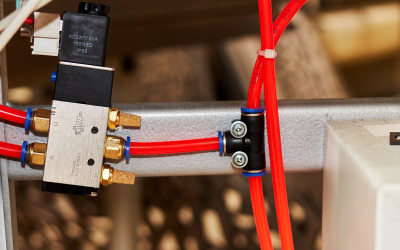
A timed drain has three main parts: a solenoid valve, an electronic timer and a strainer. The timer opens the valve for a set time at preset, adjustable intervals, and system pressure pushes out whatever has collected (US Department of Energy 2016, 16). Many timers also have a test button so you can check the valve by hand. Manufacturers make the point that choosing the timing and length of each cycle is what keeps air loss down (Atlas Copco n.d.).
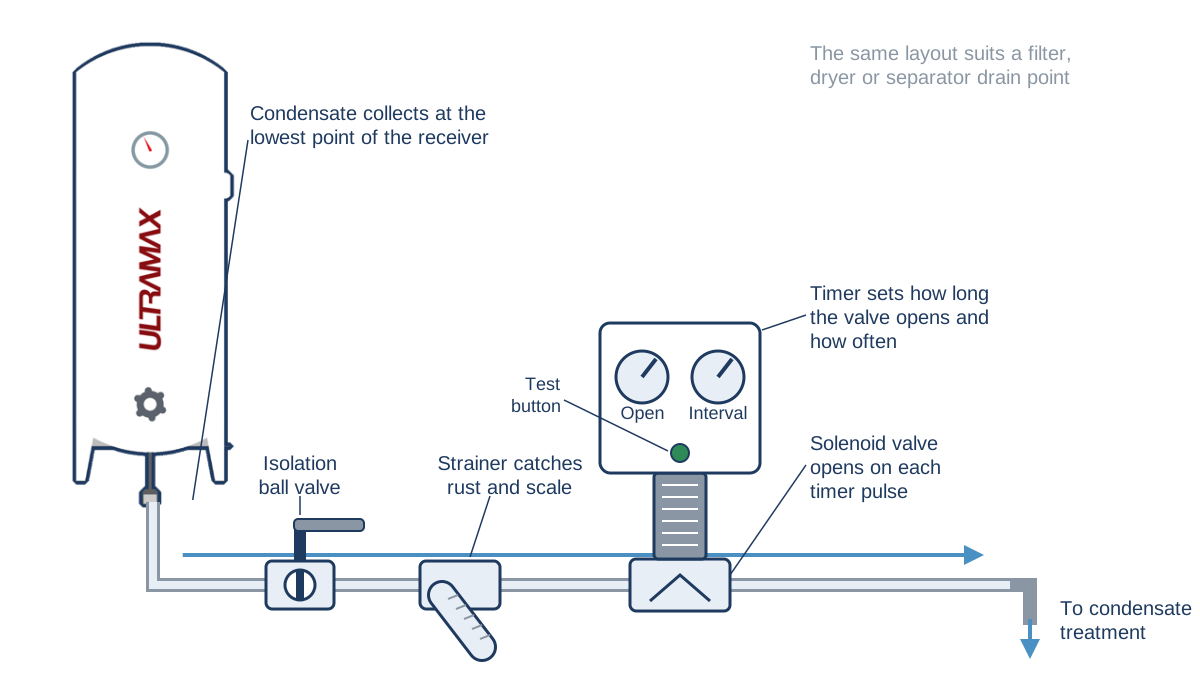
The strainer matters because condensate carries rust, scale and oil sludge. The US Department of Energy (2016) recommends strainers on solenoid drains to stop contaminants blocking the valve ports. A good installation also has a full-flow ball valve ahead of the strainer, so the drain can be isolated for servicing (NSW Office of Environment and Heritage 2017). Integrated strainer valves combine the strainer and drain valve in one compact unit.
The air-loss trade-off
A timer cannot tell water from air. If the valve opens when little or no condensate is present, it simply vents compressed air (US Department of Energy 2016). Parker Hannifin (2018) estimates that a timed drain set to open for 5 seconds every 10 minutes can lose about 1 m³ of air per hour. That is only 30 seconds of open time each hour. Yet on a plant running around the clock, it adds up to roughly 8,760 m³ of free air a year from one drain. To put a dollar figure on that, see How much do Compressed Air Leaks cost?
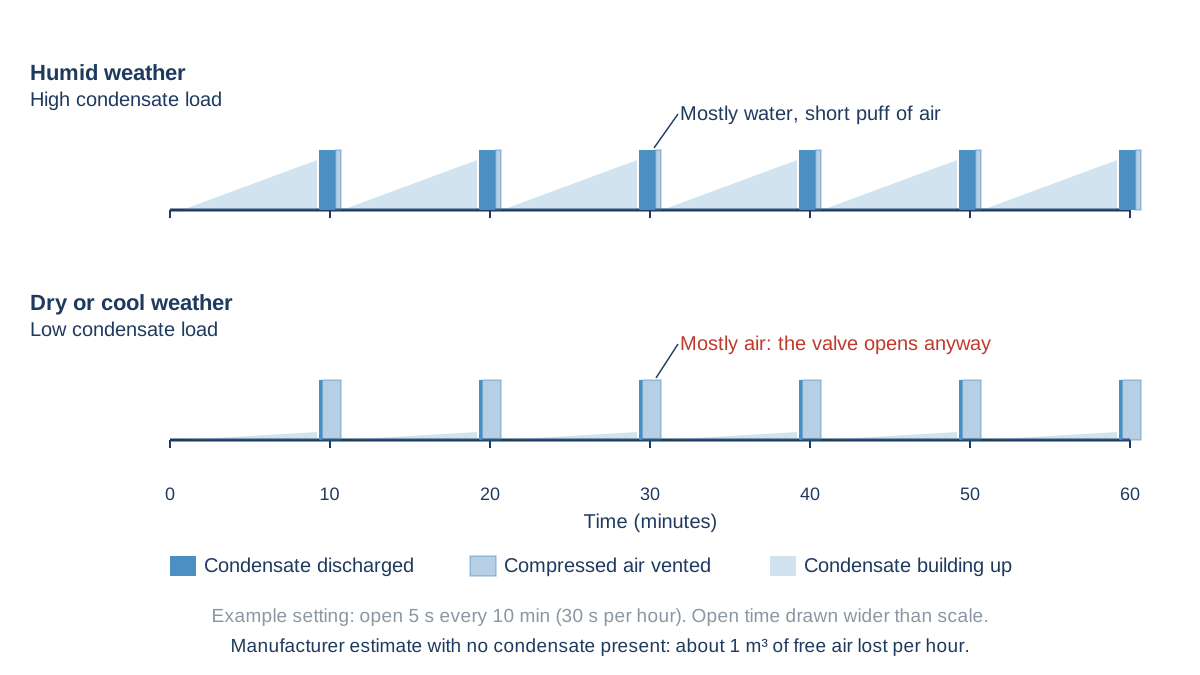
If the open time is too short for the load, condensate builds up between cycles and can be carried on into the air stream (US Department of Energy 2016). Condensate loads rise in hot, humid weather and fall in cool, dry weather. A setting that suits a humid February in Brisbane may waste air in a Perth July. Parker Hannifin (2018) notes that timed drains are often set up and then forgotten, and that the timing should follow seasonal temperature and load changes.
Timed drains versus zero air loss drains
A level-sensing drain opens only when liquid reaches a set level and closes before air can escape. Manual and timed drains are usually open longer than necessary, according to the NSW Office of Environment and Heritage (2017), which recommends sensing drains when a drain needs replacing and the budget allows. Timed drains still have a place on small compressors, low-cost installations and points with a steady condensate load. The level-sensing design is covered in How does a Zero Air Loss Drain work?
What to check
Watch a few cycles after installing or adjusting a timed drain. A burst of water followed by a brief puff of air is about right. A long blast of air means the open time is too long or the interval too short, while water left behind means the opposite. Recheck the settings at each change of season. Clean the strainer regularly and check drain performance monthly (NSW Office of Environment and Heritage 2017). Fit one drain per collection point. Finally, condensate from lubricated compressors contains oil, so send it to an oil-water separator, not the stormwater.
Related terms
- Zero air loss drain: a drain that senses liquid level and vents no air. See How does a Zero Air Loss Drain work?
- Filter auto drain: a drain fitted to the bowl of a filter housing. See What is an Auto Drain on a Filter Housing?
- Oil-water separator: treats oily condensate before disposal. See How does an Oil-Water Separator work?
References
- Atlas Copco. n.d. "Timer Water Drains." Atlas Copco online shop, TWD 230V product page. Accessed 16 October 2026. https://shopct.atlascopco.com/en-GX/products/8102046441/twd-230v-5060hz-g-12.
- NSW Office of Environment and Heritage. 2017. Low Capital Cost, Simple Solutions to Improve the Efficiency of Your Compressed Air System. OEH2017/0257. Hosted by Energy NSW. https://www.energy.nsw.gov.au/sites/default/files/2022-08/2017_NSW_CompressedAirGuidepdf.pdf.
- Parker Hannifin. 2018. Zero Loss Condensate Drains and Oil/Water Separators. Brochure BROCONDENSATE-00-EN. https://pharmaceutical.yodify.com/Documentation/Document/XVwyR/BROCONDENSATE-00-EN.pdf.
- Safe Work Australia. 2015. Compressed Air and Air Receiver Information Sheet. https://www.safeworkaustralia.gov.au/system/files/documents/1703/compressed-air-information-sheet.pdf.
- US Department of Energy. 2016. Improving Compressed Air System Performance: A Sourcebook for Industry. 3rd ed. Washington, DC: US Department of Energy and Compressed Air Challenge. https://www.energy.gov/sites/prod/files/2016/03/f30/Improving%20Compressed%20Air%20Sourcebook%20version%203.pdf.
This article is general information only. Check manufacturer documentation and applicable Australian Standards for your installation.