
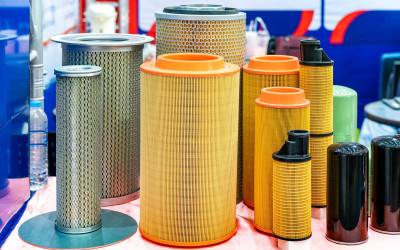
What is a Compressor Intake Air Filter?
Ultramax Systems on 16th Oct 2026
Short answer: A compressor intake air filter cleans the outside air at the compressor inlet before it reaches the inlet valve and airend, catching dust that would otherwise wear the compression element and load up the oil. It protects the machine, not the compressed air, so you still need line filters downstream.
Why it matters
A compressor draws in a large volume of air every minute, along with whatever dust that air carries. The US Department of Energy (2016) describes the inlet filter as the part that protects the compressor from airborne particles, and notes that further filtration is usually needed downstream to protect other equipment. Poor intake filtration shows up as wear. MANN+HUMMEL (n.d.) warns that sub-standard elements lead to above-average wear of compressor components. A dirty filter also costs energy, because the compressor has to work harder to draw air through it. A dirty intake filter can cut compressor efficiency by 1 to 3% (US Department of Energy 2004).
How it works
The filter is a housing on the compressor inlet holding a pleated element, usually paper or synthetic media. Air is drawn through the pleats from the outside in, the dust stays on the outer surface, and clean air leaves through the core to the inlet valve. Small piston compressors often use a simple panel or canister filter. Screw compressors use a larger cartridge, and mobile compressors often use two-stage air cleaners. In these, a pre-separation stage removes much of the dust before it reaches the element, which lengthens element life (MANN+HUMMEL n.d.).
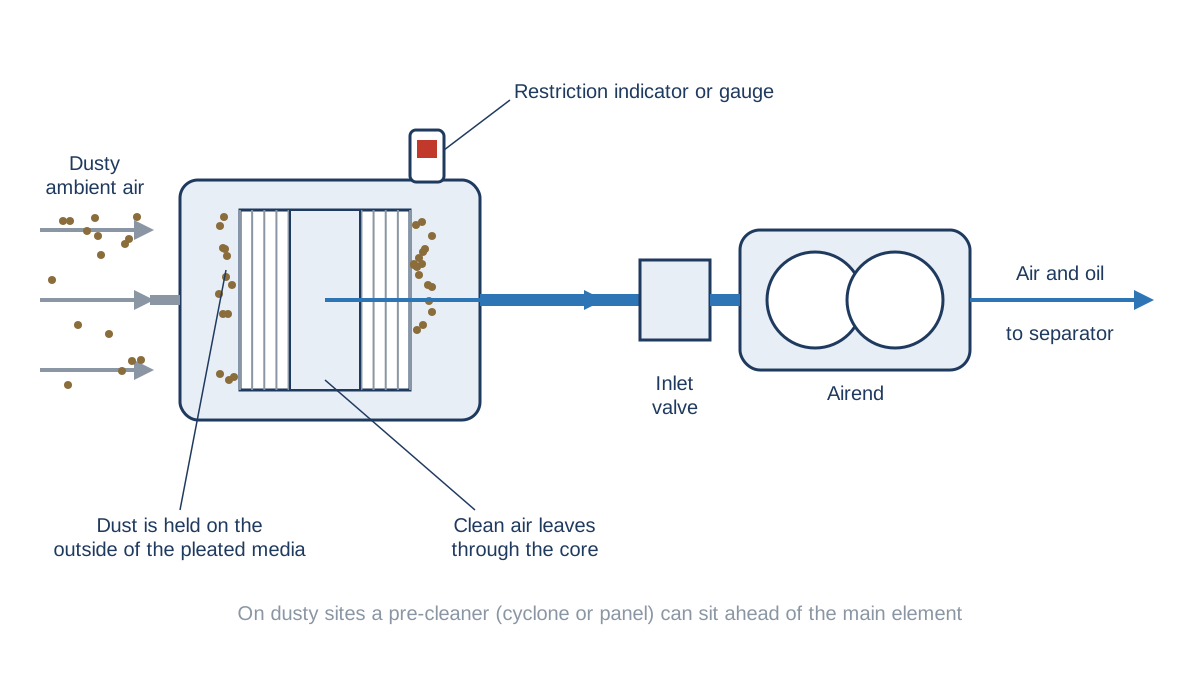
As the element loads, its pressure drop rises and the compressor delivers less air for the same power. Many filters carry a restriction indicator, and the US Department of Energy (2004) calls a pressure differential gauge one of the best ways to monitor the element. Ultramax supplies replacement intake air filter elements to suit a wide range of compressor brands.
Intake location and Australian practice
The filter can only clean the air it is given, so the intake location matters as much as the element. The Australian Government advises businesses to make sure compressor inlet air is not unnecessarily warm, humid or dirty (Australian Government n.d.). Cooler air is denser, so the compressor delivers more mass of air for the same work (US Department of Energy 2004). Atlas Copco Australia (n.d.) suggests drawing intake air from outside the building through a separate, corrosion-resistant pipe with mesh over the opening. The pipe should be large enough to keep pressure drop low. Where dust levels are high, it recommends a pre-filter such as a cyclone, panel or rotary band filter, allowing for its pressure drop in the design.
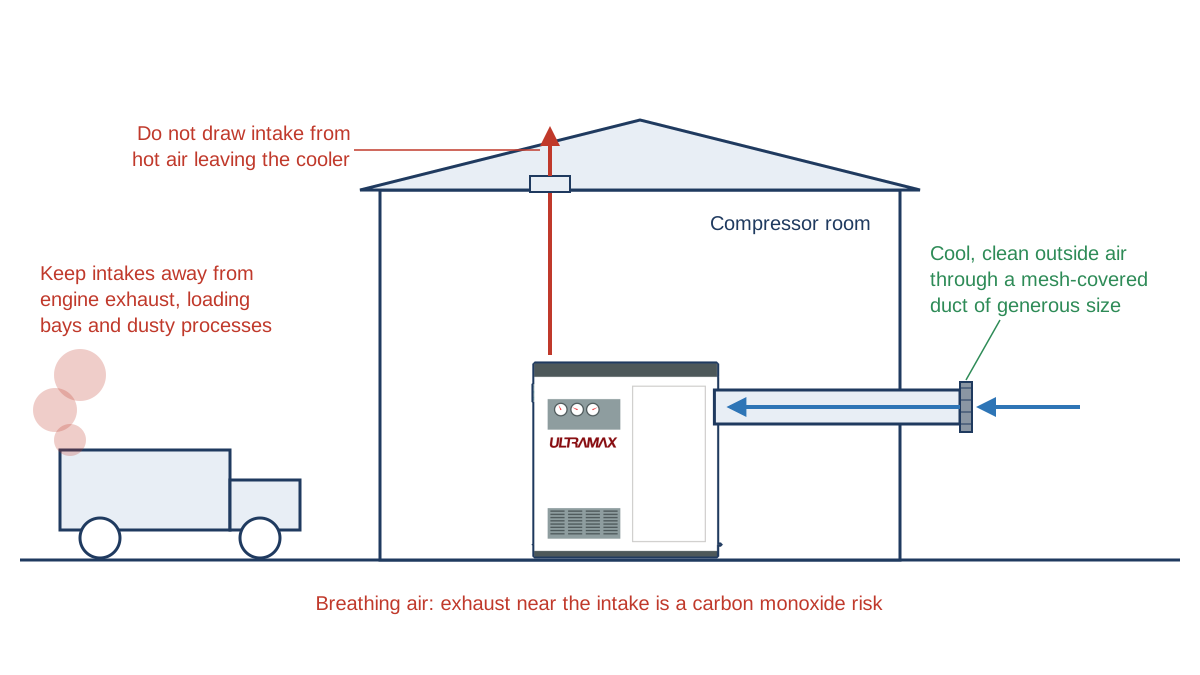
Location is a safety issue for breathing air. WorkSafe Queensland (n.d.) advises placing the compressor intake well away from contaminants, particularly exhaust from plant, equipment and vehicles. It points to AS/NZS 1715 for the air quality supplied to respirators. An intake filter removes dust, not carbon monoxide, so a breathing air system needs a clean intake and purification downstream, such as a hopcalite filter.
Common mistakes and what to check
- Running the element past its change point. Check the indicator and change elements more often on dusty sites.
- A poorly fitting replacement element or damaged seal, which lets dust bypass the media. Use the Filter Finder to match the correct element.
- Drawing intake air from a hot compressor room or from the compressor's own cooling air outlet.
- Intakes near engine exhaust, loading bays or dusty processes.
- Treating the intake filter as air treatment. Line filters and dryers still do that job.
Related terms
- Free air delivery: the output a compressor delivers, which a blocked intake reduces. See What is Free Air Delivery (FAD)?
- Airend: the compression element the filter protects. See How does a Rotary Screw Compressor work?
- Overheating: hot intake air is one cause. See Compressor Overheating: Causes and Fixes.
- Vacuum inlet filter: the equivalent filter on a vacuum pump. See What is a Vacuum Inlet Filter?
References
- Atlas Copco Australia. n.d. "Air Compressor Room Design: Optimal Working Conditions." Accessed 16 October 2026. https://www.atlascopco.com/en-au/compressors/wiki/compressed-air-articles/optimal-working-conditions-compressor-room.
- Australian Government. n.d. "Compressed Air." Business Equipment Guides, energy.gov.au. Accessed 16 October 2026. https://www.energy.gov.au/business/equipment-guides/compressed-air.
- MANN+HUMMEL. n.d. Filtration Solutions for Compressors. Brochure. Accessed 16 October 2026. https://oem.mann-hummel.com/content/dam/website/mann-hummel/oem/downloads/air-oil-separators/brochure-compressors-en.pdf.
- US Department of Energy. 2004. Energy Tips: Compressed Air, Tip Sheet #14. Washington, DC: Industrial Technologies Program. https://www.energy.gov/sites/prod/files/2014/05/f16/compressed_air14.pdf.
- US Department of Energy. 2016. Improving Compressed Air System Performance: A Sourcebook for Industry. 3rd ed. Washington, DC: US Department of Energy and Compressed Air Challenge. https://www.energy.gov/sites/prod/files/2016/03/f30/Improving%20Compressed%20Air%20Sourcebook%20version%203.pdf.
- WorkSafe Queensland. n.d. "Carbon Monoxide in Breathing Air during Air Compressor Use." Accessed 16 October 2026. https://www.worksafe.qld.gov.au/safety-and-prevention/hazards/hazardous-exposures/carbon-monoxide-in-breathing-air-during-air-compressor-use.
This article is general information only. Check manufacturer documentation and applicable Australian Standards for your installation.