
What is a Vacuum Inlet Filter?
Ultramax Systems on 16th Oct 2026
Short answer: A vacuum inlet filter sits on the suction side of a vacuum pump and stops dust, debris and process carry-over being drawn into the pump. It protects the pump's tight internal clearances and its oil, but every kilopascal of pressure drop it adds is vacuum the pump has to make up.
Why it matters
A vacuum pump draws in whatever is in the air around the job. Rotary vane, claw and screw pumps run with close clearances, so abrasive dust wears vanes, rotors and housings and contaminates the oil in lubricated pumps. Leybold (2026) describes its inlet filter kits as protection against abrasive dust that extends pump life. As Bott (2008) puts it, the service life of a vacuum pump often comes down to how well it is protected from incoming contamination. A filter costs far less than a pump rebuild.
How it works
A vacuum inlet filter works much like a compressed air filter, but the pressure inside is below atmospheric. Air flows from the process towards the pump, so the filter sits upstream of the pump on the suction line. The housing holds an element that traps particles as air passes through the media, and the clean air carries on to the pump (MANN+HUMMEL n.d.). Vacuum is best described in kPa absolute, where a lower number means a deeper vacuum.
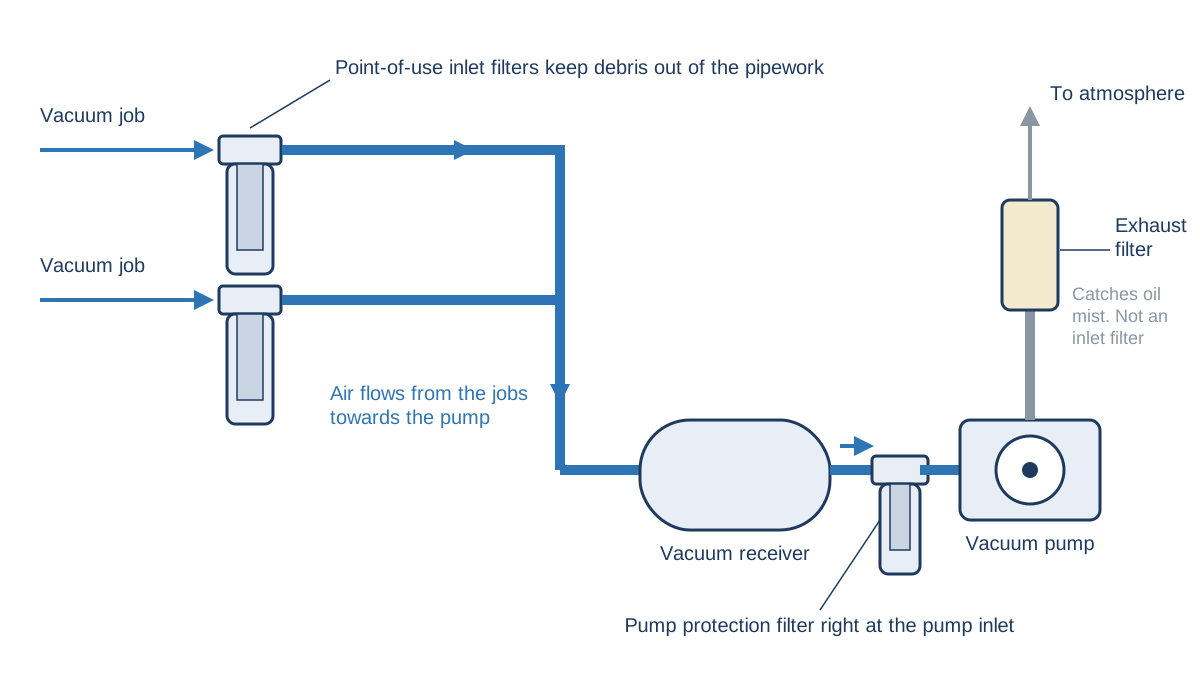
Filters can sit in two places. A pump protection filter goes right at the pump or receiver inlet. Point-of-use filters at each job keep debris out of the pipework as well as the pump. The exhaust filter on the discharge side is a different device. It catches oil mist leaving a lubricated pump and is not an inlet filter. Ultramax G Series vacuum filters cover both duties, with separate pump protection and exhaust ranges.
Typical media and ratings
Inlet elements are commonly paper or polyester. Leybold (2026) recommends paper for light, dry duty and washable polyester for medium to heavy or moist duty, with an efficiency of 99% or more down to 5 µm. A micron rating on its own says little. Bott (2008) points out that two "10 micron" media can differ widely in efficiency, and that pushing air through media too fast lowers the efficiency it achieves. Size the filter for the pump's flow, not just the pipe thread.
Pressure drop and when to change the element
Every inlet filter costs some vacuum. A clean Leybold kit reduces pumping speed by about 2%, and Leybold suggests changing the element once the pressure drop has risen 3.7 to 5 kPa (37 to 50 mbar) above its starting value (Leybold 2026). That matters more in vacuum than in compressed air. At 20 kPa absolute, a 5 kPa rise is a quarter of the absolute pressure at the job.
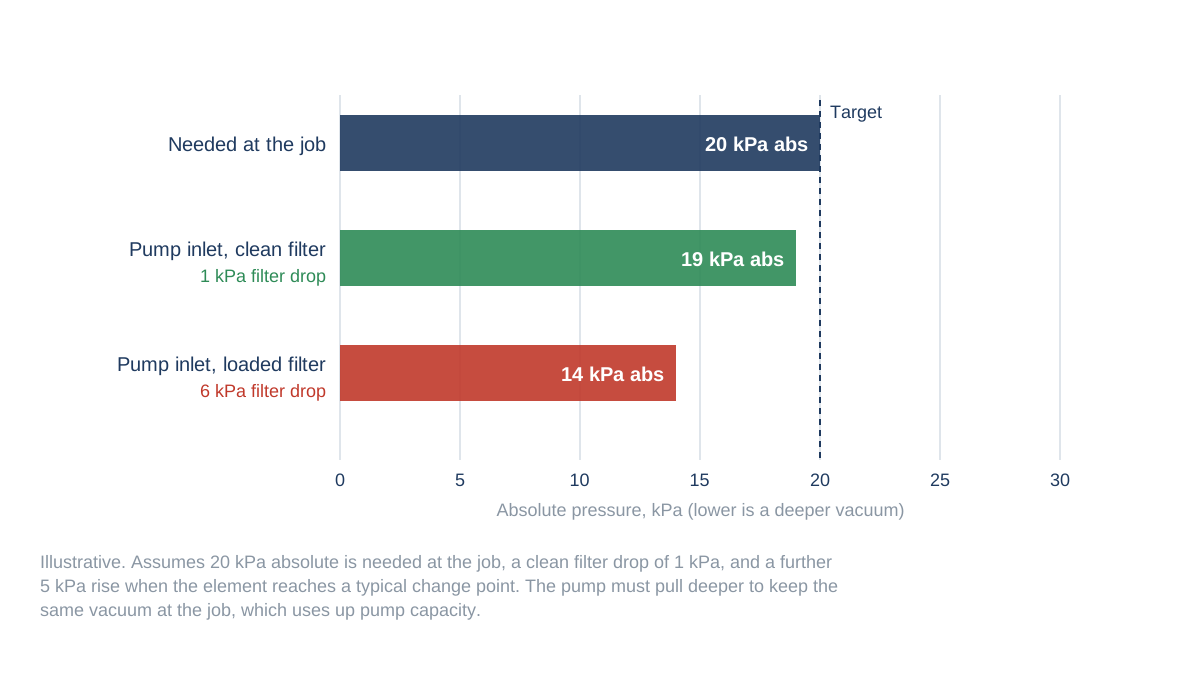
A high differential means the pump must pull a deeper vacuum to hold the same level at the job, which uses up capacity (Bott 2008). With a single filter, the pump has to stop for an element change. A dual filter arrangement lets one side be serviced while the other runs. When you lift out a loaded element, keep the debris out of the open pump inlet.
Australian practice
For most industrial vacuum there is no specific Australian standard for inlet filters, so the pump maker's instructions govern selection and service. Hospitals are the exception. Medical suction is part of the medical gas pipeline system that is installed, tested and commissioned under AS 2896 (AS 2896:2021; ANZCA 2021). Filters on medical suction plant are part of that system design, so take advice from the system designer and the facility.
Common mistakes and what to check
- An undersized filter that runs at high velocity and high pressure drop.
- A paper element in a wet process. Use a moisture-tolerant element or separate the liquid first.
- No gauge, so nobody knows when the element is loaded.
- Confusing the exhaust filter with the inlet filter when ordering spares. The Filter Finder matches elements by part number.
Related terms
- Compressor intake air filter: the equivalent filter on an air compressor. See What is a Compressor Intake Air Filter?
- Coalescing filter: the media type used in many vacuum exhaust filters. See Coalescing filters explained.
- Replacement element: see How to find a Replacement Filter Element.
References
- ANZCA (Australian and New Zealand College of Anaesthetists). 2021. PG66(A) Guideline on the Role of the Anaesthetist in Commissioning Medical Gas Pipelines. https://anzca.edu.au/getattachment/83e66317-e8f9-45a4-9ef9-47cbef01e778/PG66(A)-Guideline-on-the-role-of-the-anaesthetist-in-commissioning-medical-gas-pipelines.
- Bott, Dan. 2008. "3 Key Factors for Designing Vacuum Pump Inlet Filtration Systems." Compressed Air Best Practices, 1 October 2008. Accessed 16 October 2026. https://airbestpractices.com/technology/vacuum/3-key-factors-designing-vacuum-pump-inlet-filtration-systems.
- Leybold. 2026. All-in-One Inlet Filter Kits. Brochure, March 2026. Accessed 16 October 2026. https://www.leybold.com/content/dam/brands/leybold/downloads/brochures/general-brochures/Inlet%20Filter%20Kits-EN-Web.pdf.
- MANN+HUMMEL. n.d. "Compressed Air and Vacuum Technologies." Accessed 16 October 2026. https://www.mann-hummel.com/en/products/compressed-air-vacuum-technologies.html.
- Standards Australia. 2021. AS 2896:2021 Medical Gas Systems: Installation and Testing of Non-flammable Medical Gas Pipeline Systems. Listing on the ANSI Webstore. Accessed 16 October 2026. https://webstore.ansi.org/standards/sai/28962021.
This article is general information only. Check manufacturer documentation and applicable Australian Standards for your installation.