
What is a Claw Coupling? Pins, Clips and Whip Checks
Ultramax Systems on 16th Oct 2026
Short answer: A claw coupling is a twist-to-connect hose coupling with two hooked lugs that lock under the lugs of a matching head, common on compressor, breaker and mining air hoses. Because the twist that makes the joint can also undo it, each coupling should carry a safety pin or clip, and each hose joint should have a whip check.
Why it matters
Claw couplings often carry the full pressure of a portable compressor to drills and breakers. If a joint separates, the free hose end can flail hard enough to cause serious injury. In a 2018 Perth tunnelling incident, a high-pressure hose detached from a steel pipe and struck a worker, causing a traumatic brain injury and severe facial fractures. The company's own documents required whip checks on the hoses, none were fitted, and the employer was fined $200,000 (WorkSafe WA 2021).
How a claw coupling works
The two halves of a claw coupling are usually identical, so there is no male or female end. Each head has two lugs (the claws), two ramps and a rubber gasket in its face. Push the heads together with the lugs offset, then twist until the lugs ride up the ramps and the gaskets seal. Dixon (2020) describes the same action for its universal couplings and notes that one head size covers hoses from 1/4" to 1", so a small hose can connect to a larger one.
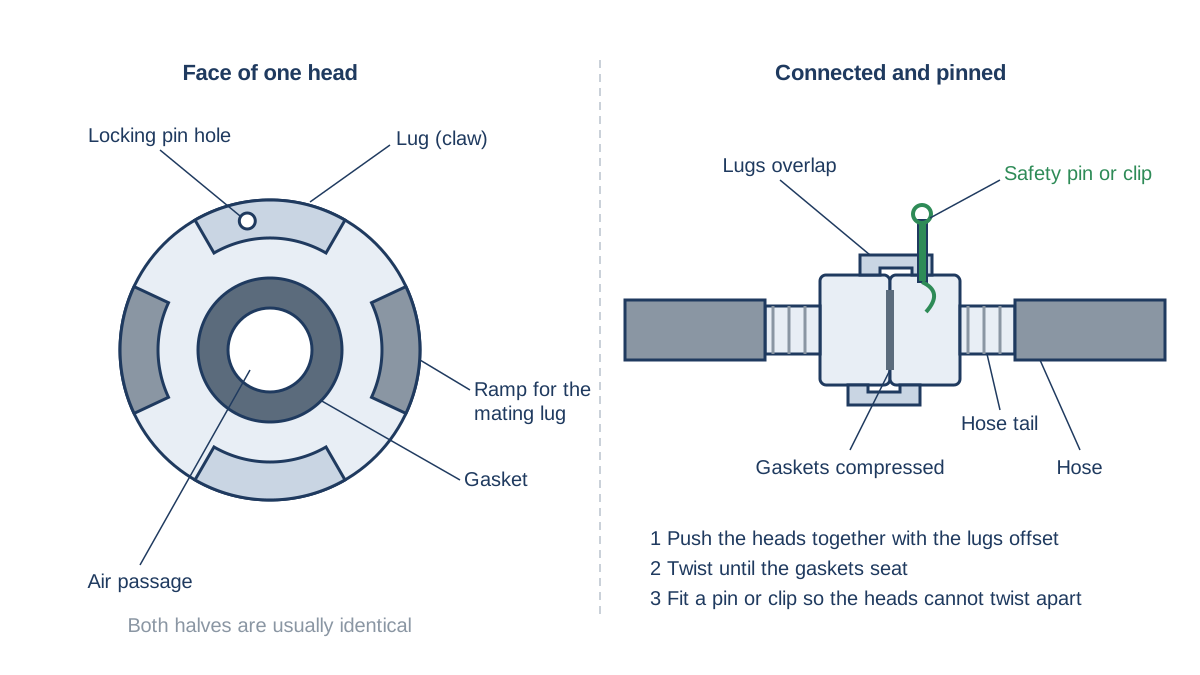
The joint has a weak point. Vibration from a breaker, hose drag or a knock can turn the heads back towards release. That is why each head has a hole through its flange for a locking pin. Dixon (2020) advises a safety clip on every universal coupling, or a cotter pin or wire retainer if no clip is available.
Types you will see
You will meet two main families. American-pattern couplings are often called universal or Chicago couplings. European claw couplings follow DIN 3489, which covers couplings with a 42 mm claw width (DIN 3489:2023). The two look alike, so check both halves come from the same family before you connect them. Both come with hose tails, threaded ends and blank caps.
Pressure ratings vary by maker, size and gasket. Dixon (2020) rates its standard universal couplings at 150 psi (about 1,030 kPa) at 21 °C and warns against using them on steam. Check the rating for the exact coupling and hose you are using. Where hoses are connected and disconnected often, push-to-connect quick couplers are another option.
Australian practice: pins, clips and whip checks
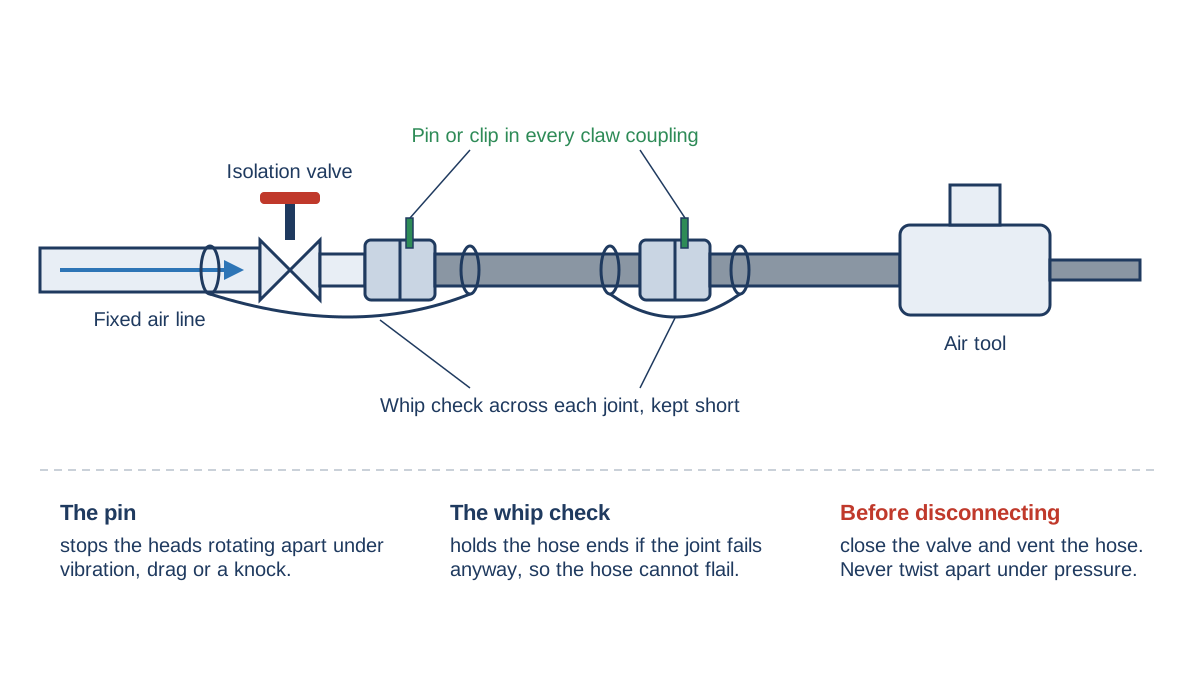
WorkSafe Victoria (2020) recommends whip checks, safety chains or other hose whip restraints on pressurised flexible hoses, particularly above about 20 mm bore. Whip checks should be fitted across hose fittings and anchored to a fixed structure or hose tree. They should be short and rated for the maximum system pressure. For NSW mines, Technical Reference Guide 41 says whip restraints should be considered for air hose assemblies operating above 700 kPa (7 bar) (NSW Resources Regulator 2025). US mining rules go further and require safety chains or other locking devices at high-pressure hose connections of 3/4 inch bore and larger, unless automatic shutoff valves are fitted (30 CFR 57.13021).
The pin and the whip check do different jobs. The pin stops the heads rotating apart. A hose whip check holds the hose ends if the joint fails anyway, for example from a cracked lug, a blown gasket or a hose pulling off its tail. Use both.
Common mistakes and what to check
- Twisting a coupling apart under pressure. Close the supply valve and vent the hose first.
- Missing, bent or makeshift pins.
- Worn, hard or missing gaskets, which leak and let the heads move.
- Rounded or cracked lugs. Replace the coupling.
- Mixing American and European heads.
- Slack, damaged or corroded whip checks. Tag them with the last inspection date (WorkSafe Victoria 2020).
Related terms
- Whip check: a cable restraint across a hose joint. See Compressed air safety: skin, clothing and hoses.
- Hose tail: the barbed stem a hose is clamped or crimped onto. See What is a Hose Tail?
- Mine valve: the isolation valve at a take-off from an underground air range. See What is a Mine Valve? and Compressed air in mining.
- Leaks: see How much do Compressed Air Leaks cost?
References
- DIN (Deutsches Institut für Normung). 2023. DIN 3489:2023-11, Couplings for Compressed Air: Claw Coupling, 42 mm Internal Width, without Securing Nut. Standard listing. Accessed 16 October 2026. https://www.din.de/en/wdc-beuth:din21:371361517.
- Dixon. 2020. Outside Air Applications. Catalogue OUTAIR120. Accessed 16 October 2026. https://dixonvalve.com/sites/default/files/documents/outside-air-applications-2020_0.pdf.
- eCFR (Electronic Code of Federal Regulations). n.d. "30 CFR 57.13021: High-Pressure Hose Connections." Accessed 16 October 2026. https://www.ecfr.gov/current/title-30/chapter-I/subchapter-K/part-57/subpart-L/section-57.13021.
- NSW Resources Regulator. 2025. Technical Reference Guide 41: Fluid Power Safety Systems at Mines. Version 2.0. NSW Department of Primary Industries and Regional Development. https://www.resources.nsw.gov.au/sites/default/files/2025-03/trg-41-fluid-power-safety-systems.pdf.
- WorkSafe Victoria. 2020. "Fatalities and Injuries as a Result of High Pressure Hose Whip." Safety alert, published 1 July 2020, reviewed 2 March 2022. Accessed 16 October 2026. https://www.worksafe.vic.gov.au/safety-alerts/fatalities-and-injuries-result-high-pressure-hose-whip.
- WorkSafe WA. 2021. "Salini Australia Pty Ltd." Prosecution record, sentenced 22 November 2021, Magistrates Court of Western Australia. Accessed 16 October 2026. https://prosecutions.commerce.wa.gov.au/prosecutions/view/1514.
This article is general information only. Check manufacturer documentation, your site risk assessment and the guidance from your state regulator for your installation.