
Why you should never clean Skin or Clothing with Compressed Air
Ultramax Systems on 16th Oct 2026
Short answer: Compressed air can push air through broken skin or a body opening, blow grit into eyes, damage hearing and throw fine dust back into the air you breathe. Clothing gives little protection. Use a vacuum, brush or wash station to clean yourself, and keep blow guns for parts and machines.
Why it is so tempting, and so risky
An air line is usually within arm's reach in a workshop, and a quick blast seems the fastest way to clear sawdust or swarf from overalls. The habit persists for exactly that reason. Safe Work Australia (2015) is direct about it: do not point compressed air at a person, because the air can penetrate the skin and cause significant health problems. It also advises against using compressed air for cleaning at all, especially with other people nearby.
How compressed air injures people
Air embolism
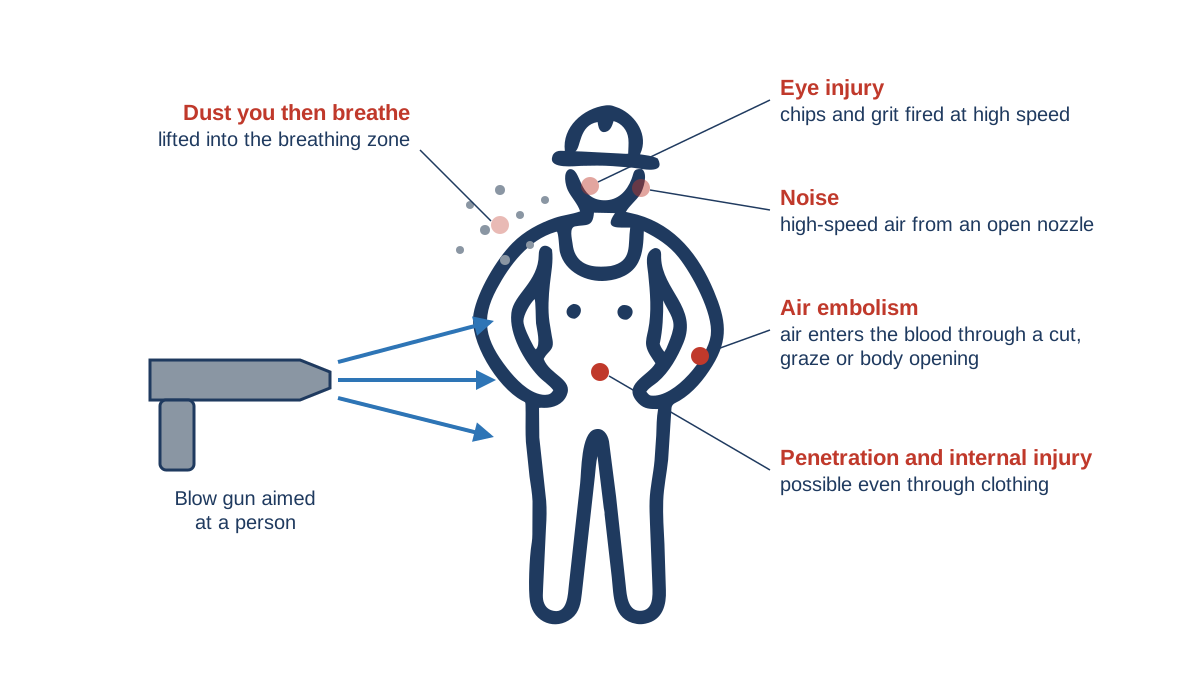
Air forced through a cut, a graze or a body opening can enter the bloodstream (CCOHS 2022). Bubbles that reach an artery can block blood flow, and an arterial embolism can cause coma, paralysis or death, depending on its size and where it lodges (OHS Reps 2017). The wound that lets the air in may be too small to notice.
Penetration and internal injuries
The UK Health and Safety Executive (1998) lists skin penetration and entry through body openings among the main injuries caused by compressed air. Internal injuries are a documented result of both horseplay and dusting off clothes. A review of cases found that a nozzle held near the body could rupture the bowel even through clothing, and it cites an average of roughly 28 kPa (0.29 kg/cm²) to tear the bowel wall (Yin et al. 2016). A typical workshop air line runs at many times that pressure.
Eye injuries
A jet of air picks up chips, grit and metal fines and fires them at high speed. Particles can enter the eyes or abrade the skin, and the damage depends on their size and shape (CCOHS 2022). Blowing off clothing puts the source of those particles right below your face.
Noise
Air leaving an open nozzle at high speed is loud. WorkSafe Victoria (2023) lists compressed air as a source of hazardous noise and sets out the exposure standard: an 8-hour average of 85 dB(A) and a peak of 140 dB(C) at the ear. Its first recommended control is to reduce or stop using compressed air for cleaning.
Dust you then breathe
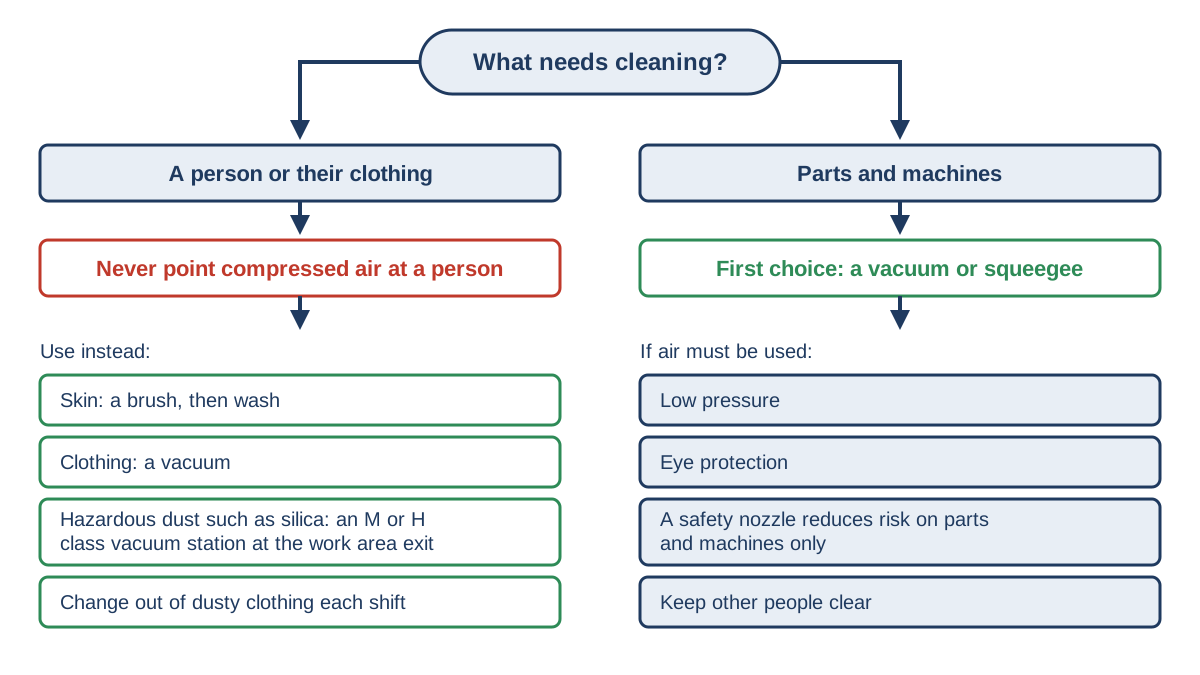
Blowing dust off a person does not remove it. It lifts it into the breathing zone of everyone nearby (CCOHS 2022). That matters most with hazardous dusts. For silica, SafeWork NSW (n.d.) calls for a ban on dry sweeping or compressed air to clean surfaces or clothing, and recommends an M or H class vacuum for removing dust from clothes and PPE.
Safety nozzles and dead-end pressure
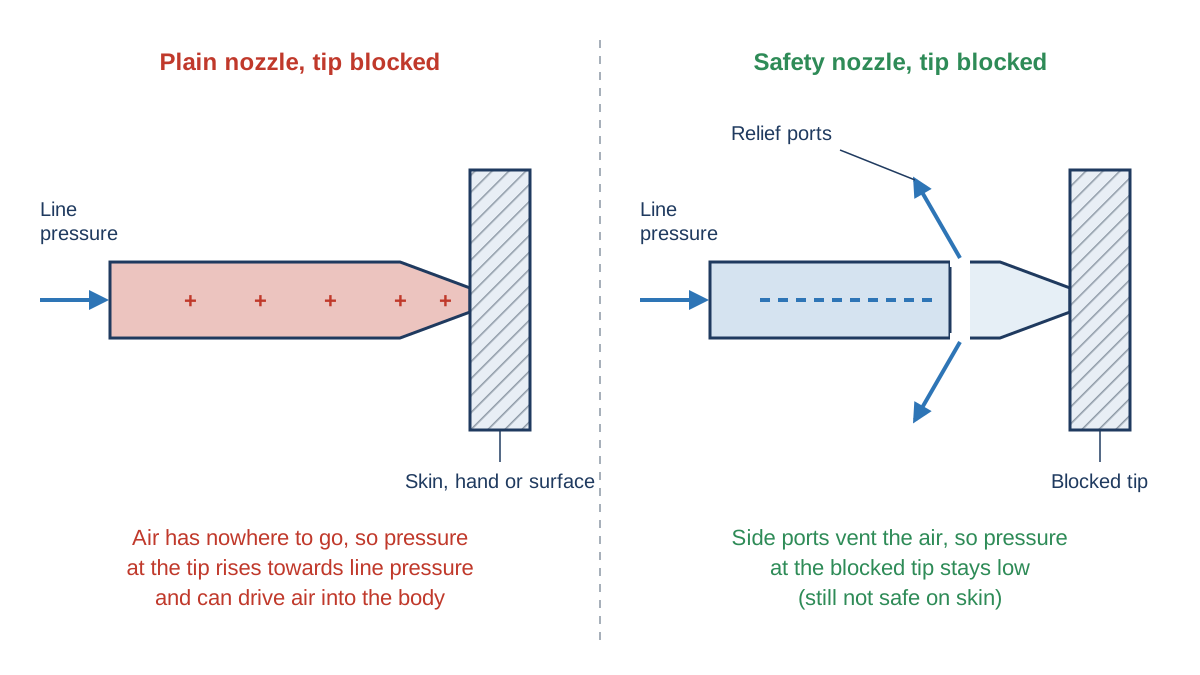
The highest-pressure moment for a blow gun is when its tip is blocked, for example when pressed against a hand. With nowhere to go, the pressure at the tip climbs towards line pressure. A safety nozzle limits this "dead-end" pressure, often through side relief ports that vent air when the tip is covered.
As overseas context, US rules set a numeric limit. OSHA's general industry standard allows compressed air for cleaning only when reduced to less than about 210 kPa (30 psi), with effective chip guarding and personal protective equipment (29 CFR 1910.242(b)). OSHA's enforcement directive applies that limit to the static pressure at the nozzle when it is dead-ended (OSHA 1978). In Australia, Safe Work Australia (2015) advises low pressure and eye protection where air must be used for cleaning. None of these makes a safety nozzle suitable for skin or clothing. It reduces risk on parts and machines only.
Whip checks, hoses and couplings
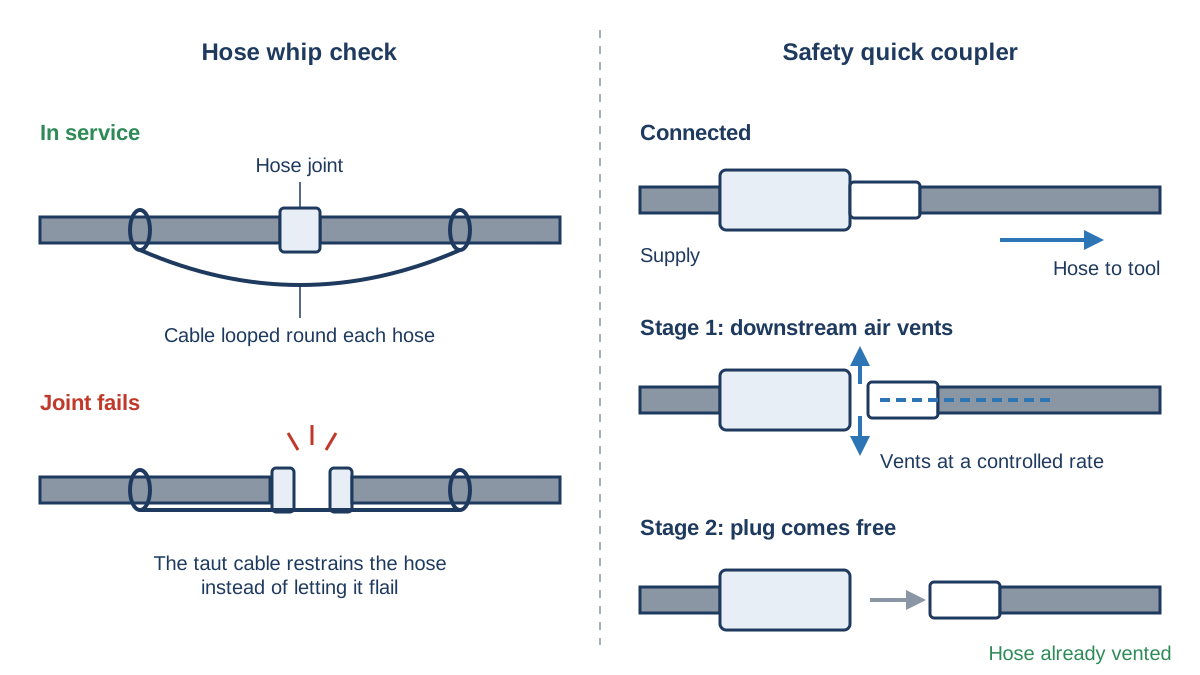
A hose that separates under pressure becomes a flail. In a Perth tunnelling case, a large compressed air hose came loose and struck a worker in the face, causing a brain injury, facial fractures and eye damage. The company's own documents required whip checks on the hoses, but none were fitted, and it was fined $200,000 (WorkSafe WA 2021). Hose whip checks restrain the hose if a joint fails, and they are cheap insurance on larger lines.
Disconnecting a pressurised hose at a standard coupling can also make the free end whip. Safety quick couplers use a two-stage release that vents the downstream air at a controlled rate before the plug comes free (Joniak 2006). Use air hose rated for your line pressure, and replace hose that is cracked, kinked or soft.
Safer ways to clean people and clothing
The alternatives are simple. WorkSafe Victoria (2023) suggests a vacuum cleaner or rubber squeegee instead of compressed air. For skin, a brush followed by washing is the usual answer. Where hazardous dust is present, an M or H class vacuum station at the exit of the work area lets people clean overalls before leaving (SafeWork NSW n.d.). Changing out of dusty clothing at the end of each shift helps too.
Common mistakes
- Assuming a regulator set to low pressure makes air safe on skin.
- Treating a safety nozzle as approval for cleaning clothing.
- Using compressed air as a joke. Horseplay is behind many reported internal injuries.
- Leaving whip checks off "temporary" hose runs.
Key takeaways
- Do not point compressed air at yourself or anyone else.
- Air can enter through broken skin or body openings and cause embolism or internal injury.
- Air cleaning spreads dust into the breathing zone and adds to noise exposure.
- Use vacuums, brushes and wash stations for people. Keep blow guns for parts.
- Fit whip checks and safety couplers, and use hose rated for the line.
Frequently asked questions
Is it safe if I turn the pressure down?
No. Lower pressure reduces the risk on parts and machines, but it does not make air safe to direct at the body. The case review above cites bowel-tearing pressures far below normal line pressure.
Is there an Australian pressure limit for blow guns?
We did not find a numeric limit in the Safe Work Australia or state regulator guidance reviewed for this article. They focus on avoiding compressed air for cleaning and managing noise. Check with your state regulator.
What should I do after an air injection injury?
Get medical help straight away, even if the wound looks minor, and tell the clinician it involved compressed air.
Related reading
- How much do Compressed Air Leaks cost?
- What are Hard Seat and Soft Seat Valves?
- Water in Air Tools: Causes and Fixes
References
- CCOHS (Canadian Centre for Occupational Health and Safety). 2022. "Cleaning with Compressed Air." OSH Answers Fact Sheet. Accessed 15 October 2026. https://www.ccohs.ca/oshanswers/safety_haz/compressed_air.html.
- Health and Safety Executive. 1998. Compressed Air Safety. HSG39. Sudbury: HSE Books. Accessed 15 October 2026. https://www.hse.gov.uk/PUBNS/books/hsg39.htm.
- Joniak, John. 2006. "Thoughts on Applying Pneumatic Quick-Acting Couplings." Power & Motion, 27 June 2006. Accessed 15 October 2026. https://www.powermotiontech.com/technologies/fittings-couplings/article/21881758/thoughts-on-applying-pneumatic-quick-acting-couplings.
- OHS Reps. 2017. "Compressed Air." Victorian Trades Hall Council. Last amended September 2017. Accessed 15 October 2026. https://www.ohsrep.org.au/compressed_air.
- OSHA (Occupational Safety and Health Administration). 1978. "Reduction of Air Pressure below 30 psi for Cleaning Purposes." Directive STD 01-13-001. Accessed 15 October 2026. https://www.osha.gov/enforcement/directives/std-01-13-001.
- OSHA (Occupational Safety and Health Administration). n.d. "1910.242: Hand and Portable Powered Tools and Equipment, General." 29 CFR 1910.242. Accessed 15 October 2026. https://www.osha.gov/laws-regs/regulations/standardnumber/1910/1910.242.
- Safe Work Australia. 2015. Compressed Air and Air Receiver Information Sheet. https://www.safeworkaustralia.gov.au/system/files/documents/1703/compressed-air-information-sheet.pdf.
- SafeWork NSW. n.d. "Clean-up and Disposal of Silica Dust." Engineered Stone Code of Practice. Accessed 15 October 2026. https://www.safework.nsw.gov.au/resource-library/list-of-all-codes-of-practice/codes-of-practice/engineered-stone-code-of-practice/clean-up-and-disposal-of-silica-dust.
- WorkSafe Victoria. 2023. "Controlling Compressed Air Noise." Reviewed 4 May 2023. Accessed 15 October 2026. https://www.worksafe.vic.gov.au/resources/noise-control-compressed-air-noise.
- WorkSafe WA. 2021. "Salini Australia Pty Ltd." Prosecution record, sentenced 22 November 2021, Magistrates Court of Western Australia. Accessed 15 October 2026. https://prosecutions.commerce.wa.gov.au/prosecutions/view/1514.
- Yin, W. B., J. L. Hu, Y. Gao, X. X. Zhang, M. S. Zhang, G. W. Liu, X. F. Zheng, and Y. Lu. 2016. "Rupture of Sigmoid Colon Caused by Compressed Air." World Journal of Gastroenterology 22 (10): 3062-65. https://doi.org/10.3748/wjg.v22.i10.3062.
This article is general information only. It is not medical or legal advice. Check your WHS obligations with your state regulator and follow manufacturer instructions for air tools and fittings.