
What is a Mine Valve?
Ultramax Systems on 16th Oct 2026
Short answer: A mine valve is a heavy-duty quarter-turn ball valve built for compressed air and water lines in mining, usually with a ductile iron body and ends that suit mining pipe and hose couplings. It matters because these valves isolate high-energy lines underground, where a valve that opens by accident or will not lock off can injure someone.
Why it matters
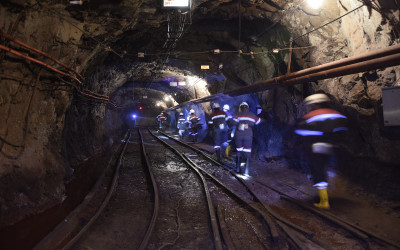
Mine sites run long air and water reticulation to drills, pumps, washdown points and refuge stations. Valves on those lines take knocks from equipment, mud, vibration and rough handling. A general-purpose brass valve can crack or seize in that service. Mine valves use tougher materials and heavier construction to cope with that service. Valve choice also feeds straight into isolation and hose safety, which mining regulators treat as known hazards. For a wider view of mine air systems, see Compressed air in mining.
How it works and how it is built
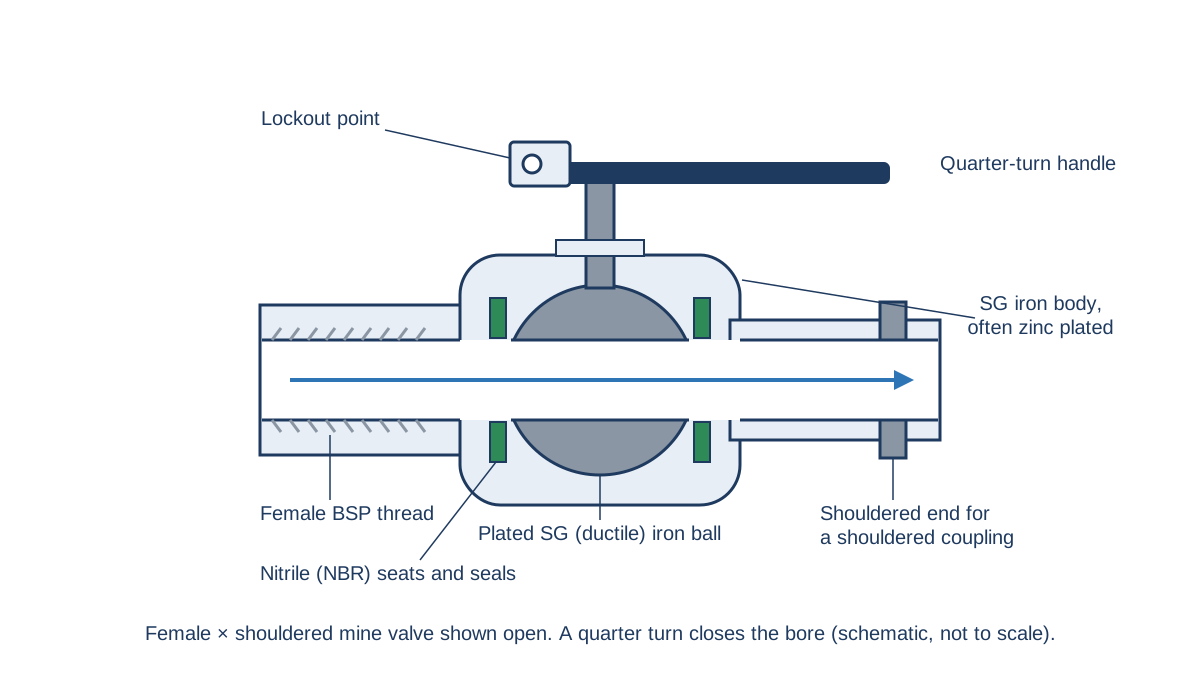
Inside, a mine valve is a standard ball valve. A ball with a bore through it sits between two seats. A quarter turn of the handle lines the bore up with the pipe to open it, or turns it across the flow to close it. What sets a mine valve apart is the construction. A typical mining ball valve has a spheroidal graphite (SG) iron body, often zinc plated, and a plated SG iron ball and stem. Nitrile (NBR) seats and seals suit air and water service. One such range is rated to 2.07 MPa (about 21 bar) in sizes from 20 mm to 50 mm, with a working temperature of minus 20 °C to 80 °C (Dixon n.d.). Check the rating of the exact valve you buy, as ratings vary by maker and size.
Typical end types
Mine valves come with different ends to match the pipe and hose on site. The common types are:
- Female BSP thread: screws onto threaded pipe or a hose tail.
- Shouldered end: a pipe end with a raised shoulder, joined to the next length by a shouldered coupling.
- Mixed ends: for example female × shouldered, to adapt between a threaded fitting and shouldered pipe.
Some ranges also offer proprietary quick-connect ends for mining hose couplings (Dixon n.d.). Ultramax lists SG iron mine valves in female and female × shouldered patterns. For the hose side, see What is a Claw Coupling?
Australian practice and safety
Isolation is the main safety job of a mine valve. The NSW Resources Regulator's Technical Reference Guide 41 says valves used for isolation should be lockable (NSW Resources Regulator 2025). It also advises that ball valves and other quick-action valves should not vent directly to atmosphere, and should not be used as metering valves. The general plant code adds that a lock, not a tag, isolates the energy source, and that stored pneumatic pressure may need separate release (Safe Work Australia 2024).
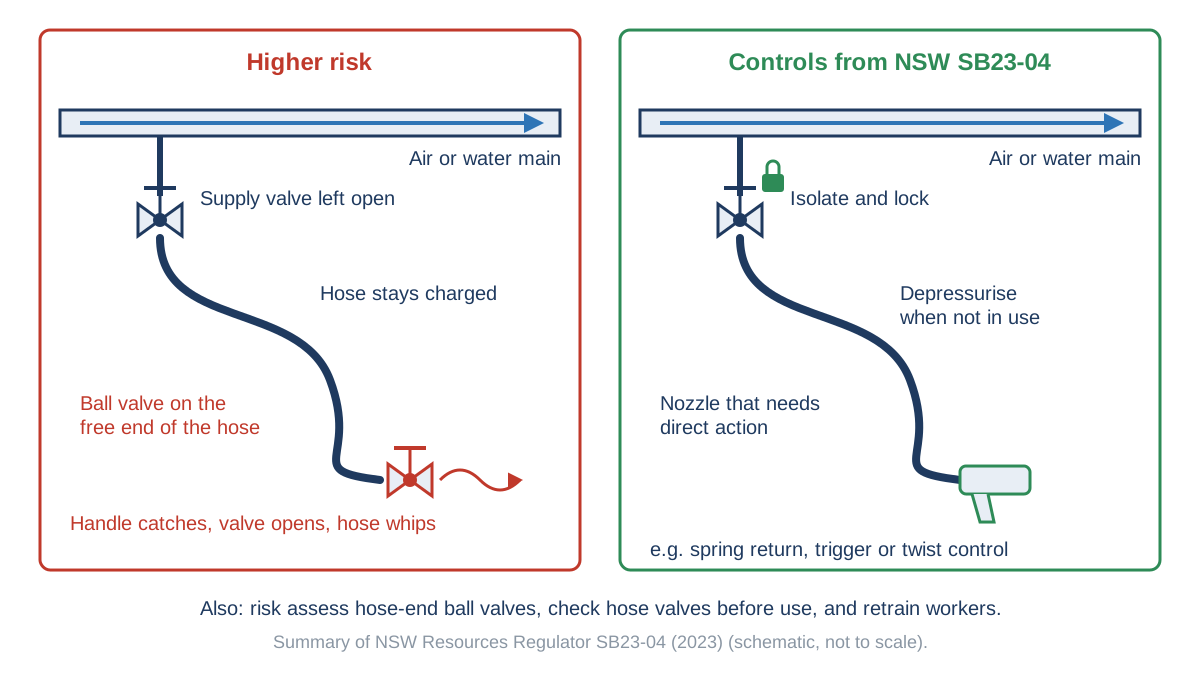
Where the valve sits matters too. In 2023, two NSW mine workers were hurt when ball valves on the free end of charged hoses were knocked open and the hoses whipped. The regulator asked sites to risk assess ball valves on hose ends, depressurise hoses when not in use, and consider nozzles that need direct action to open (NSW Resources Regulator 2023). A mine valve belongs at the supply point, not on the loose end of a hose.
Common mistakes and what to check
Check the pressure rating against the line, not just the pipe size. Confirm the handle can take a padlock in the closed position and that the lock fits your site's isolation system. Make sure the end type matches the coupling on site, as shouldered and threaded ends do not mix without an adaptor. Inspect seats and handles regularly, because a worn valve may pass air when closed. Finally, never use a mine valve to throttle flow.
Related terms
- Claw coupling: a quick-connect hose coupling used on air lines. See What is a Claw Coupling?
- Hard and soft seats: seat materials and shut-off. See What are Hard Seat and Soft Seat Valves?
- Three-way ball valve: a ball valve that switches flow between ports. See What is a Three-Way Ball Valve?
References
- Dixon. n.d. Minsup Econovalves Data Sheet. Dixon Valve Australia. https://australia.dixonvalve.com/sites/default/files/documents/minsup_econovalves_data_sheet.pdf.
- NSW Resources Regulator. 2023. Safety Bulletin SB23-04: Hose Ball Valves Injure Mine Workers. Department of Regional NSW. https://www.resources.nsw.gov.au/sites/default/files/2023-05/safety-bulletin-sb23-04-hose-ball-valves-injure-mine-workers.pdf.
- NSW Resources Regulator. 2025. Technical Reference Guide 41: Fluid Power Safety Systems at Mines. Version 2.0. NSW Department of Primary Industries and Regional Development. https://www.resources.nsw.gov.au/sites/default/files/2025-03/trg-41-fluid-power-safety-systems.pdf.
- Safe Work Australia. 2024. Model Code of Practice: Managing the Risks of Plant in the Workplace. Hosted by WorkSafe Tasmania. https://www.worksafe.tas.gov.au/__data/assets/pdf_file/0010/806734/model-Code-of-Practice-Managing-the-risks-of-plant-in-the-workplace.PDF.
This article is general information only. Check manufacturer documentation, applicable Australian Standards and your state or territory mining regulator's guidance for your site.