
What is a Hose Tail? Types, Sizing and Clamping
Ultramax Systems on 16th Oct 2026
Short answer: A hose tail is a fitting with a barbed or ribbed spigot that pushes inside a hose and is held there by a clamp or crimped ferrule, with a thread, coupling or flange on the other end. It matters because the tail, hose and clamp must suit each other, or the joint can leak or blow apart under pressure.
Why it matters
The hose tail is where a flexible hose joins everything else, so it is often the first place an assembly fails. On compressed air, a joint that lets go releases stored energy at once. WorkSafe Victoria (2020) warns that a pressurised hose that disconnects will typically whip or flail until the system is depressurised. It lists incorrect design, selection or installation of hoses and couplings among the causes. A correctly matched tail and clamp is a small cost against that risk.
How it works
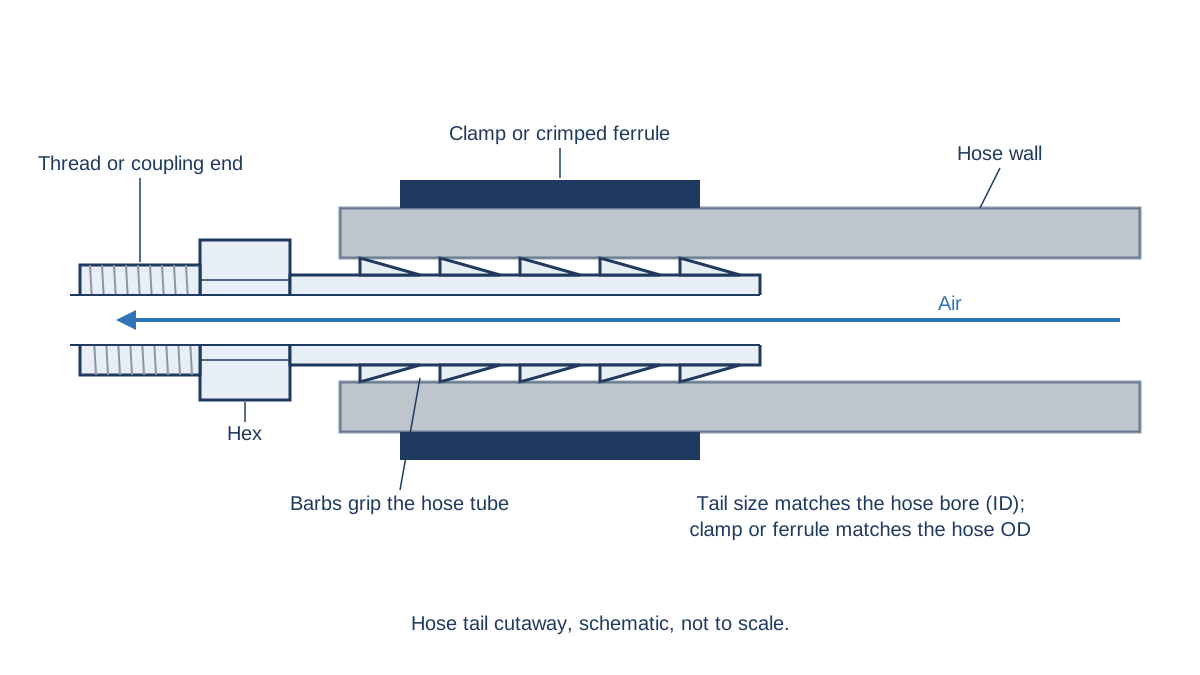
The spigot carries a row of barbs or ribs. As the hose is pushed on, its inner tube stretches over each barb. The clamp or ferrule then squeezes the hose down behind the barbs, so pressure and pull-out forces push the hose against their sharp edges. The other end of the tail connects to the system, typically with a male or female thread, a claw coupling or a quick coupler.
Types
Threaded hose tails screw into a port or fitting and suit general workshop air, water and low-pressure lines. Coupling hose tails are made as one piece with a quick-connect head, such as the claw couplings common on mine sites and compressors. Crimp-style tails are designed for a matching ferrule pressed on with a crimping machine. Clamp-style tails take a separate band or bolted clamp. Dixon (2024), for example, sizes the crimp ferrule for its 20 mm claw-coupling tails to suit hose with an outside diameter of 24.0 to 32.5 mm. Ultramax carries claw-coupling hose tails and matching clamps in its hose fittings range.
How to size and specify one
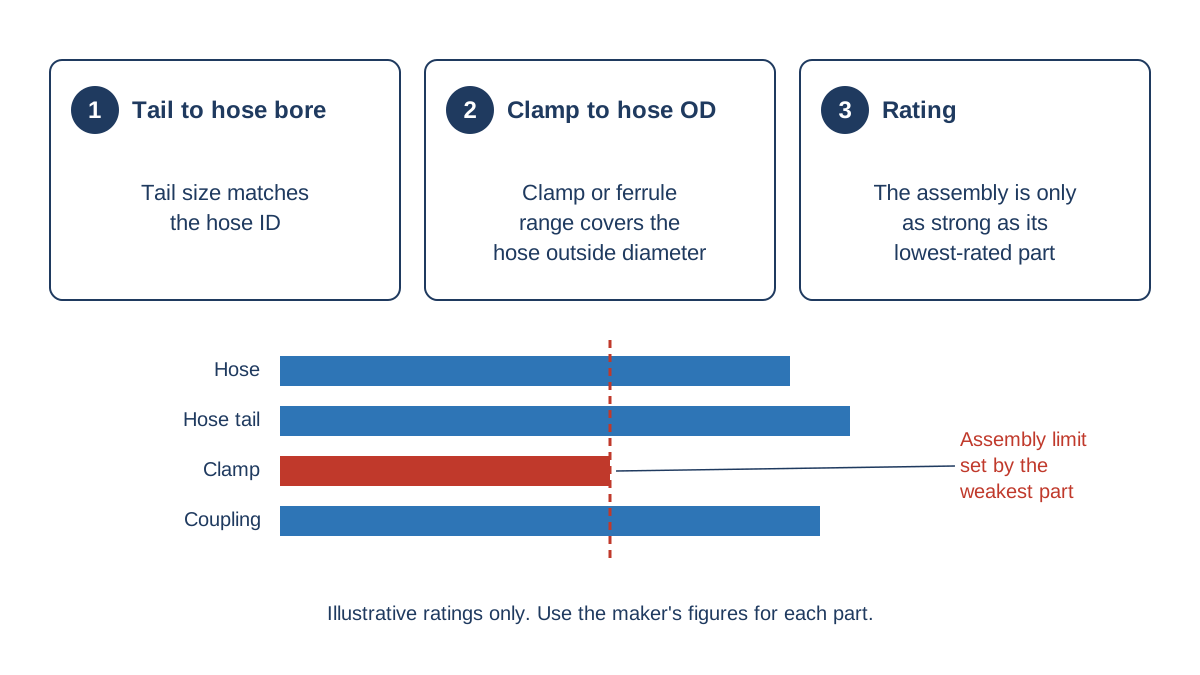
A hose tail is sized by the hose bore. A 20 mm tail fits 20 mm inside diameter hose. The clamp or ferrule is chosen by the hose outside diameter, which varies with wall thickness and construction, so measure it rather than guess. The thread or coupling end must suit what it connects to. Gates (n.d.) groups these checks under its STAMPED method, where E stands for ends and couplings matched to the hose ID, OD and pressure rating. It also advises using only manufacturer-approved couplings for a hose assembly.
Australian practice
Australian regulators focus on the whole assembly. WorkSafe Victoria (2020) recommends whip checks fitted across hose connections and anchored to a fixed point, rated for the maximum system pressure and inspected regularly. The NSW Resources Regulator (2024) reports incidents where airline connections were opened before stored pressure was released. It urges workers to verify isolation and dissipation before disconnecting hoses or pipes. See compressed air safety for skin and clothing for related hazards.
Common mistakes
The working pressure of a complete hose assembly is set by its lowest-rated component (Dixon 2024). A high-pressure hose on a light clamp is only as good as the clamp. Other mistakes are forcing hose onto a tail one size too big, reusing a tail with damaged barbs and choosing a clamp by hose bore instead of outside diameter. Bolted clamps also need re-tensioning at regular intervals (Dixon 2024).
Related terms
- Ferrule: a metal sleeve crimped over the hose to hold it on the tail.
- Claw coupling: see What is a Claw Coupling?
- Whip check: a steel cable restraint fitted across a hose joint to stop it flailing if it separates.
References
- Dixon (Asia Pacific). 2024. Minsup Catalogue. Wingfield, SA: Dixon (Asia Pacific) Pty Ltd. Accessed 16 October 2026. https://australia.dixonvalve.com/sites/default/files/documents/Dixon_Minsup_Catalogue_2024.pdf.
- Gates. n.d. "Find the Right Hose Assembly for the Job Every Time." Accessed 16 October 2026. https://gates.com/us/en/industries/automotive/vehicle-aftermarket/power-up/find-the-right-hose-assembly-for-the-job-every-time.html.
- NSW Resources Regulator. 2024. Incidents and Injuries Associated with Working on Pressurised Systems. Safety Bulletin SB24-06. NSW Resources Regulator. Accessed 16 October 2026. https://www.resources.nsw.gov.au/sites/default/files/2024-09/safety-bulletin-sb24-06-incidents-involving-pressurised-systems-increase.pdf.
- WorkSafe Victoria. 2020. "Fatalities and Injuries as a Result of High Pressure Hose Whip." Safety alert. Accessed 16 October 2026. https://www.worksafe.vic.gov.au/safety-alerts/fatalities-and-injuries-result-high-pressure-hose-whip.
This article is general information only. Check manufacturer documentation and applicable Australian Standards for your installation.