
AS/NZS 1715 Breathing Air Compliance: What it Covers
Ultramax Systems on 26th Oct 2026
Short answer: AS/NZS 1715 is the Australian and New Zealand standard for selecting, using and maintaining respiratory protective equipment (RPE). For compressed breathing air, it sets the air quality that supplied-air respirators must receive, while AS/NZS 1716 covers the respirators themselves. Regulators point to it, but only a competent person working from the current standard can confirm that a system complies.
What AS/NZS 1715 is
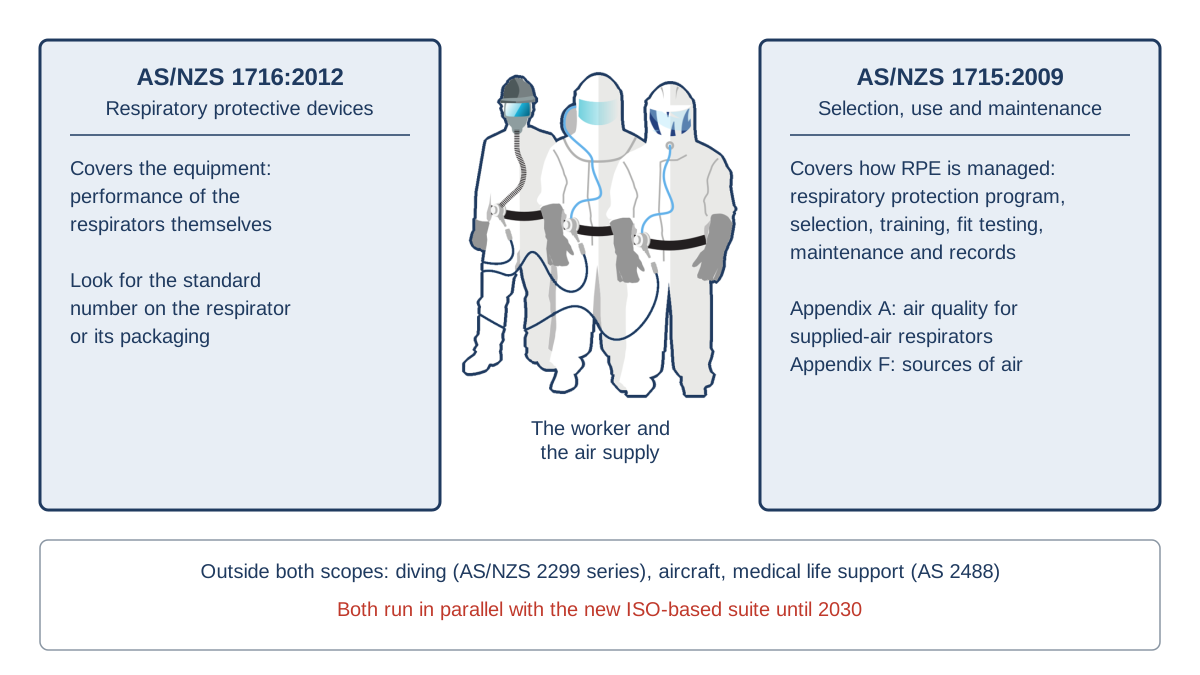
The current edition is AS/NZS 1715:2009. It was reconfirmed in 2024 and is now listed as AS/NZS 1715:2009 (R2024) (AS/NZS 1715:2009). The standard sets out requirements and guidance for respiratory protection, from hazard identification and risk assessment through to the choice and care of RPE. Its sections cover a respiratory protection program, selection, training, fit testing, maintenance and record keeping (Ministry of Business, Innovation and Employment n.d.-a). It does not deal with diving, aircraft or medical life support, which have their own standards. For surface-supplied diving air, see What is a Hookah Dive Compressor?
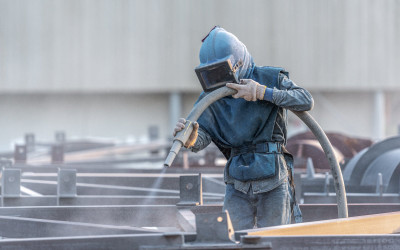
Work health and safety guidance leans on the standard heavily. The Commonwealth abrasive blasting code, developed by Safe Work Australia, points to AS/NZS 1715 for breathing air quality (Commonwealth of Australia 2015). WorkSafe WA (2022) does the same in its own abrasive blasting code.
How AS/NZS 1715 relates to AS/NZS 1716
The two standards work as a pair. AS/NZS 1716:2012 covers respiratory protective devices: respirators that protect against harmful substances and, for some types, oxygen-deficient atmospheres. Its scope sends readers to AS/NZS 1715 for selection, use and maintenance (Ministry of Business, Innovation and Employment n.d.-b). In practice, a respirator for work should carry the AS/NZS 1716 number, usually on the device or its packaging (WorkSafe Queensland n.d.-b). AS/NZS 1715 then governs how you choose it, fit it, supply it with air and look after it.
Some guidance also applies AS/NZS 1716 to the air supply hardware. Western Australia's refuge chamber guideline asks for air from a lubricated compressor to pass through a purification system, with a regulator, valves and outlet that conform to AS/NZS 1716 (Department of Mines and Petroleum 2013). Compressed Air in Mining and Mineral Processing covers that setting in more detail.
What it covers for compressed breathing air
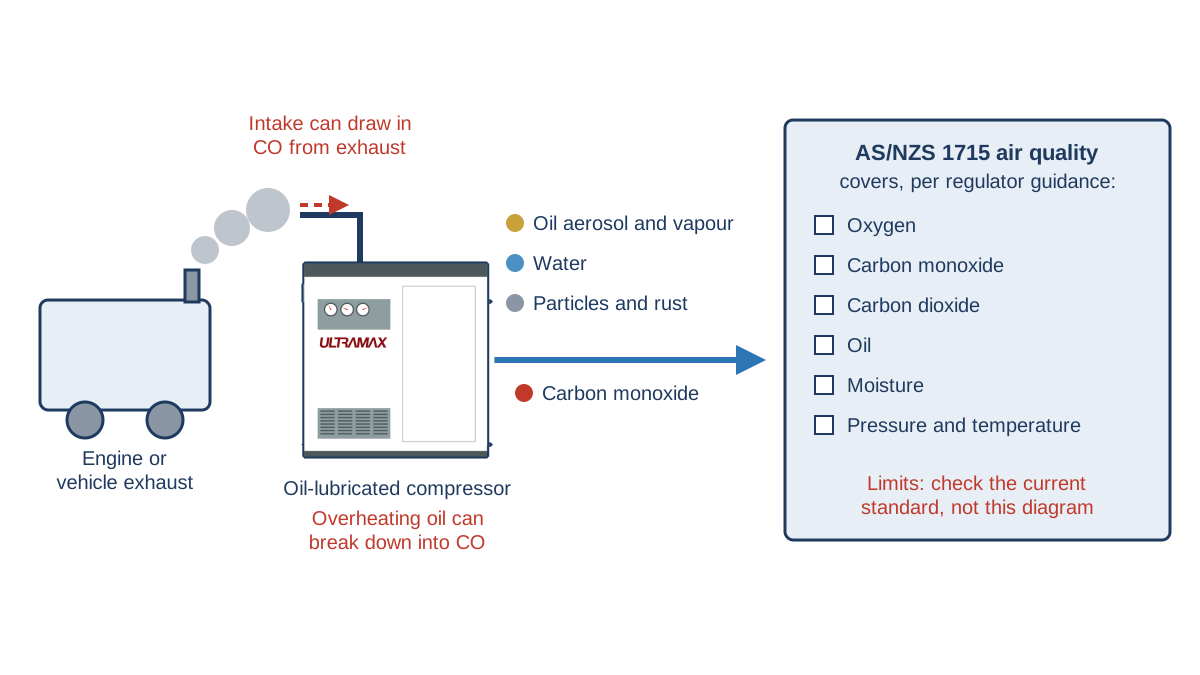
Appendix A of AS/NZS 1715 deals with air quality for supplied-air respirators fed by compressors or cylinders, and Appendix F covers sources of air for airline RPE (Ministry of Business, Innovation and Employment n.d.-a). WorkSafe Queensland (n.d.-a) summarises the scope as air quality, air temperature, oxygen, carbon monoxide, carbon dioxide, stale air, moisture and pressure. Its respiratory protection guidance also lists oil (WorkSafe Queensland n.d.-b). This article does not reproduce the limits. Work from the current standard and its own tables.
Carbon monoxide
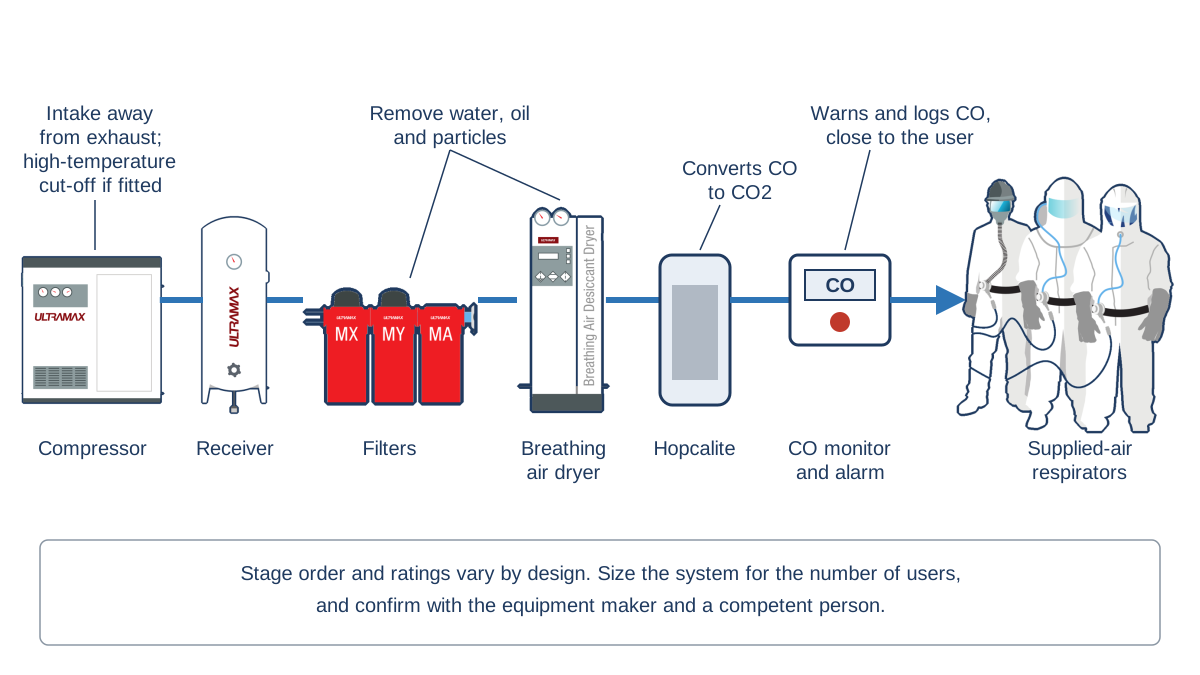
Carbon monoxide (CO) is the contaminant regulators worry about most. An oil-lubricated compressor that keeps running while overheated can burn or break down its oil and produce high levels of CO (WorkSafe Queensland n.d.-a). The same guidance recommends a continuously operating CO monitor with an alarm on oil-lubricated compressors, placed as close to the user as practicable and calibrated as the maker recommends. The Commonwealth code also asks for air-fed respirators to have an alarm that warns of CO and logs it (Commonwealth of Australia 2015). A catalyst stage, explained in What is a Hopcalite Filter and how does it remove Carbon Monoxide?, converts CO to carbon dioxide, but it does not replace the monitor.
Oil, water and particles
Oil aerosol, water and pipe scale come from the compressor and the distribution system. They make air unpleasant or unsafe to breathe, and water also deactivates the CO catalyst. WorkSafe Queensland (n.d.-b) recommends a breathing air system designed for supplied-air respirators, and warns that air from a general-purpose industrial compressor can carry harmful gases, including CO. Purpose-built breathing air systems combine filtration, drying and CO conversion, with breathing air dryers keeping water vapour away from the hopcalite filters downstream.
Intake location
No purifier can fully fix air that was contaminated at the intake. Both abrasive blasting codes ask for breathing air compressor intakes to sit well away from contaminant sources, particularly exhaust from mobile liquid fuel engines and areas where fumes build up (Commonwealth of Australia 2015; WorkSafe WA 2022). On portable units, the compressor's own engine exhaust is a common culprit. An intake filter stops dust, not exhaust gases, as What is a Compressor Intake Air Filter? explains.
What a typical supply looks like
A compressor-fed system usually runs from the compressor and receiver through filtration, a breathing air dryer, a CO conversion stage and a CO monitor, then to a regulated outlet and the respirators. Stage order and ratings vary between makers, so follow the purifier manufacturer's instructions. Where available, WorkSafe Queensland (n.d.-a) suggests a high-temperature cut-off on the compressor that fails safe if a wire or sensor fails.
Capacity matters as much as purity. For blasting chamber operators, the Commonwealth code calls for at least 2.8 L/s (170 L/min) of continuous flow per person, measured at the regulator, with more for air-cooled or encapsulated suits (Commonwealth of Australia 2015). It also asks for breathing air lines to be protected from vehicles and blasting damage.
Testing, inspection and records
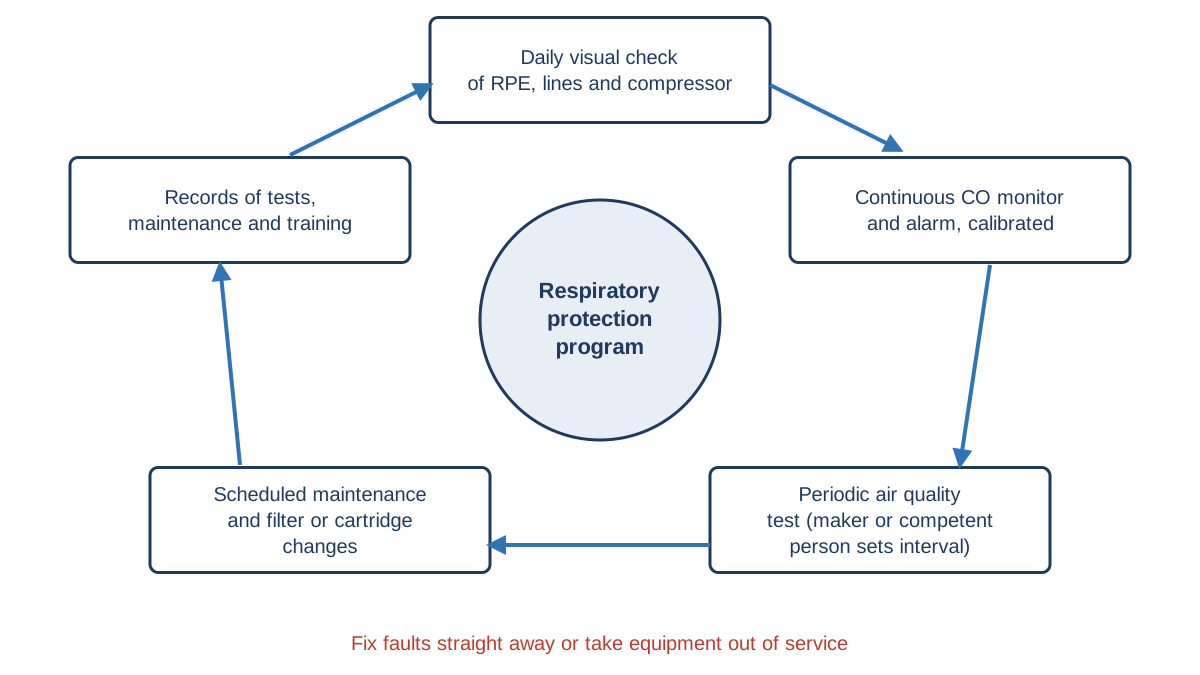
Neither abrasive blasting code fixes a test interval. Breathing air quality should be tested regularly, following the manufacturer's instructions or, where none exist, a competent person's (WorkSafe WA 2022). WorkSafe Queensland (n.d.-a) adds a daily visual inspection of RPE and breathing air systems, including the compressor, scheduled maintenance by competent persons, and immediate repair or removal from service of faulty equipment.
AS/NZS 1715 frames this work inside a respiratory protection program, with sections on maintenance, record keeping and program evaluation (Ministry of Business, Innovation and Employment n.d.-a). Keep air test reports, CO monitor calibration records and filter change dates together. When you book a test, ask which edition of the standard the tester works to and where the sample is taken.
The standards are changing
Standards Australia (2025) is adopting a suite of 30 ISO-based respiratory standards that will replace AS/NZS 1715:2009 and AS/NZS 1716:2012. Old and new will operate in parallel until 2030. Check which edition your regulator, client or contract names.
Who confirms compliance?
This article explains what the standard covers. It is not a compliance assessment. Whether a system meets AS/NZS 1715 depends on the compressor, the purification train, the respirators, the work and the test results. Use the current standard, your state regulator's guidance and a competent person to confirm it.
Key takeaways
- AS/NZS 1715:2009 (reconfirmed 2024) covers the selection, use and maintenance of RPE, including air quality for supplied-air respirators.
- AS/NZS 1716:2012 covers the respirators themselves; the two standards work as a pair.
- CO from overheated oil or engine exhaust is the key hazard, so fit a CO monitor with an alarm and site the intake carefully.
- Test breathing air regularly, inspect daily and keep records inside a respiratory protection program.
- ISO-based standards will replace both by 2030. Confirm compliance with a competent person.
Frequently asked questions
Is AS/NZS 1715:2009 still current?
Yes. It was reconfirmed in 2024, and it runs in parallel with the new ISO-based suite until 2030. Check which edition your regulator or contract cites.
Does an ISO 8573-1 purity class make air breathable?
Not on its own. ISO 8573-1:2010 Purity Classes explained covers particles, water and oil, while breathing air also needs control of gases such as CO, which AS/NZS 1715 addresses.
How often should breathing air be tested?
The codes of practice do not set a fixed interval. Follow the purifier maker's instructions or a competent person's advice, and test again after any change or fault.
References
- Commonwealth of Australia. 2015. Work Health and Safety (Abrasive Blasting) Code of Practice 2015. F2016L00417. Federal Register of Legislation. https://legislation.gov.au/F2016L00417/asmade/2016-03-30/text/original/epub/OEBPS/document_1/document_1.html.
- Department of Mines and Petroleum. 2013. Refuge Chambers in Underground Mines: Guideline. Perth: Resources Safety, Department of Mines and Petroleum. Hosted by WorkSafe WA. https://www.worksafe.wa.gov.au/system/files/documents/2025-02/MSH_G_RefugeChambersUGmines.pdf.
- Ministry of Business, Innovation and Employment. n.d.-a. "AS/NZS 1715:2009 Selection, Use and Maintenance of Respiratory Protective Equipment." Codehub. Accessed 26 October 2026. https://codehub.building.govt.nz/resources/asnzs-17152009.
- Ministry of Business, Innovation and Employment. n.d.-b. "AS/NZS 1716:2012 Respiratory Protective Devices." Codehub. Accessed 26 October 2026. https://codehub.building.govt.nz/resources/asnzs-17162012.
- Standards Australia. 2025. "What You Need to Know: Australia's New Respiratory Protection Standards." 28 April 2025. Accessed 26 October 2026. https://www.standards.org.au/blog/what-you-need-to-know-australias-new-respiratory-protection-standards.
- Standards Australia and Standards New Zealand. 2009. AS/NZS 1715:2009 (R2024) Selection, Use and Maintenance of Respiratory Protective Equipment. Listing on ANSI Webstore. Accessed 26 October 2026. https://webstore.ansi.org/standards/sai/nzs17152009r2024.
- WorkSafe Queensland. n.d.-a. "Carbon Monoxide in Breathing Air During Air Compressor Use." Accessed 26 October 2026. https://www.worksafe.qld.gov.au/safety-and-prevention/hazards/hazardous-exposures/carbon-monoxide-in-breathing-air-during-air-compressor-use.
- WorkSafe Queensland. n.d.-b. "Respiratory Protective Equipment (RPE)." Accessed 26 October 2026. https://www.worksafe.qld.gov.au/safety-and-prevention/creating-safe-work/managing-risks/personal-protective-equipment-ppe/respiratory-protective-equipment-rpe.
- WorkSafe WA. 2022. Abrasive Blasting: Code of Practice. Perth: Department of Mines, Industry Regulation and Safety. Updated 25 November 2024. https://www.worksafe.wa.gov.au/publications/code-practice-abrasive-blasting-0.
This article is general information only and is not a compliance assessment. Check the current edition of AS/NZS 1715, your state regulator's guidance and the equipment maker's instructions, and have a competent person confirm your breathing air system.