

What is a Hookah Dive Compressor?
Ultramax Systems on 16th Oct 2026
Short answer: A hookah dive compressor is a small, usually engine-driven compressor that sends low-pressure air from the surface down a hose to a diver's regulator, so the diver can breathe without carrying a scuba cylinder. Because the diver breathes whatever the compressor draws in, intake position and air quality are life-safety issues, and carbon monoxide (CO) is the main hazard.
Why it matters
Hookah systems are popular with boat owners, fishers and recreational divers because they are light and need no cylinder fills. Certification is not a prerequisite for recreational hookah diving, so many users have had little formal training (Anderson 2019). The risks are serious. WorkSafe Queensland (2005) has reported divers poisoned and killed by CO drawn into hookah compressors. This article explains the equipment in general terms only. It does not replace dive training or the manufacturer's instructions.
How it works
A typical unit pairs a small petrol engine or electric motor with a low-pressure compressor, mounted on a boat or a float. Air passes through an intake, the compressor, a small reservoir and an inline filter, then along a hose to each diver's demand regulator. Anderson (2019) notes that low-pressure systems commonly use diaphragm compressors, while higher-pressure systems use piston compressors. The hose length limits how deep a diver can go, but hookah divers can still get decompression sickness.
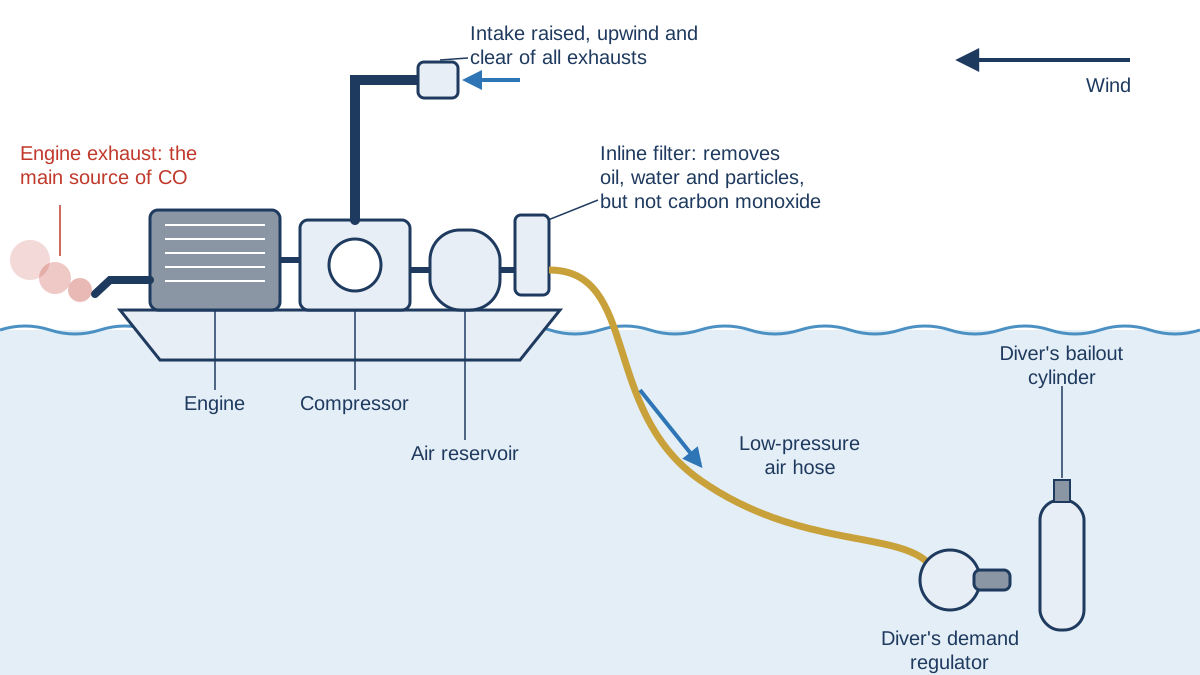
Inline filters remove oil, water and particles, and their elements need changing on schedule. Ultramax supplies replacement filter elements for Australian Dive Hookahs units by filter grade. Most air filters do not remove CO, however, so filtration is no defence against a contaminated intake (Smart n.d.).
The carbon monoxide risk
CO has no colour or smell, and its toxic effect is amplified under pressure (Smart n.d.). WorkSafe Queensland (2005) identifies exhaust from the engine driving the compressor as the most common source. Poorly built, positioned or inspected intake hoses let exhaust in, and engine vibration can loosen connections. Its guidance is to extend the intake well away from the exhaust and, on an open dory, place it at least 1.5 m above the exhaust outlet. A second source is the compressor itself. An overheating oil-lubricated, engine-driven compressor can burn oil and produce excessive CO (WorkSafe Queensland n.d.-a).
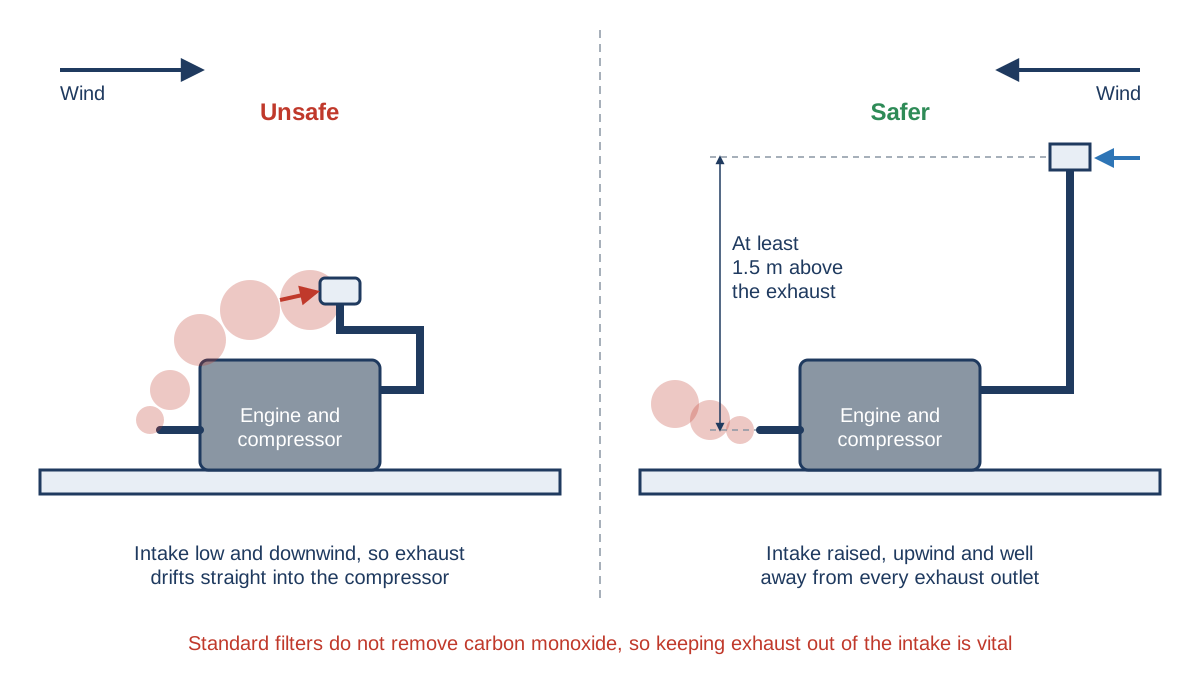
The controls follow from those causes. Keep the intake upwind of every exhaust, including other boats nearby, and check the intake hose before each dive. Route hoses clear of hot or vibrating parts. Divers and boat attendants should know the signs of CO poisoning, and each diver should carry a bailout cylinder sized for a safe ascent (WorkSafe Queensland 2005). For recreational hookah use, Smart (n.d.) recommends staying shallower than 18 m, with each diver's hose connected directly to the reservoir rather than shared through a Y connector.
Australian standards and practice
The rules depend on whether the dive is work. Under the model WHS Regulations, diving work is either general diving work or high risk diving work, and divers must be competent and medically fit (Safe Work Australia n.d.). High risk diving work must be carried out in line with AS/NZS 2299.1:2015, which covers occupational diving operations, including compressed gas supply and surface-supplied breathing apparatus (AS/NZS 2299.1:2015). Recreational dive operators face separate laws. In Queensland, for example, the Safety in Recreational Water Activities Act 2011 and a recreational diving code of practice apply (WorkSafe Queensland n.d.-b). Smart (n.d.) notes that compulsory maintenance and air testing apply to scuba filling stations, but not to private recreational hookah units.
Industrial breathing air standards are a separate track. AS/NZS 1716:2012 covers respiratory protective devices at work and excludes respirators used under water, pointing to the AS/NZS 2299 series instead (Ministry of Business, Innovation and Employment n.d.). Breathing air systems for supplied-air respirators are therefore a different application from diving. Check the current edition of each standard with Standards Australia and your state regulator, and get hookah-specific training before you dive.
Related terms
- Hopcalite filter: a catalyst that converts CO in industrial breathing air. See What is a Hopcalite Filter?
- Coalescing filter: removes oil aerosols and water droplets. See Coalescing filters explained.
- Compressor intake air filter: protects the compressor from dust. See What is a Compressor Intake Air Filter?
References
- Anderson, George. 2019. "Hooked on Hookah Diving." Alert Diver, 1 May 2019. Divers Alert Network. https://dan.org/alert-diver/article/hooked-on-hookah-diving/.
- AS/NZS 2299.1:2015. Occupational Diving Operations: Standard Operational Practice. Sydney: Standards Australia. Listing accessed 16 October 2026. https://webstore.ansi.org/standards/sai/nzs22992015.
- Ministry of Business, Innovation and Employment. n.d. "AS/NZS 1716:2012 Respiratory Protective Devices." Codehub. Accessed 16 October 2026. https://codehub.building.govt.nz/resources/asnzs-17162012.
- Safe Work Australia. n.d. "Diving." Model WHS Laws. Accessed 16 October 2026. https://www.safeworkaustralia.gov.au/safety-topic/industry-and-business/diving.
- Smart, David. n.d. "Hookah Diving Safety in Tasmania." Marine and Safety Tasmania. Accessed 16 October 2026. https://media.mast.tas.gov.au/uploads/2020/06/Hookah-article-.pdf.
- WorkSafe Queensland. 2005. "Carbon Monoxide Poisoning, Hookah Compressors and Diving." Workplace Health and Safety Alert, 12 April 2005. Updated 29 January 2019. Accessed 16 October 2026. https://www.worksafe.qld.gov.au/news-and-events/alerts/workplace-health-and-safety-alerts/2005/carbon-monoxide-poisoning-hookah-compressors-and-diving.
- WorkSafe Queensland. n.d.-a. "Carbon Monoxide in Breathing Air during Air Compressor Use." Accessed 16 October 2026. https://www.worksafe.qld.gov.au/safety-and-prevention/hazards/hazardous-exposures/carbon-monoxide-in-breathing-air-during-air-compressor-use.
- WorkSafe Queensland. n.d.-b. "Diving, Snorkelling and Recreational Water Activities Laws." Accessed 16 October 2026. https://www.worksafe.qld.gov.au/your-industry/diving-and-snorkelling/diving-laws.
This article is general information only. It is not dive training. Check manufacturer documentation, applicable Australian Standards and your state regulator's requirements before diving.