
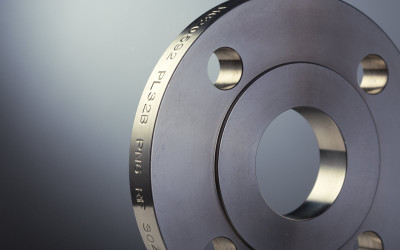
What are Table D and Table E Flange Drillings?
Ultramax Systems on 16th Oct 2026
Short answer: Table D and Table E are two flange classes in the Australian Standard AS 2129, each with its own outside diameter, bolt circle, bolt hole and bolt size for every nominal size. They matter because two flanges only bolt together when the drilling matches, and Table E is the heavier class for higher pressures.
Why it matters
A flanged joint is only as good as its fit. Two flanges with different drilling will not line up, and a flange that bolts up but belongs to a lighter class may be thinner than the job needs. In Australia, valves, pumps, filter housings and stub flange kits for poly pipe are often specified as "Table D" or "Table E". The term turns up on quotes, drawings and product labels, so getting it right before ordering saves a return trip and a delayed shutdown.
What AS 2129 covers
AS 2129-2000, reaffirmed in 2025, sets requirements and dimensions for circular flanges from DN 15 to DN 3000 and their bolting. It covers carbon steel, stainless steel, cast iron and copper alloy flanges for water, steam, compressed air, chemical and petroleum plants (AS 2129-2000). The standard groups flanges into lettered tables, and each table is a pressure class with its own dimensions. Flanges for water and wastewater are covered separately by AS/NZS 4087, which uses PN classes from PN 14 to PN 35 for service up to 80 °C (AS/NZS 4087:2011).
How Table D and Table E differ
The Plastics Industry Pipe Association of Australia (PIPA 2026) lists steel backing flanges to Table D for a maximum of 700 kPa (7 bar) at 50 °C, and to Table E for a maximum of 1400 kPa (14 bar) at 50 °C. Those limits apply to steel backing flanges in PE pipe joints. The real rating of any joint also depends on flange material, thickness, temperature and the weakest part of the assembly, so confirm it with the manufacturer.
Table E flanges are thicker than Table D flanges of the same size. Up to DN 80, the two tables share the same outside diameter, pitch circle diameter (PCD) and bolt holes, so the faces look identical. Above that, the drilling starts to change. At DN 100, Table E doubles the bolt count, and at DN 150 it moves to larger holes and M20 bolts.
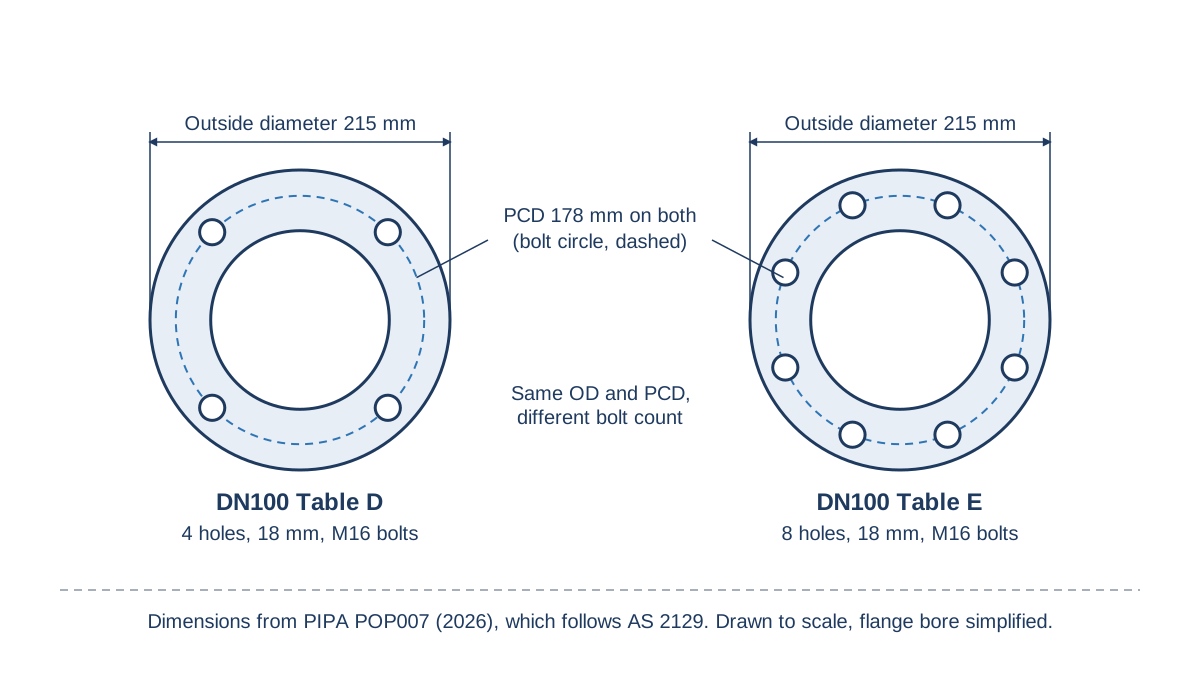
Three sizes show where the drilling starts to change (PIPA 2026). For any other size, use the dimension tables in AS 2129 or the flange maker's data sheet.
| Size | OD and PCD (mm) | Table D holes and bolts | Table E holes and bolts |
|---|---|---|---|
| DN 80 | 185 and 146 | 4 x 18 mm, M16 | 4 x 18 mm, M16 |
| DN 100 | 215 and 178 | 4 x 18 mm, M16 | 8 x 18 mm, M16 |
| DN 150 | 280 and 235 | 8 x 18 mm, M16 | 8 x 22 mm, M20 |
How to identify a flange on site
Measure the outside diameter, then the PCD from the centre of one bolt hole to the centre of the hole directly opposite. Count the holes and measure their diameter. Compare all four figures with AS 2129 or the flange maker's data for the size you have. If they match both classes, as they will up to DN 80, look for a marking or measure the thickness against the manufacturer's data.
Australian practice
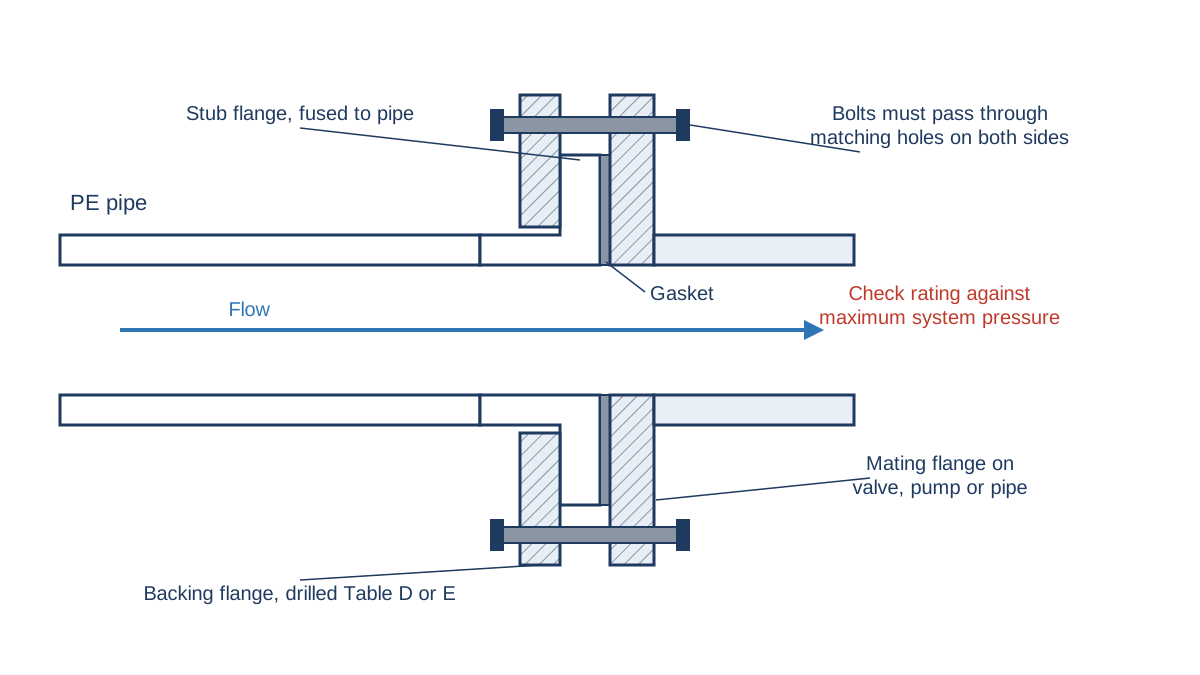
On HDPE compressed air and water lines, a stub flange is fused to the pipe and a loose backing flange carries the bolts. Ultramax stocks galvanised drilled backing flanges for this job. PIPA (2026) notes that AS/NZS 4087 PN 16 flanges have bolting compatible with AS 2129 Table D, which helps when a water-industry valve meets a general industrial line.
Common mistakes
The most common mistake is assuming PN 16 means Table E. A metric PN 16 flange to ISO 7005-1 at DN 100 has a 220 mm outside diameter, a 180 mm PCD and 8 holes, against 215 mm and 178 mm for Table E (PIPA 2026). The difference is small enough to miss by eye, but the bolts will not sit square. ASME Class 150 flanges use their own drilling too. A second mistake is checking drilling but not pressure. Compare the flange rating with the maximum system pressure, including the relief valve set pressure.
Related terms
- PCD: pitch circle diameter, the circle through the centres of the bolt holes.
- Stub flange: the fused PE collar behind a backing flange. See What is a Stub Flange?
- HDPE pipe: see What is HDPE (PE100) Pipe? and What is SDR in Poly Pipe?
References
- Plastics Industry Pipe Association of Australia. 2026. POP007: Flanged Joints for Polyethylene (PE) Pipe. Industry Guideline, Issue 3.2. North Lakes, Qld: PIPA. Accessed 16 October 2026. https://pipa.com.au/wp-content/uploads/2026/07/POP007_Flanged_Joints_for_PE_Pipe_V3.2-July-26.pdf.
- Standards Australia. 2000. AS 2129-2000 (R2025) Flanges for Pipes, Valves and Fittings. Sydney: Standards Australia. Listing on ANSI Webstore, accessed 16 October 2026. https://webstore.ansi.org/standards/sai/21292000r2025.
- Standards Australia and Standards New Zealand. 2011. AS/NZS 4087:2011 Metallic Flanges for Waterworks Purposes. Listing on Building CodeHub, accessed 16 October 2026. https://codehub.building.govt.nz/resources/40872011asnzs.
This article is general information only. Check manufacturer documentation and applicable Australian Standards for your installation.