
Hard Seat vs Soft Seat Valves: What is the Difference?
Ultramax Systems on 15th Oct 2026
Short answer: Hard seat and soft seat valves differ in the material that seals against the closing element. A soft seat uses a polymer or elastomer, such as PTFE, PEEK or NBR, that flexes slightly to give very tight shut-off. A hard (metal) seat copes with higher temperatures and abrasive media, but it typically allows a small, defined leakage.
What a valve seat does
An isolating valve closes by pressing a ball, disc or plug against a ring called the seat. As a result, the seat material decides how tightly the valve closes, how hot it can run and how long it lasts in dirty service. Choosing a seat type is really a choice about which of those three matters most.
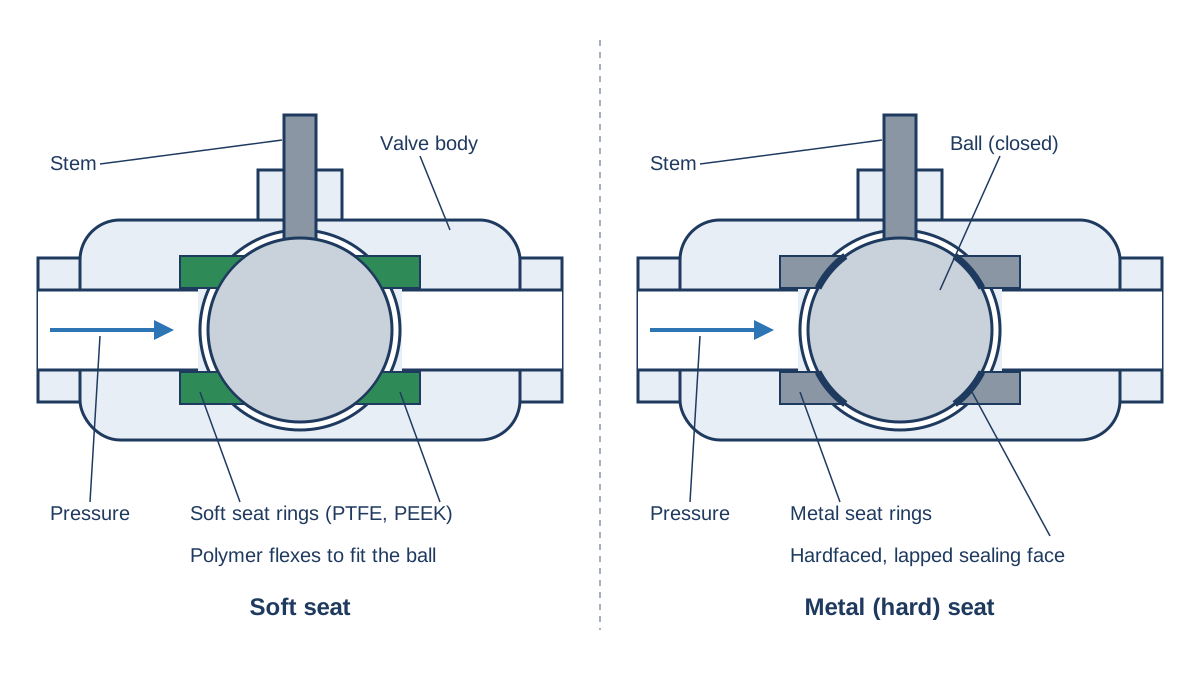
In a floating ball valve, line pressure pushes the ball against the downstream seat. A soft seat deforms a little under that load and fills the tiny imperfections on the ball surface, which is why it seals so well. A metal seat cannot, so makers lap the ball and seat together to get close, even contact across the sealing face (Wermac n.d.).
Soft seat materials and their limits
Soft seats are usually thermoplastics, sometimes filled with glass or carbon for strength. Virgin PTFE is chemically resistant and low in friction, so it suits general service at moderate temperatures. Reinforced or filled PTFE (RPTFE) resists creep better and carries higher pressure ratings, and PEEK is a harder polymer chosen for hotter, higher pressure duty (Project Materials n.d.). Elastomers such as NBR, EPDM and FKM appear mainly in O-ring style seals, where fluid compatibility drives the choice.
Temperature is the main limit for any polymer seat. Valmet (2022) gives its virgin PTFE seats a range of −73 °C to 204 °C, extends filled PTFE to 260 °C and rates PEEK seats to 288 °C in some valve series. Pressure capability falls as temperature rises. In one ball valve range, a virgin PTFE seat rated at 1500 psig (about 103 bar) near ambient drops to 100 psig (about 7 bar) at 232 °C (450 °F) (Swagelok 2025). So check the valve's own pressure and temperature chart, not a generic table.
Hard (metal) seats
Metal seats use stainless steel or hard alloys. Makers commonly hardface the sealing surfaces with materials such as Stellite, tungsten carbide or chromium oxide coatings, because a hard surface resists erosion from particles and scale (Project Materials n.d.). Metal seats also survive higher temperatures. Emerson (2021) offers a metal seat option on one floating ball valve for service up to 500 °C. The trade-offs are higher cost, higher operating torque and a harder path to bubble-tight shut-off.
Leakage classes and shut-off tightness
Test standards set how much seat leakage a new valve may show, so they are the fairest way to compare seat types. ISO 5208 covers pressure testing of industrial metallic valves and is used alongside a product standard (ISO 5208:2015).
| Standard | What it covers | Soft seats | Metal seats |
|---|---|---|---|
| API 598 | Inspection and pressure testing of gate, globe, check, ball, plug and butterfly valves | No visible leakage during the test | A defined leakage allowance for some types and sizes |
| ISO 5208 | Pressure testing of industrial metallic valves, used with a product standard | Rate A (no visible leakage) is typical | A lower rate, such as Rate D, may be specified |
| FCI 70-2 (ANSI) | Seat leakage Classes I to VI for control valves | Class VI is commonly linked with soft seats | Class IV or V is common, and some designs reach Class VI |
In each case, the soft seat column describes a tighter result (Process Systems 2024). Note that "bubble-tight" means no visible bubbles or drops over the test period, not zero leakage at a molecular level. One metal seat option is rated to FCI 70-2 Class V, with Class VI available (Emerson 2021). Swagelok (2025) goes further and states that the nitrogen-tested seat leak rate of its 60 Series ball valves is tighter than Class VI.
Comparing soft and metal seats
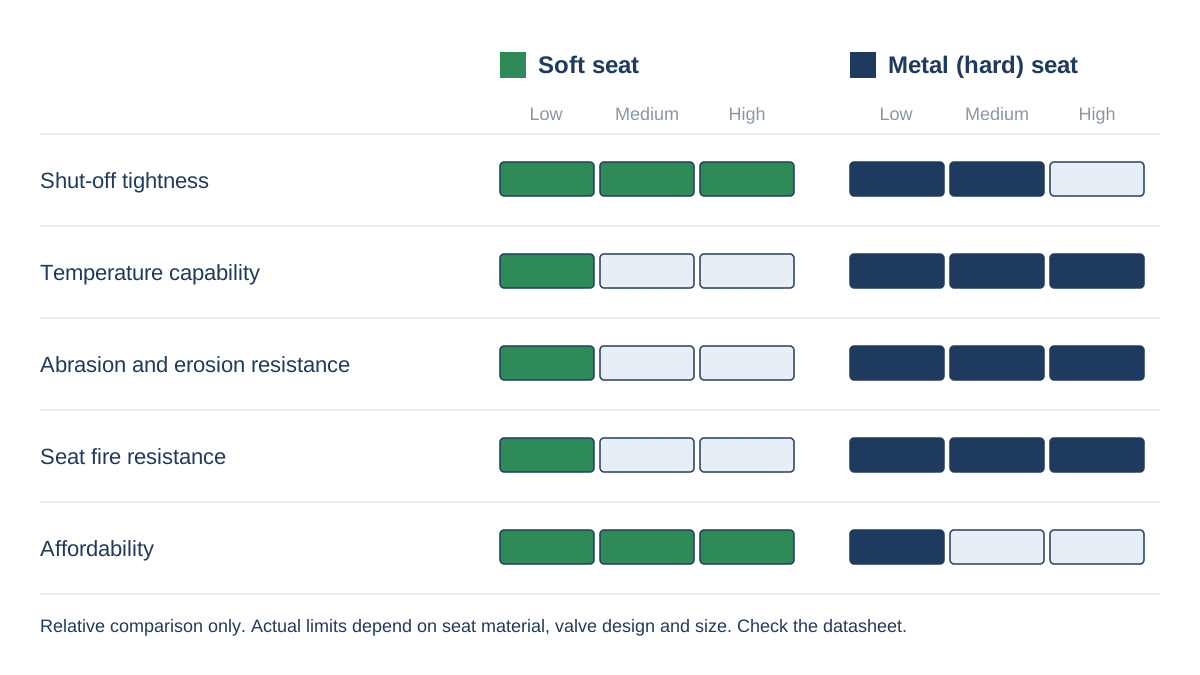
Abrasion is where soft seats struggle most. Hard particles can embed in a polymer seat or cut a path across it, and the valve then leaks every time it closes. Fire is the other concern. A polymer seat can burn away in a fire, so soft seated valves in hydrocarbon service usually need a fire-tested design, such as one certified to API 607 (Project Materials n.d.).
Australian standards and safe isolation
In Australia, the standard depends on where the valve sits. Standards Australia (2003) covers the design, construction and testing of safety valves, other valves and fittings for boilers and unfired pressure vessels, and their associated piping, in AS 1271. An air receiver is an unfired pressure vessel, so valves fitted to it fall within that scope. For the line itself, AS 4041 sets requirements for the materials, design, testing and inspection of pressure piping (Standards Australia 2006). Neither standard picks a seat material for you.
Seat condition also matters during maintenance. Safe Work Australia (2024) lists valves among the devices used to lock out plant, and notes that pneumatic pressure may need extra steps to release even after plant is isolated. A worn seat can let air pass a closed valve, so vent the downstream line and confirm zero pressure before work starts. As SafeWork NSW (n.d.) points out, only a lock is effective at isolating the energy source, and a tag on its own is not enough.
Where each suits in compressed air and process
Soft seats suit most clean, dry compressed air service. Typical examples are ball valves on ring mains, drops and instrument air lines. The NSW Office of Environment and Heritage (2017) shows a full flow ball valve ahead of a strainer and drain so they can be isolated for servicing. Tight shut-off matters here, because typically 25 to 45 per cent of a site's compressed air is lost through leaks (NSW Office of Environment and Heritage 2017).
Metal seats earn their higher cost in harsher duty: hot service such as steam and thermal oil, abrasive slurries and powders, dirty process gases and fire-critical isolation. Condensate sits between the two. It can carry rust, scale and oil, which is hard on any seat. A zero air loss drain opens only when liquid is present, so its valve cycles far less often than a timer drain.
Common mistakes
The most common error is choosing a seat on pressure rating alone, even though soft seat ratings drop as temperature rises. Others are fitting soft seats in abrasive service and assuming every metal seated valve is bubble-tight. In practice, the stated leakage class on the datasheet is the only reliable guide.
Key takeaways
- Soft seats (PTFE, RPTFE, PEEK, elastomers) give very tight shut-off at moderate temperatures.
- Seat temperature and pressure limits vary by material, valve size and maker, so check the valve's own chart.
- Metal seats handle heat, abrasion and fire-critical duty, usually with a small defined leakage.
- API 598, ISO 5208 and FCI 70-2 define seat leakage tests. Check which one a datasheet quotes.
- In Australia, AS 1271 and AS 4041 apply to valves on pressure vessels and in pressure piping. Lock out and vent before maintenance.
Frequently asked questions
Are soft seat ball valves suitable for compressed air?
In most systems, yes. Clean, dry compressed air at normal plant temperatures sits within typical PTFE and RPTFE limits. Check the valve's pressure and temperature chart for your conditions.
What does FCI 70-2 Class VI mean?
Class VI is the tightest seat leakage class in FCI 70-2. The test uses air or nitrogen, and the allowable leakage depends on valve size. It is commonly specified for soft seated control valves.
Can a metal seated valve be bubble-tight?
Some can. Some lapped metal seat designs reach FCI 70-2 Class V or VI. Confirm the stated leakage class on the datasheet.
Is a closed valve enough to isolate a compressed air line for maintenance?
Not on its own. Lock the isolation valve, release the stored pressure downstream and confirm it is at zero before work starts, following the plant code of practice in your state or territory.
Related Ultramax products
- Ball valves: general industry, lockable and stainless ball valves.
- Soft seat safety relief valves (brass): soft seat SRVs for compressed air.
- Hard seat safety relief valves (brass): metal seat SRVs.
- Actuated ball valves: pneumatic and electric actuation.
References
- Emerson. 2021. KTM Series EB1 Split Body Floating Ball Valves. Data sheet VCTDS-02448-EN. https://d1-auth.emerson.com/documents/automation/data-sheets-series-eb1-split-body-floating-ball-valves-ktm-en-en-5196080.pdf.
- ISO (International Organization for Standardization). 2015. ISO 5208:2015 Industrial Valves: Pressure Testing of Metallic Valves. Geneva: ISO. https://www.iso.org/standard/65111.html.
- NSW Office of Environment and Heritage. 2017. Low Capital Cost, Simple Solutions to Improve the Efficiency of Your Compressed Air System. Compressed air guide. State of NSW and Office of Environment and Heritage. https://www.energy.nsw.gov.au/sites/default/files/2022-08/2017_NSW_CompressedAirGuidepdf.pdf.
- Process Systems. 2024. "International Valve Leakage Testing Standards: A Comparison." Valves Online. Accessed 13 October 2026. https://www.valvesonline.com.au/blog/comparison-of-internationally-accepted-valve-leaka/.
- Project Materials. n.d. "Metal Seat vs Soft Seat Valve." Accessed 13 October 2026. https://blog.projectmaterials.com/quick-answers/valves/metal-seat-vs-soft-seat/.
- Safe Work Australia. 2024. Model Code of Practice: Managing the Risks of Plant in the Workplace. Safe Work Australia. https://www.worksafe.tas.gov.au/__data/assets/pdf_file/0010/806734/model-Code-of-Practice-Managing-the-risks-of-plant-in-the-workplace.PDF.
- SafeWork NSW. n.d. Isolation of Plant: Lock-Out/Tag-Out. Fact sheet. https://www.safework.nsw.gov.au/__data/assets/pdf_file/0010/586342/factsheet-isolation-of-plant.pdf.
- Standards Australia. 2003. AS 1271-2003 Safety Valves, Other Valves, Liquid Level Gauges and Other Fittings for Boilers and Unfired Pressure Vessels. Reconfirmed 2025. Standards Australia. https://store.standards.org.au/product/as-1271-2003.
- Standards Australia. 2006. AS 4041-2006 Pressure Piping. Reconfirmed 2016. Standards Australia. https://store.standards.org.au/product/as-4041-2006.
- Swagelok. 2025. Special Alloy 60 Series Ball Valves. Catalogue MS-02-439, Rev. E. https://www.swagelok.com.cn/downloads/webcatalogs/en/ms-02-439.pdf.
- Valmet. 2022. Jamesbury Ball Valve Polymeric Seats. Bulletin T140-1EN. https://www.valmet.com/globalassets/sharepoint/imported/t140-1en.pdf.
- Wermac. n.d. "Bubble Tight Valves." Accessed 13 October 2026. https://www.wermac.org/valves/valves_bubble_tight.html.
This article is general information only. Check manufacturer documentation, applicable Australian Standards and your state or territory WHS regulator's guidance for your installation.