

What is Leak Detector Spray?
Ultramax Systems on 16th Oct 2026
Short answer: Leak detector spray is a liquid that forms a thin film over a joint or fitting and blows visible bubbles or foam wherever gas escapes, so you can pinpoint leaks in compressed air and gas systems. It matters because leaks waste a large share of compressor output in many plants, and a spray shows the exact joint that needs fixing.
Why it matters
Every compressed air system leaks to some degree. Poorly maintained plants can lose 20 to 30% of a compressor's output through leaks, and a proactive find-and-fix programme can bring that below 5 to 10% (US Department of Energy 2016, 29). That waste costs power around the clock and can make an undersized compressor look overloaded. A can of leak detector spray is one of the simplest tools for finding where the air is going. For the dollar value of a leak, see How much do Compressed Air Leaks cost?
How it works
With the line under pressure, you spray the solution over a joint and watch. On a tight joint the film stays flat. Where air escapes, it blows the film into bubbles, and the bigger the leak, the bigger the bubbles (Swagelok n.d.). A very small leak shows as a cluster of bubbles that slowly grow. A large leak may produce rapid foam or simply blow the film away, and you can often hear or feel it too.
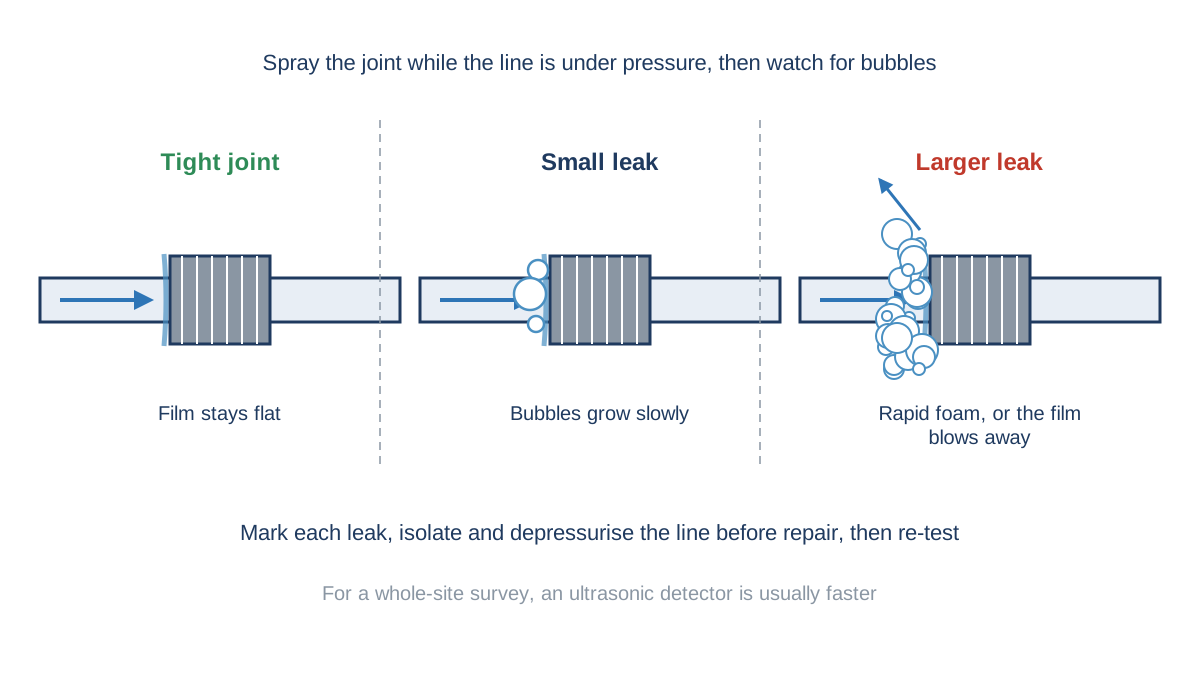
Plain soapy water works on the same principle, and the NSW Office of Environment and Heritage (2017, 27) describes it as a tried and true method for any gas system. Purpose-made fluids are designed to keep producing bubbles rather than collapsing after one set, which helps on very small leaks and on vertical surfaces. Some are chlorine-free and contain a corrosion inhibitor, which matters on stainless steel and other sensitive materials (Swagelok n.d.).
Where to spray
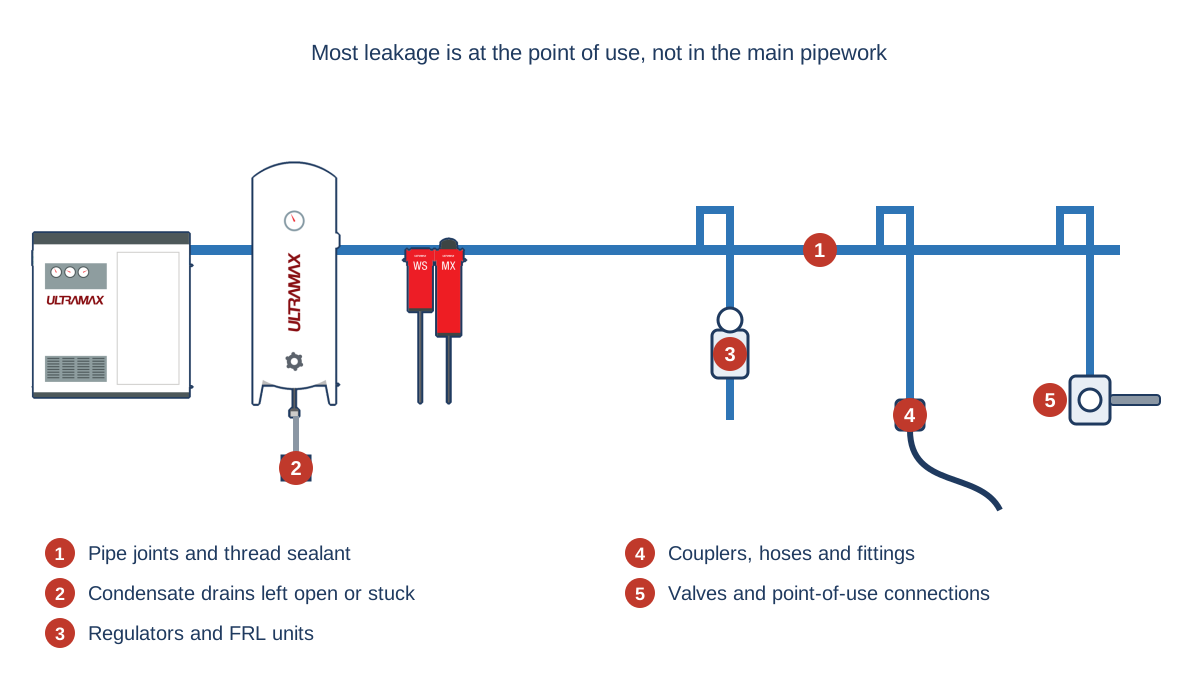
Leaks can occur anywhere, but the US Department of Energy (2016, 29) lists the usual problem areas as couplings, hoses, tubes and fittings, pressure regulators, open condensate traps and shut-off valves, and pipe joints, disconnects and thread sealant. Most leakage is at the point of use, not in the main pipework (US Department of Energy 2016, 16). Start at the drops, hoses and quick couplers, then work back along the system.
Spray or ultrasonic?
Spray and ultrasonic detection do different jobs. An ultrasonic detector picks up the high-frequency hiss of escaping air and is the quickest way to survey a whole site (US Department of Energy 2016, 30). Soapy solutions are reliable but can be time consuming over a large plant. In practice the two work well together. The ultrasonic survey finds the general area, and spray confirms the exact joint before anyone picks up a spanner. The NSW Office of Environment and Heritage (2017, 28) notes that good ultrasonic detectors can be hired, which suits smaller sites.
Common mistakes and what to check
Test with the system at normal operating pressure, because some joints only leak when fully loaded. Spray all the way around a fitting, including the underside, and give each joint time to show bubbles. Tag each leak as you find it, so repairs are not missed. Isolate and depressurise the line before you tighten or remake any joint, then spray it again to confirm the fix. Wipe off residue afterwards, and check the product's safety data sheet before using it on oxygen, gas or potable water systems. Replace worn couplings and reseal threaded joints with suitable thread sealing products.
Related terms
- Air leak: any unintended escape of compressed air. See How much do Compressed Air Leaks cost?
- Claw coupling: a common hose connection that can leak if worn. See What is a Claw Coupling?
- Free air delivery (FAD): the measure used to express leak flow. See What is Free Air Delivery?
References
- NSW Office of Environment and Heritage. 2017. Low Capital Cost, Simple Solutions to Improve the Efficiency of Your Compressed Air System. OEH2017/0257. Hosted by Energy NSW. https://www.energy.nsw.gov.au/sites/default/files/2022-08/2017_NSW_CompressedAirGuidepdf.pdf.
- Swagelok. n.d. "Advantages of Using Swagelok Snoop Liquid Leak Detector." Swagelok Bangalore. Accessed 16 October 2026. https://bangalore.swagelok.com/en/knowledge/fluid-system-health/advantages-of-using-swagelok-snoop-liquid-leak-detector.
- US Department of Energy. 2016. Improving Compressed Air System Performance: A Sourcebook for Industry. 3rd ed. Washington, DC: US Department of Energy and Compressed Air Challenge. https://www.energy.gov/sites/prod/files/2016/03/f30/Improving%20Compressed%20Air%20Sourcebook%20version%203.pdf.
This article is general information only. Check manufacturer documentation and applicable Australian Standards for your installation.