
What is an IP Rating? Ingress Protection explained
Ultramax Systems on 26th Oct 2026
Short answer: An IP rating (Ingress Protection code) is a short code that shows how well an enclosure keeps out solid objects and dust (the first digit) and water (the second digit). In Australia, the code is set out in AS 60529, which adopts the international standard IEC 60529 with modifications. IP65, for example, means dust-tight and protected against low-pressure water jets.
How the IP code works
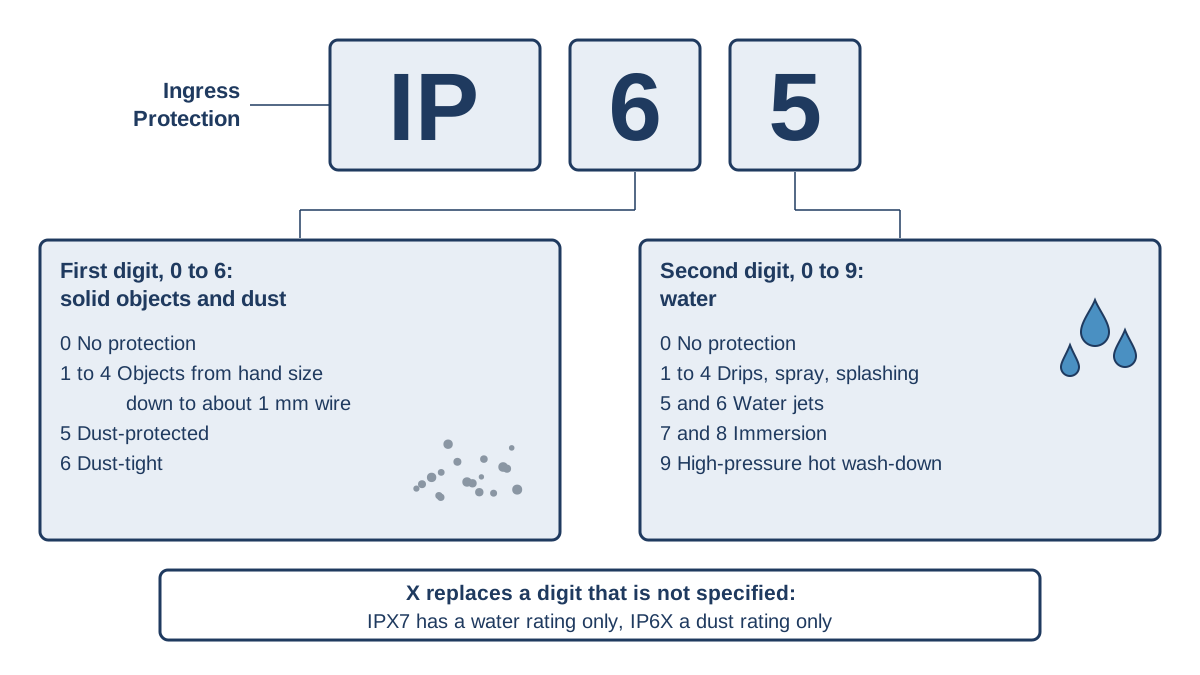
The letters IP are followed by two digits. The first digit, from 0 to 6, rates protection against solid objects, from something as large as a hand down to fine dust. The second digit, from 0 to 9, rates protection against water, from dripping water up to immersion and high-pressure, high-temperature wash-down (Bouchery 2018). The first digit also covers protection of people against touching hazardous parts inside the enclosure (Standards Australia 2004). Where one part has not been specified, an X takes its place. IPX5 therefore has no dust rating, and IP4X has no water rating (Oriental Motor n.d.).
The Australian standard
Australia first adopted IEC 60529 as AS 60529-2004, which covers enclosures for electrical equipment rated up to 72.5 kV (Standards Australia 2004). AS 60529:2025, published on 23 May 2025, supersedes it. The new edition adopts IEC 60529 with its 1999 and 2013 amendments, with Australian modifications (Standards Australia 2025). The standard sets the tests, and the equipment maker states the rating.
Common ratings
Four ratings turn up again and again on industrial equipment. The descriptions below paraphrase the test conditions in general terms (Oriental Motor n.d.; TÜV Rheinland n.d.).
| Rating | Solids and dust | Water |
|---|---|---|
| IP54 | Dust-protected: some dust may enter, but not enough to stop normal operation | Splashing water from any direction |
| IP65 | Dust-tight | Low-pressure water jets from any direction (about 12.5 L/min in the test) |
| IP66 | Dust-tight | Powerful water jets (about 100 L/min in the test) |
| IP67 | Dust-tight | Temporary immersion, to 1 m for 30 minutes in the test |
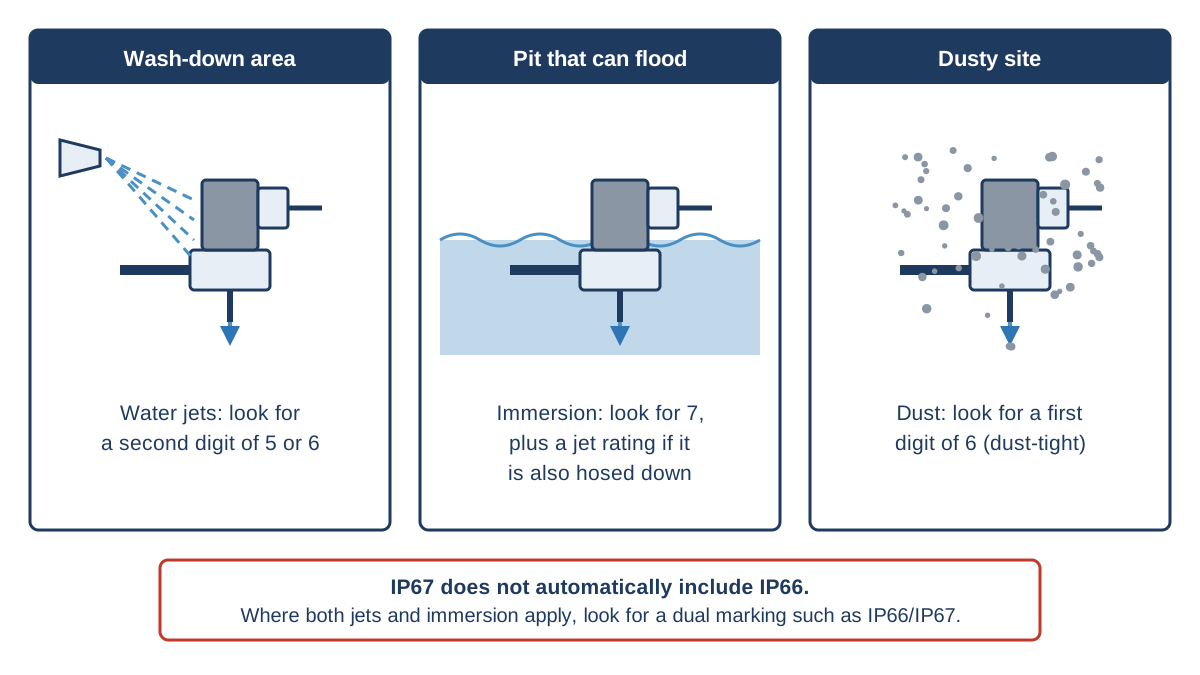
Higher is not always better for every hazard. Up to 6, the water digits form a graduated series of spray and jet tests, but 7 and above test immersion, which is a different stress. A product can be IP67 without being IP66: it may survive accidental immersion yet fail under a strong jet (Bouchery 2018). Where both matter, look for a dual marking such as IP66/IP67 on the datasheet.
Why it matters for drains and solenoid valves
Timed solenoid drains, electronic drains and solenoid valves all put live electrics, such as a coil, a timer or a level-sensing circuit, close to compressed air and water. Drains sit at the lowest points of receivers, dryers and filter lines, where condensate, splashes and dirt collect. Water that gets into a coil housing or connector can corrode terminals and lead to coil or timer faults. The IP rating tells you which conditions the enclosure has been tested against.
Match the rating to the location. A wash-down area in a food or beverage plant points towards a jet rating of 5 or 6. A pit or sump that can flood points towards 7, with a jet rating as well if it is also hosed down. A dusty mine, quarry or cement site points towards a first digit of 6. Outdoor units face rain driven from any direction, so a water digit of 4 (splashing from all directions) or higher is a sensible starting point.
The rating also depends on installation. A solenoid connector is typically rated only when fitted with its sealing gasket; one DIN connector, for example, is listed as IP65 when installed with a gasket (RS Components n.d.). One Australian valve supplier advises fitting the plug with its cable gland facing down to keep moisture out of the coil (Process Systems n.d.). Always check the datasheet for the exact model, because ratings vary between coils, connectors and drain bodies.
Related terms
- Timed solenoid drain: a drain that opens on a timer. See What is a Timed Solenoid Drain?
- Zero air loss drain: a level-sensing drain that vents no air. See How does a Zero Air Loss Drain work?
- Filter auto drain: a drain fitted to a filter bowl. See What is an Auto Drain on a Filter Housing?
References
- Bouchery, Gregory. 2018. "Do You Speak Robustness-ish? IP Protection Levels." Schneider Electric Blog, 24 January 2018. Accessed 26 October 2026. https://blog.se.com/industry/machine-and-process-management/2018/01/24/speak-robustness-ish-ip-protection-levels/.
- Oriental Motor. n.d. "IP Ratings: Degree of Protection." Oriental Motor U.S.A. Corp. Accessed 26 October 2026. https://www.orientalmotor.com/technology/ip-ratings-chart.html.
- Process Systems. n.d. "10mm Coil." Valvesonline. Accessed 26 October 2026. https://www.valvesonline.com.au/10mm-coil.
- RS Components. n.d. "Hirschmann GSAZ 2P+E DIN 43650 A, Male Solenoid Valve Connector." Product page 358-5683. Accessed 26 October 2026. https://uk.rs-online.com/web/p/din-43650-solenoid-connectors/3585683.
- Standards Australia. 2004. AS 60529-2004 Degrees of Protection Provided by Enclosures (IP Code). Reconfirmed 2018. Listing accessed via ANSI Webstore, 26 October 2026. https://webstore.ansi.org/standards/sai/605292004r2018.
- Standards Australia. 2025. AS 60529:2025 Degrees of Protection Provided by Enclosures (IP Code). Listing accessed via NSAI Standards Store, 26 October 2026. https://shop.standards.ie/en-ie/standards/as-60529-2025-121215_saig_as_as_3631075/.
- TÜV Rheinland. n.d. "IP Testing." Accessed 26 October 2026. https://origin.tuv.com/india/en/lp/ip-testing.html.
This article is general information only. Check manufacturer documentation and applicable Australian Standards for your installation.