
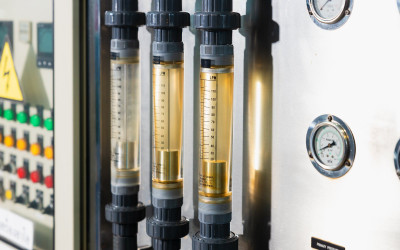
What is a Variable-Area Flow Meter?
Ultramax Systems on 16th Oct 2026
Short answer: A variable-area flow meter measures flow by letting a float or spring-loaded piston rise inside a tapered passage until the gap around it is just wide enough to pass the flow, so its position shows the flow rate. It is simple, needs no power and gives a direct reading, but on compressed air the reading is only right at the pressure the scale was calibrated for.
Why it matters
Knowing how much air a machine, a production line or a leak uses is the starting point for most efficiency work. Variable-area flow meters are a low-cost way to see flow at a point of use, without electronics or a power supply. They are also easy to misread. The scale is calibrated for one gas at one pressure and temperature, and compressed air is rarely used at exactly those conditions. Understanding how the meter works shows why.
How it works
The classic form is the rotameter: a vertical tube with a bore that widens towards the top, and a float inside it. As Control Engineering (2007) explains, air enters at the bottom and lifts the float until the gap around it is large enough to pass the flow without lifting it further. The float then settles where the upward force of the moving air balances its weight. A change in flow upsets that balance, so the float moves to a new position, and you read the flow from a scale at its edge (DwyerOmega n.d.).
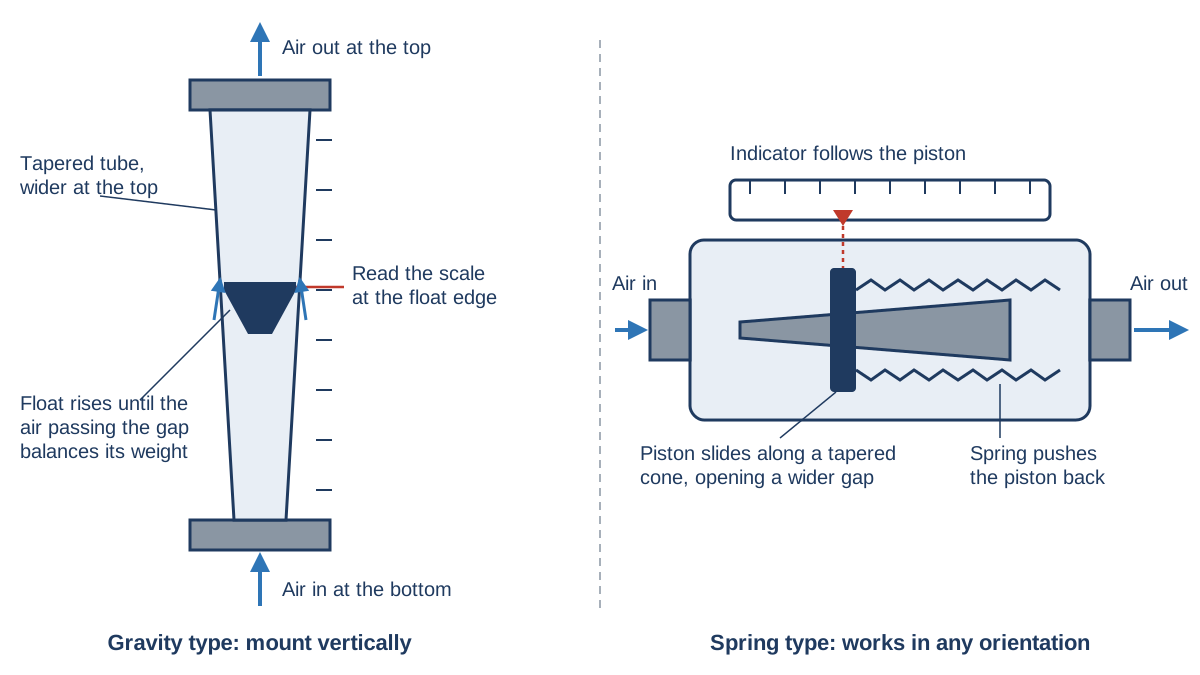
A gravity rotameter must be mounted vertically. DwyerOmega (n.d.) notes that spring-loaded designs work in any orientation, because a spring replaces gravity. In a common compressed air version, a piston slides along a tapered cone inside a metal body and drives an external pointer. This layout is used in many in-line compressed air flow meters, because glass tubes have pressure and size limits (DwyerOmega n.d.).
Typical accuracy
Industrial rotameters are typically accurate to 1 to 2% of full scale over a 10:1 range, with good repeatability if conditions stay the same (DwyerOmega n.d.). Because accuracy is quoted as a percentage of full scale, readings near the bottom of the scale carry a much larger relative error. Where possible, choose a range so normal flow sits in the upper half of the scale.
Pressure and density correction
A variable-area meter responds to the volume of air passing the float, not its mass, so the same float position means different amounts of free air at different pressures (Control Engineering 2007). Fluke Corporation (n.d.) shows that the corrections scale with the square root of the ratio of gas densities. For air at a steady temperature, that becomes the square root of the ratio of absolute pressures.
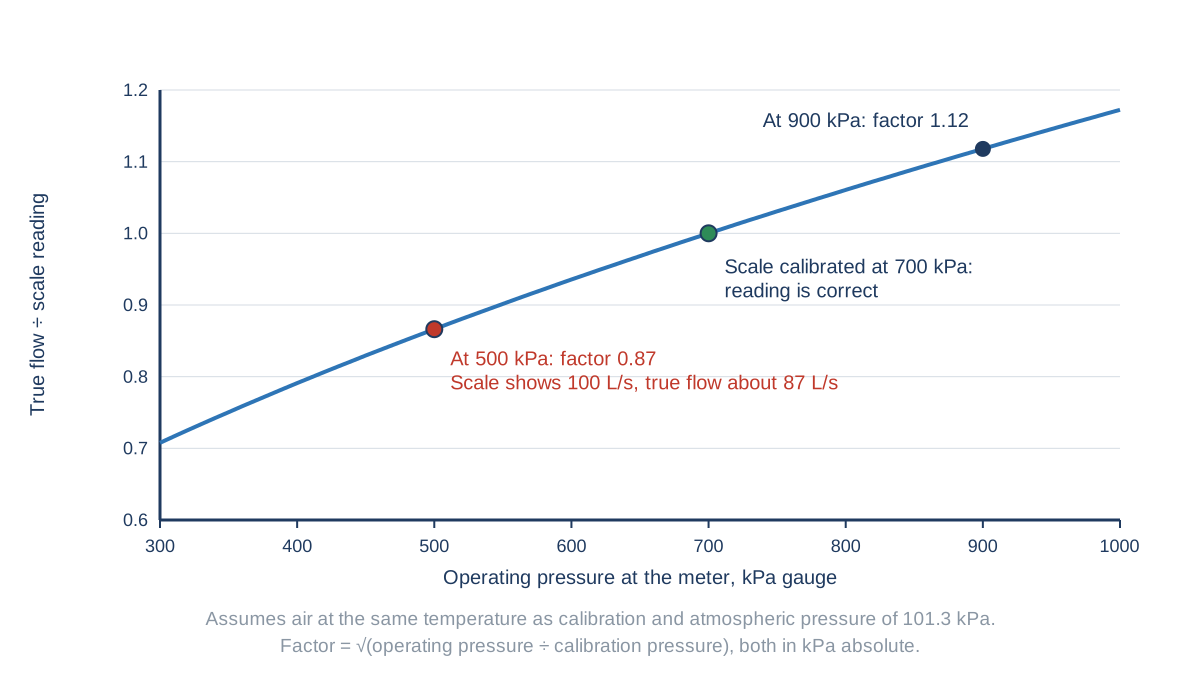
Take a meter whose scale was calibrated at 700 kPa (7 bar) but which is used at 500 kPa (5 bar). The factor is the square root of 601.3 ÷ 801.3 kPa absolute, or about 0.87. A reading of 100 L/s therefore means about 87 L/s of free air. At 900 kPa (9 bar) the factor is about 1.12. Some meters carry curves for several pressures, and suppliers can provide a scale for a fixed operating pressure (Control Engineering 2007). Fit a pressure gauge at the meter inlet so you know which correction applies.
Australian standards and practice
Where readings support energy audits or contracts, calibration traceability matters. The National Measurement Institute (n.d.) calibrates gas flow instruments, including variable-area flowmeters, traceable to Australia's national standards. NATA-accredited laboratories can provide that traceability too.
Common mistakes
The most common mistake is reading a scale at a pressure it was not calibrated for. Others are mounting a gravity meter at an angle, sizing the meter so normal flow sits near the bottom of the scale, and using a meter on dirty or oily air. Variable-area meters suit clean fluids only (DwyerOmega n.d.), so fit them downstream of filtration.
Related terms
- Free air delivery (FAD): flow expressed at intake conditions. See What is Free Air Delivery?
- Leak cost: what wasted flow costs a year. See How much do Compressed Air Leaks cost?
- Compressor sizing: uses measured demand. See How to size an Air Compressor.
References
- Control Engineering. 2007. "Tutorial: Rotameters (Variable Area) for Compressed Air Flow Metering." 20 September 2007. Accessed 16 October 2026. https://www.controleng.com/tutorial-rotameters-variable-area-for-compressed-air-flow-metering/.
- DwyerOmega. n.d. "What Is a Variable Area Flow Meter?" Accessed 16 October 2026. https://www.dwyeromega.com/en-au/resources/variable-area-flow-meter.
- Fluke Corporation. n.d. "Rotameter Calibration." Fluke Learn blog. Accessed 16 October 2026. https://www.fluke.com/en-au/learn/blog/calibration/rotameter-calibration.
- National Measurement Institute. n.d. "Gas Flow Measurement and Calibration Services." Department of Industry, Science and Resources. Accessed 16 October 2026. https://www.industry.gov.au/policies-and-initiatives/physical-measurement-services/gas-flow-measurement-and-calibration-services.
This article is general information only. Check manufacturer documentation and applicable Australian Standards for your installation.