
What is Strut Channel? Sizes, Finishes and Uses
Ultramax Systems on 16th Oct 2026
Short answer: Strut channel is a cold-formed steel C-section with inturned lips that forms a bolt-together framework for supporting pipes, cable trays and equipment. It matters because well-chosen, well-supported channel keeps compressed air and other service lines secure and level, and makes later changes quick.
Why it matters
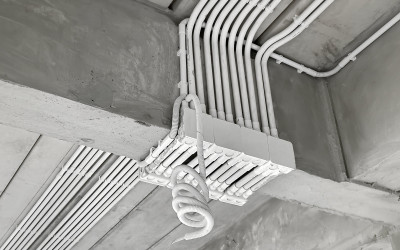
Compressed air mains need firm support. A sagging main can hold water in low spots, vibration can loosen joints, and a run that cannot be altered easily slows down every new drop. Strut channel solves this with a modular kit of channel, nuts, clamps and brackets that installers cut and assemble on site. Because fittings can slide along the channel, supports can move when a line is added or rerouted, without new holes in the structure. See Water in Air Tools: Causes and Fixes for why drops and drainage matter.
How it works
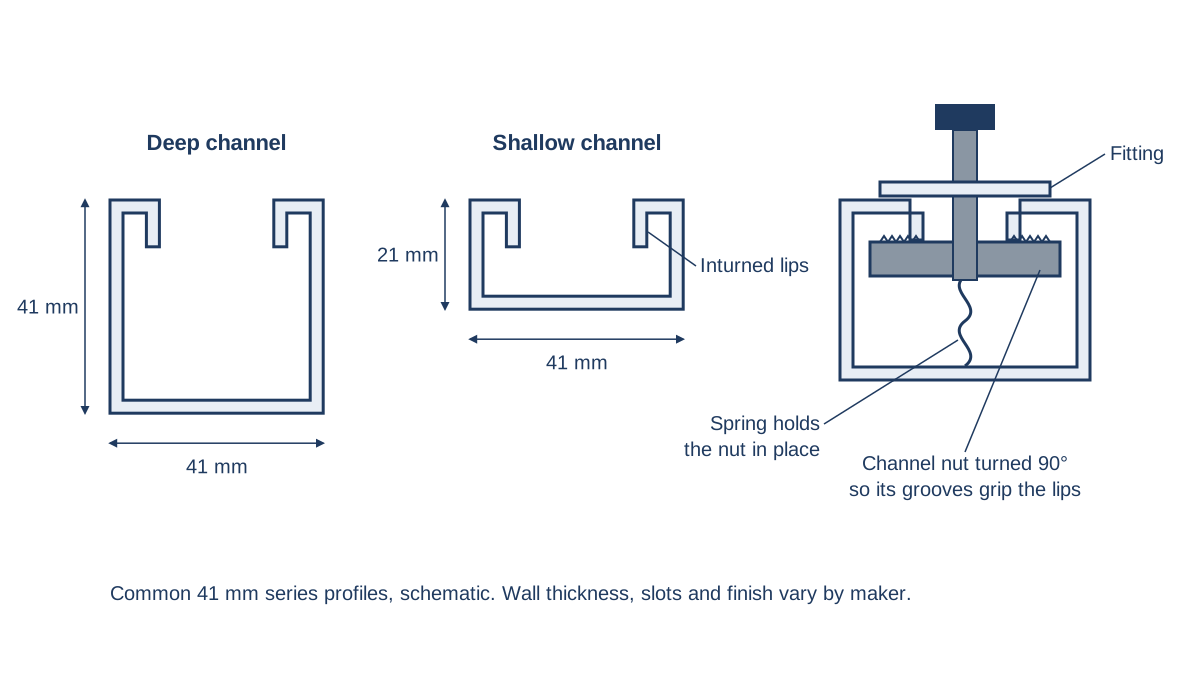
The channel is a C-shape whose open face has two lips folded inward. A channel nut slips through the opening at any point along the run. Turning it 90° lines up its grooves with the lips, so it locks in place when the bolt is tightened (RS Components 2024). Spring nuts hold their position while the installer lines up a fitting. Spring-less nuts rely on the fitting being bolted against the channel. Clamps, brackets, beam clamps and threaded rod all connect the same way, so one channel size suits a wide range of jobs.
Typical sizes and finishes
The most common series is 41 mm wide. Deep 41 x 41 mm channel and shallow 41 x 21 mm channel are the usual choices, with deeper sections available for heavier loads. Thicker material carries more load, and channel comes plain or with pre-punched slots that save drilling on site (RS Components 2024).
Finish matters as much as size. Pre-galvanised channel is coated as strip before forming. Hot-dip galvanised channel is coated after fabrication, which gives a thicker coat and covers cut edges. The Galvanizers Association of Australia (Hesse 2024) notes the thickest commercial pre-galvanised coating averages about 31 µm, against a typical minimum of 45 µm for batch galvanising on steel under 1.5 mm. It suggests pre-galvanised products suit low-corrosivity environments, rated C1 and C2. Stainless steel suits wash-down, coastal and chemical areas. Ultramax stocks strut systems and accessories, and its continuous support channel for poly pipe runs comes in Zincalume steel and stainless steel.
Australian standards and practice
In Australia, load capacity for cold-formed sections such as strut is calculated to AS/NZS 4600, which covers structural members cold-formed from steel sheet, strip, plate or bar up to 25 mm thick (AS/NZS 4600:2018). One Australian maker, for example, states its ultimate loads are calculated to AS/NZS 4600, with working loads set at the ultimate load divided by 1.5, and its galvanised strip to AS 1397 (Unistrut n.d.). Batch galvanising is covered by AS/NZS 4680 (Hesse 2024). For anything beyond routine pipe support, ask a structural engineer.
Common mistakes
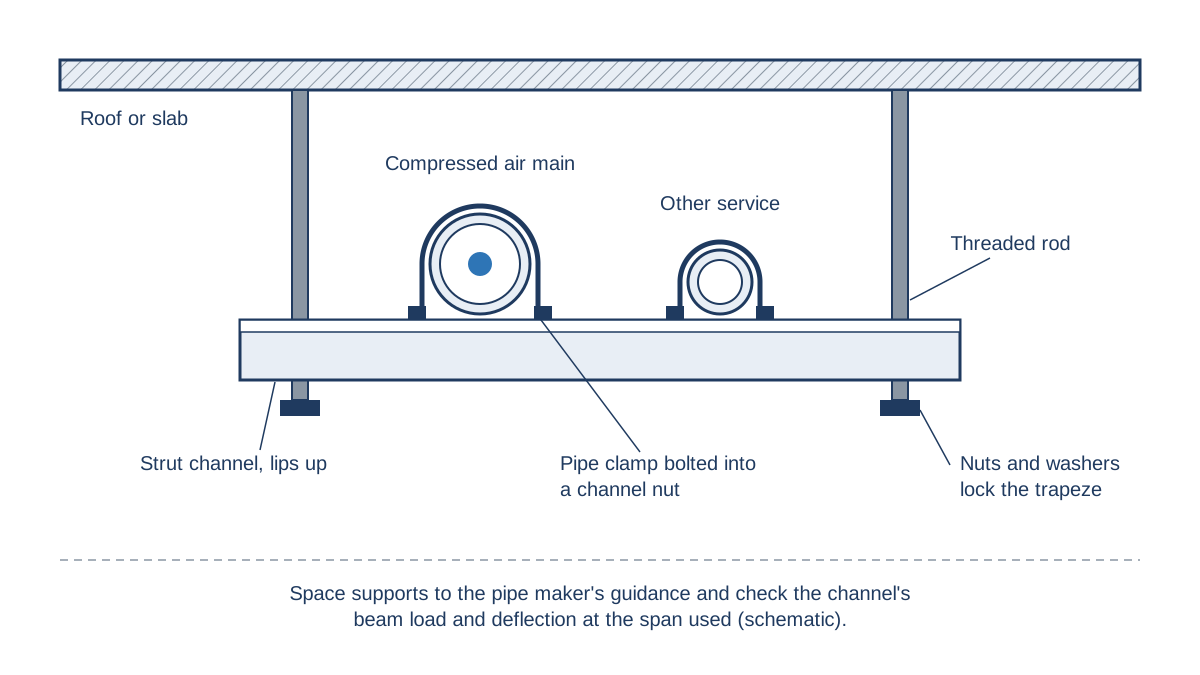
Using a beam load figure for a vertical column is a common error. Load tables treat the two cases separately, and column capacity depends on height and how the load is applied (RS Components 2024). Ignoring deflection is another. A channel may carry the load yet sag enough to trap condensate, so check the load at the deflection limit the table quotes, such as span/240. Other mistakes include mixing nuts and fittings from different systems, choosing pre-galvanised channel for a corrosive area and leaving cut ends untreated. Space supports to the pipe manufacturer's guidance.
Related terms
- Channel nut: the grooved nut that locks under the lips of the channel.
- Trapeze: a length of channel hung on two threaded rods to carry several pipes.
- Poly pipe: see What is HDPE (PE100) Pipe?
References
- Hesse, Kim. 2024. "Unveiling the Superiority of Batch Hot Dip Galvanized Steel: A Comparative Analysis Against Pre-Galvanized Coatings." Galvanizers Association of Australia, 15 May 2024. Accessed 16 October 2026. https://gaa.com.au/2024/05/15/unveiling-the-superiority-of-batch-hot-dip-galvanized-steel-a-comparative-analysis-against-pre-galvanized-coatings/.
- RS Components. 2024. "A Guide to Unistrut Dimensions and Loads." Accessed 16 October 2026. https://uk.rs-online.com/web/content/discovery/ideas-and-advice/unistrut-dimensions-loads-guide.
- Standards Australia and Standards New Zealand. 2018. AS/NZS 4600:2018 Cold-Formed Steel Structures. Listing on Building CodeHub, accessed 16 October 2026. https://codehub.building.govt.nz/resources/46002018asnzs/.
- Unistrut. n.d. "Tech Data Sheet: P1000T-TG Strut." Accessed 16 October 2026. https://media.goelectrical.com.au/Datasheets/Unistrut/Unistrut_P1000T-TG-Strut.pdf.
This article is general information only. Check manufacturer documentation and applicable Australian Standards for your installation.