
What is Hot Tapping? Branch Connections on live Pipes
Ultramax Systems on 16th Oct 2026
Short answer: Hot tapping is a way of making a new branch connection on a pipe or vessel while it stays in service and under pressure. It avoids a shutdown and the need to drain or vent the line, but it is specialised, safety-critical work that must be done by trained people with the right equipment and permits.
Why it matters
Adding a branch to a live main the usual way means isolating it, draining or venting it, cutting in a tee and recommissioning. That can stop production, cut off customers and waste product. Hot tapping lets the operator make the new connection without shutting the line down, and on gas pipelines it avoids venting gas to the atmosphere (US Environmental Protection Agency 2023). In one Australian job, a live tap on a 500 mm PE water main under a railway line kept a town supplied throughout the work (Plasson 2022).
How it works
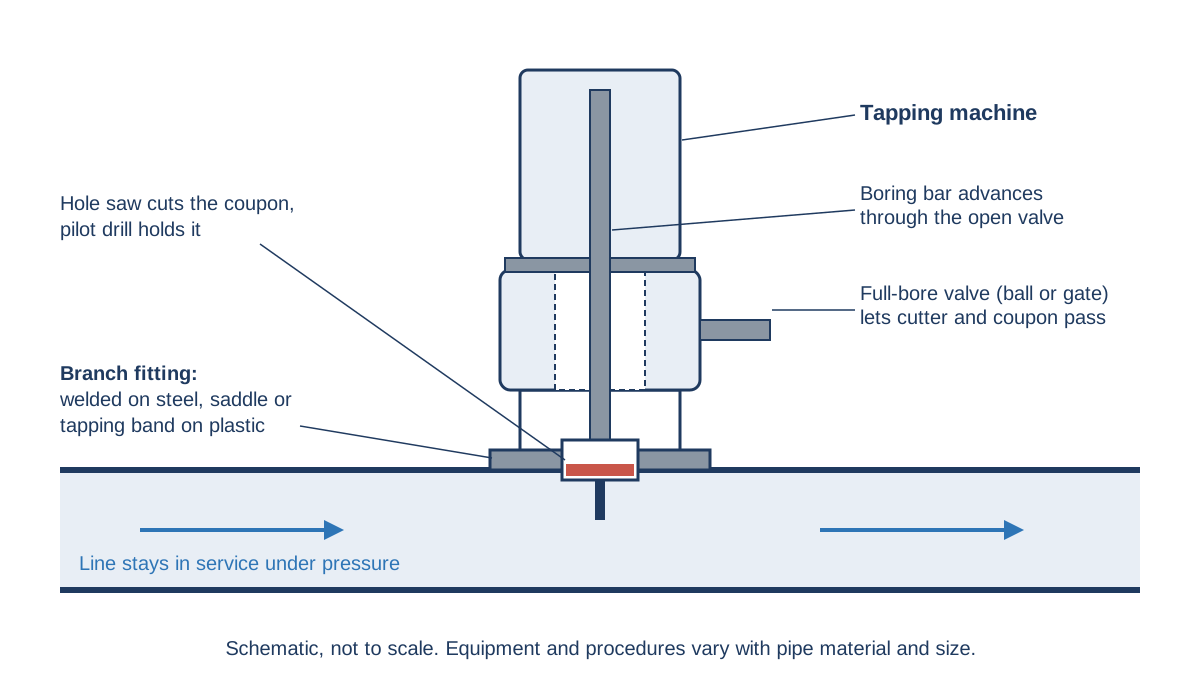
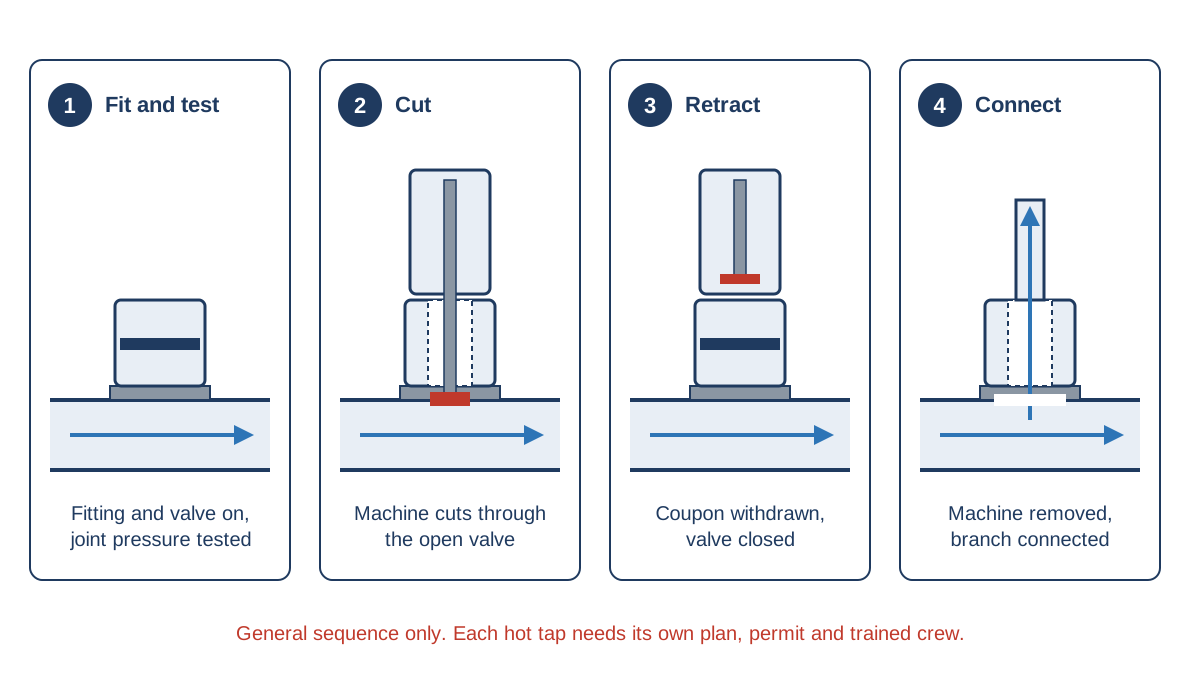
The principle is the same on most pipe materials. A branch fitting is attached to the outside of the live pipe, and a valve is fitted to the branch. The joint is then pressure tested before any cutting starts. Next, a tapping machine is sealed onto the valve. Its boring bar advances through the open valve, a pilot drill centres the cut, and a hole saw cuts a disc from the pipe wall, called the coupon.
The pilot drill holds the coupon as the cutter retracts back past the valve. The valve is then closed, the machine removed, and the new branch connected. The valve must allow the cutter and coupon to pass through. The US Environmental Protection Agency (2023) lists ball or gate valves as suitable, but not plug or butterfly valves.
Steel versus plastic pipe
On steel pipelines, the hot tap fitting is welded onto the in-service pipe following approved weld procedures (T.D. Williamson 2024). That makes it hot work on a live line. API RP 2201 covers the safety considerations for this kind of work and applies to ferritic and austenitic steels. It notes that other materials, including aluminium, copper, plastic and cast iron, may be unsuitable or may need special procedures (American Petroleum Institute 2003).
On PE pipe, the fitting is fused rather than welded. An electrofusion tapping saddle is fused to the main, tested, and then drilled through with a hot tapping tool. A core cutter recovers the coupon so it does not float off down the main (Plasson 2022). For poly pipe, Ultramax supplies pressurised drilling tools for this kind of work. See What is Electrofusion Welding? for how the saddle joint is made.
Australian standards and practice
There is no single Australian rule that covers every hot tap, so practice follows the asset owner. Water utilities control who may tap their mains. Sydney Water (2016) allows only providers it lists as drillers to work on its mains, requires approved tapping bands and fittings, and needs prior approval for drillings of DN 25 or larger. Where a tap involves welding, hot work controls apply. SafeWork NSW (2018) calls for a hot work permit system with a detailed hazard review before work starts. On a site compressed air main, the plant's own permit and isolation procedures apply.
What to check
Hot tapping is not a do-it-yourself job. API RP 2201 is explicit that general guidance does not replace job-specific planning (American Petroleum Institute 2003). A competent person plans each tap around the pipe material and wall condition, the contents, pressure and temperature, and the fitting and valve ratings. Before any cut, the crew pressure tests the joint and agrees an emergency plan. Equipment must suit the pipe size and material. Common mistakes include using a valve that will not pass the cutter, losing the coupon into the line and assuming any pipe can be tapped.
Related terms
- Coupon: the disc of pipe wall cut out and recovered during the tap.
- Tapping saddle or band: the fitting that clamps or fuses onto the main to carry the branch.
- HDPE pipe: see What is HDPE (PE100) Pipe?
References
- American Petroleum Institute. 2003. API RP 2201: Safe Hot Tapping Practices in the Petroleum and Petrochemical Industries. 5th ed. Washington, DC: API. Listing on GlobalSpec, accessed 16 October 2026. https://standards.globalspec.com/std/14204853/api-rp-2201.
- Plasson. 2022. "Water Main Renewal with PLASSON Hot Tapping System." Case study. Accessed 16 October 2026. https://flowsolutions.plasson.com/case-study/water-main-renewal-with-plasson-hot-tapping-system/.
- SafeWork NSW. 2018. "Hot Work." Safety alert. Accessed 16 October 2026. https://www.safework.nsw.gov.au/safety-alerts/safety-alerts/hot-work.
- Sydney Water. 2016. Instructions and Technical Requirements for Drillers. BMIS ACDP0211, version 11. Sydney: Sydney Water. Accessed 16 October 2026. https://www.sydneywater.com.au/content/dam/sydneywater/documents/provider-information/instructions/provider-instructions-for-drillers-water-mains.pdf.
- T.D. Williamson. 2024. "Safe, Efficient Pipeline Hot Tapping: Perform Repairs and Maintenance Without Disrupting Service." Accessed 16 October 2026. https://www.tdwilliamson.com/resources/papers/safe-efficient-pipeline-hot-tapping.
- US Environmental Protection Agency. 2023. "Pipeline Hot Taps." Natural Gas STAR Program. Accessed 16 October 2026. https://epa.gov/natural-gas-star-program/pipeline-hot-taps.
This article is general information only. Hot tapping must be planned and carried out by trained, competent people under the site or asset owner's permit system. Check manufacturer documentation and applicable Australian Standards for your installation.